

As he releases CITIZEN'S ARREST, LUCY, AKA Cooper B. Handy, takes Sophie Leigh Walker on a deep dive through the songs that made him.
My path crossed with LUCY - Cooper B. Handy - under improbable circumstances: an El Korah Shrine social club in Downtown Boise, Idaho.
Snaking stairways lead to lengthy hallways lined with the near-identical portraits of the members of this Masonic organisation – legions of old men wearing fezzes – alongside kitsch oil paintings of puppies with extraordinarily wide, sad eyes and posters making cryptic inquiries such as, ‘Does your best friend know from whence you came?’
There are two dancefloors, one on top of the other. The bottom lives in a red-lit, Lynchian bar (in this case, it really merits the descriptor) where drag queens huddle in booths and outsiders tend to gather.
Wearing a Kangol beret and long overcoat, LUCY’s performance was at once romantic and deeply absurd; traversing the extremities of southern cloud-rap influences to sampling ‘80s belters, his lyrics were strikingly simple and wise, like the aphorism in a fortune cookie.
And they were sung with feeling, always; the kind of oblivious, sincere showmanship we reserve for the shower or our hairbrush-as-microphone. A small but absolutely devoted pit opened against all odds in the anti-momentum. In short, it was unlike anything I had encountered before or since.
When he opened for King Krule in Atlanta, Georgia his performance absolutely baffled and divided the crowd. This confusion birthed a semi-viral video of his show, racking up over thousands of comments and 360,000 likes with the text overlay: “when the opener so bad u have to pull up slime videos to zone out.”
Father, forgive them, for they know not what they do. But King Krule knew, and soon the novelty of LUCY’s music spawned a devoted cult following – often themselves artists – who recognised him for who he was: a bit of a genius.
Making ends meet as a pot washer in his home of Western Massachusetts, he released a litany of albums and side projects (The Taxidermists, Safe Mind and Club Casualties to name a few) – each as curiously magnetic as the last, making no effort to preach to anyone but the converted. His albums have called upon the production of similarly mystical figures including Drain Gang’s Whitearmor and the prolific New York collective SURF GANG. The sound shapeshifts, but LUCY himself is constant.
His new album CITIZEN’S ARREST is something he describes as a “folk art album”: devoid of drums and perhaps his most accessible music to date, conjured in his windowless studio in Massachusetts. He went on long walks in the early hours of the morning along the trails next to the railroad, obsessively listening to the playlist that would become the album.
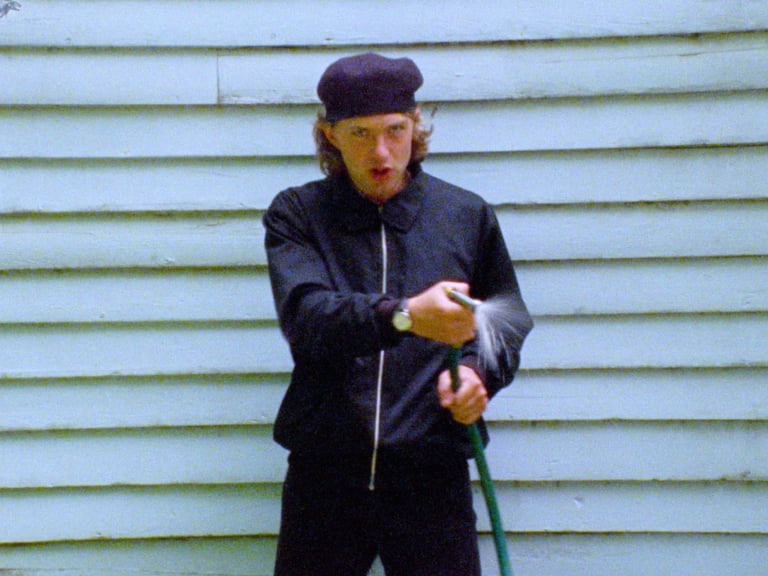
“I was sick of looking at the computer so much,” he says. “This album has a lot of acoustic guitar and upright piano. I still edit some of the things on the computer, but it’s good to have as much of the process outside the screen as possible. That’s what happened with this album: I really zoned into the actual instruments rather than zoning into what to do with a sample, or something like that.”
I wonder, if after all these projects, CITIZEN’S ARREST brings him closer to defining the real essence of what LUCY is? “It’s changing all the time, but it’s not changing so much that it’s something I need to work on finding,” he answers cryptically. “The only thing that doesn’t change is the lyrics. I think the lyrics I have written could be interchangeable with all of my projects. They’re always vague and universal at the same time.”
And it’s this contradiction, ever present at the core of LUCY’s music, which also defines the music he’s drawn to. His Nine Songs choices can be driven by pop and break its logic; they’re uplifting and yet strangely melancholic; strikingly simple with a complex philosophy at their heart. And as he walks me through why he chose them, LUCY realises they hold a mirror up to himself.
“The Boats They Come and the Boats They Go” by Bill Staines
COOPER B. HANDY: A friend of mine played me that song earlier this summer, and he was like, “I think you might like this song.” He had it on a cassette, and it was the first time in a long time where someone was like, "Oh, I think you'd really like this."
I feel like a lot of the time people say that just because they really like something, you know what I mean? But in this case, it was true, and I liked the song a lot. And I don't know, I think we approached that song as like super emotional or something. I was kind of tearing up hearing it, and I was like, "This is crazy!’ This song has a lot of power."
BEST FIT: He writes children’s songs as well, which I think makes sense when you consider they need to have great meaning in incredibly simple terms.
I love that. That's kind of how I try to write as well. I like the songs to almost be like things that would be understandable for a young kid.
I can completely see that. He’s from Massachusetts as well.
I read that too. I sent my mom that song, and she said that he used to actually play on the Cape every summer. I feel like his vibe was very much the guy on the ocean, telling it how it is.
“Oh Babe It Ain't No Lie” by Elizabeth Cotten
COOPER B. HANDY: I didn't know which one of her songs to choose, because a friend burned me a CD of hers when I was probably in, I don't know, a sophomore. I think I was 16, and her picking style of playing, her approach to her delivery and everything… I thought it was so perfect, and I never really stopped listening to it.
BEST FIT: What was the other song you might have picked?
There's another one that’s called “Going Down the Road Feeling Bad”. That's another one of her bangers that I was thinking about. And then there's another song, I forget the name of it. It's an instrumental song that has almost grunge chords. I was listening to it recently and I was like, "This is so ahead of its time." It’s dissonant in a really cool way.
Who was the friend who gave you this CD?
I'm pretty sure it was something where someone had burned a CD for a friend of my girlfriend at the time. It was some CD that had been passed around, so everyone was getting into it at the same time.
That's a very tasteful thing to be passing around in high school.
I was really happy that was the case. I had good friends that were putting me onto cool things at a good time.
She didn’t even record anything until she was in her 60s
Yes, and she was working for Pete Seeger's family.
What was it about this particular song which particularly resonated with you?
I like the way her voice follows the guitar. Her voice almost sounds like a violin or something on this song. It bends in a cool way. I was thinking about this song when I was doing this list and I was like, I could have chosen a bunch of her songs. I felt it was necessary to have her on the list because her songs have had a big impact. Listening to them, you are forced to feel something.
“Outstanding” by The Gap Band
COOPER B. HANDY: Honestly, there's sort of a through line with these songs. Like the others, I feel like something about this song is really happy and sad.
Melodically, it's one of those things where I can't tell if it's in a major key or a minor key, and I'm not a big theory person, but I can quickly tell if the scales are major or minor just by hearing how they sound. I feel like it might be one of those songs where it switches from major to minor with the verse-chorus, verse-chorus. I don't know exactly how to say what I'm trying to say, but just something about it being major and minor at the same time is a good emotional tool to have in your songwriting.
BEST FIT: How far back does your relationship go with this song?
Good question. I probably heard it over the years on the radio. I don't actually even know when. I feel like I got into this song a year ago. I'm in a band [Taxidermists], and I was thinking about trying to cover it, but then it just didn't really make sense. I like the content and the singing style and everything, but it’s not really my zone to be making a cover of a song like that. More recently, I was like, ‘I wonder if, rather than cover this song, learn the chords and make a song that is inspired by the progressions in this song.’
I found out that it's called the Washed Anthem. It was used in a viral video of a basketball player called Kevin Garnett, and he was playing really badly way past his prime. People used the track on top of a clip of him flopping during a match, and now it’s known as the ‘Washed Anthem’.
That’s so funny, I had no idea. Was that a recent thing?
It's a good question. I don't know if this actually goes far back in meme culture, but when I was reading the YouTube comments everybody was making a sports reference to some player who flopped recently. This song has weirdly become co-opted by the sports community. It's also one of the most sampled songs in history.
Really?
Yes, it's cited as one of the most sampled ever. Apparently, over 150 artists have sampled it including Tyler the Creator and Ice Cube.
I should look into this. I had no idea.
“Citgo” by Chief Keef
COOPER B. HANDY: It's the name of a gas station here in the US. It's one of the bigger gas station chains.
I heard this song when it was popping off in 2013. All the people I was around were kind of freaking out about him, and it was a really exciting time period for music and the internet and whatever. People from all walks of life were brought together by Chief Keef’s music. I feel like he's one of those artists who is a household name at this point for so many.
BEST FIT: So, what stage of life would you have been at when this was at its peak?
I was fresh out of high school. I think I was 18, I’d just moved away from home and living with people who are also 18 and smoking too much weed. It was an anxious time period for sure.
I think this is one of those songs that, if it comes on somewhere, it really will have an effect on the mood of the room. There's no drop really, there's barely anything going on with the drums. It's also sad and happy at the same time. I feel like all these songs have that sort of thing: they're all sort of strangely emotional.
We would just put it on in the house or put it on in the car. We listened to a lot of his music all the time, and I always thought that song was almost edgy in how there's so little going on. His voice kind of does the job of what the drums would do. Anyone who has a connection to music in that world now will mention him as someone they think is important.
Was Chief Keef an influence on your music as well?
I don't think my sound was extremely influenced by him or anything, but I do think of him as an artist in the way he navigates being a famous musician and without being an industry weirdo. I think he's in his own lane.
I used to make a comparison between him and Bob Dylan. I feel like people think he's really odd in this way that I think with early Bob Dylan people were like, “What is this?" I think when he was popping off, people were like, ‘This is really crazy,’ but knew it was undeniably swaggy.
“Every Rose Has Its Thorn” by Poison
COOPER B. HANDY: That song's kind of crazy and also kind of silly, because that band is hard to take seriously. It’s before our time completely, but I always liked that song.
It's another one that I always wanted to make some kind of cover of at some point, because it's really basic, in an iconic way. There’s this melodic cadence to the chorus, and it starts major and then when it's “Every cowboy sings the same sad song” it gets into minor chords. It's an iconic track.
BEST FIT: When did you first encounter the song?
I remember it was probably the same time as Chief Keef. I think I was freshly out of high school after I moved out of my parents' house, I heard it on the radio in the car, and I was singing it a lot for a summer just to myself. It was always stuck in my head in a kind of funny way. Maybe funny is the wrong word, but it's a funny song to me.
I love the drum sounds and the snare drum - that song is so over the top with reverb. I think some of the stuff I've sampled in the past has been in that kind of era. I'm drawn to it because it's so not something that we ever experienced. Stuff like that stopped existing before we were born.
“White Houses” by Vanessa Carlton
COOPER B. HANDY: If you’re not aware of this song then you’ll definitely know “A Thousand Miles”. I feel like this song was the same album, maybe – definitely the same era, but it was not obviously as popular as that one. But in my mind, it's just as good.
When I think about her career, I feel like she was almost too technically good and maybe it wasn’t marketable because it's too interesting. That song is so technical with all the changes, it reminds me of like Michael Jackson or something. I think the song's arrangement is perfect.
BEST FIT: It's mad you mentioned Michael Jackson, because you’ve seen the music video, right?
Yes I have, she does the moon walk right? I was actually watching that music video when I made this list. I don’t know who directed it, but that’s the kind of video that would pop off if someone made it now.
So is your attachment to this song on a technical level?
A little bit, but I also remember hearing it when I was 13 or 14 or something. I was confused at the time about why it wasn't as popular as her mega hit, but I guess the technical side of the music is what drew me into having it be on the list.
I feel like when a 13-year-old hears something like this - especially this song, which is incredibly earnest - you'd imagine this coming out and kids taking the piss out of it because it's so sincere. Do you know what I mean?
Yes, totally. I had an older friend who was a senior when I was a freshman in high school, and I remember listening to it with him - and he was about to go to Berkeley School of Music, so he was big into theory - and he was geeking out about it, and I think that opened my eyes to taking it seriously. But then he dropped out of Berkeley. But that doesn’t change the fact it’s a very good song.
I didn't actually realise it was about her writing about losing her virginity and her relationship with innocence. It’s quite ahead of its time, in that sense.
I didn't really notice that either. It's a coming-of-age song that's also kind of happy and sad at the same time.
“Black Cat” by Kodak Black
COOPER B. HANDY: There are so many songs of his that I could have put on this list. I would say he's my favourite living rapper right now, for sure.
I think his delivery on this song in particular, and the lyrics, are really crazy. I don’t believe that song is on an album either, I don't know. I've only ever seen it on YouTube as a music video. It’s really bizarre, I've shown it to a lot of people, and most of the people are like, ‘What is this?’ I've been subscribed to his YouTube channel for probably seven years, so I get notified every time he puts something on and I watch all of it.
When I saw that song, I was like, ‘This is so crazy…’ The music video is directed by him, and he's wearing his clothes backwards and kind of flopping around a brand new-looking house. He's kind of the craziest.
BEST FIT: What is it about Kodak Black that you think really resonates with you? I get the impression he’s quite divisive. You either get it or you don’t.
It's one of those things where you can really hear how real his delivery is, there’s a certain quality in his voice. It's the same way people would talk about like Tupac or something. It's like you can tell he is meant to be doing what he's doing, does that make sense? He's definitely one of the voices of our generation; in the way he’s unintentionally doing exactly what he sounds best doing.
How old were you when you first discovered him?
I must have been eighteen, or maybe a bunch younger. I think Project Baby is the first one I heard, and that was a long time ago.
Kodak Black was weirdly one of those artists I’m yet to really spend some time listening to. Have you remained a constant fan throughout everything that he's done?
In the beginning I wasn't immediately thinking he was the best ever. I thought he was kind of crazy, and then all these things came out… I think he’s done some bad things. It’s like child star syndrome, in a way. I think people realised he was super gifted at a young age which then gave him the power to mess it all up, and that's why his career has been so in and out.
What is it about him in particular that you feel really stands apart?
I like how he sounds. I think you can tell that he's passionate about it. Sometimes, in his vocal takes, you can hear that he's actually very emotional about a lot of the stuff he's saying even if he's saying crazy stuff.
“Pig In A Blanket” by Rudimentary Peni
COOPER B. HANDY: That song’s on the album Death Church, I believe. I got into that in high school and there's a bunch of songs on that album that I really like.
But that one in particular - I think it's about not eating meat - I always loved how that song has got such a hard riff, and then it gets faster and faster. By the end, it's going really crazy. I always thought that was cool. Listening to that when I was thirteen, I thought it was a great concept for a song structure to have the whole band get faster and faster.
BEST FIT: Were you making music back then?
I was. I started playing with my friend Sal [Salvadore McNamara] who’s in The Taxidermists. We started writing and recording songs together around that same time.
How did you discover this song in particular? Because this is quite a niche, British anarcho-punk band.
Good question. I might be wrong, but I feel it was maybe a skate video I was watching at the time. I also had older friends who were into that kind of stuff, but it might have also been my uncle who put me onto The Slits and a bunch of other UK punk things from that era.
I wasn’t familiar with them before this, but apparently this band really did not look like punks, at all. They weren’t well-received at first in the scene because of how normal they looked. Then they unleashed this song, and it became the ultimate vegan anthem.
Wow, I didn’t know that. I think the way that the vocals are on that song is also really cool. I would like to see live footage of them. I actually don't know what they look like, but I know that the lead singer makes really crazy visual art, and that's what most of their album artwork is.
I think even after the band dissolved, the lead singer Nick Blinko continued to make some crazy outsider music.
Cool, I should look into that. I haven’t heard any of it.
Was this influential for you as a musician directly, or were you more just impressed with the extremities of what you can do in a band?
I think it was influential for me, particularly that style of guitar-playing. I wanted to be a rocker, and that was definitely inspirational for how I wanted to sound.
What were you in school when you started discovering this music for yourself?
I was kind of the same as I am now. In high school, a lot of music stuff hit me at the same time. I didn't get into the Beatles until that year. Also, I didn't grow up with the Beatles, and most of my friends had the Beatles music around them as kids - I didn't really get into it until I was thirteen or so.
I feel like a lot of different kinds of music all came together for me as a young teenager, and I think it benefited me that it all came at once.
“Beautiful Child” by Fleetwood Mac
COOPER B. HANDY: I think that whole album is really good. Do you know that album?
For sure, but this particular song hit me afresh when I saw it on your list.
That album has a lot of emotional bangers on it, but that song goes super hard. I love the drums and the way they come in and go out. I feel like they did a really good job delivering what they were trying to do emotionally on that song.
BEST FIT: When did you hear it for the first time?
I think I got that record in 2015 or something, so I must have been in my early twenties. I remember I had a speaker sound system in my room when I was living in this huge house with a lot of other people, and I would blast that record like really loud.
It was also a big weed-smoking era for me, but I remember sitting in my room smoking, listening to that cranked all the way, and being, ‘This is a perfect emotional execution of a song.’
I was reading about the background of the song, Stevie Nicks had written about the end of an affair she was having with The Beatles’ road manager Derek Taylor. He was quite a bit older than her, and that’s why she writes about not being a child anymore. The lyrics are supposed to be a retelling of their final night together at the Beverley Hills Hotel. I’m glad you put it on there because it’s an incredibly emotional, beautiful song.
I think if you like that song, you would probably be into the rest of the album, because there's a lot more songs kind of in that vein. But yes, it’s a very special record.
Is there anything in this particular song that really resonated with you?
It’s really heavy and gentle at the same time. They worked really well with space in that song in a way that I would like to learn. It's cool when a band can sort of drop out and let the vocals take the spotlight and then come back in altogether in a way that's precise.
CITIZEN'S ARREST is out now.
Sign up to Best Fit's Substack for regular dispatches from the world of pop culture