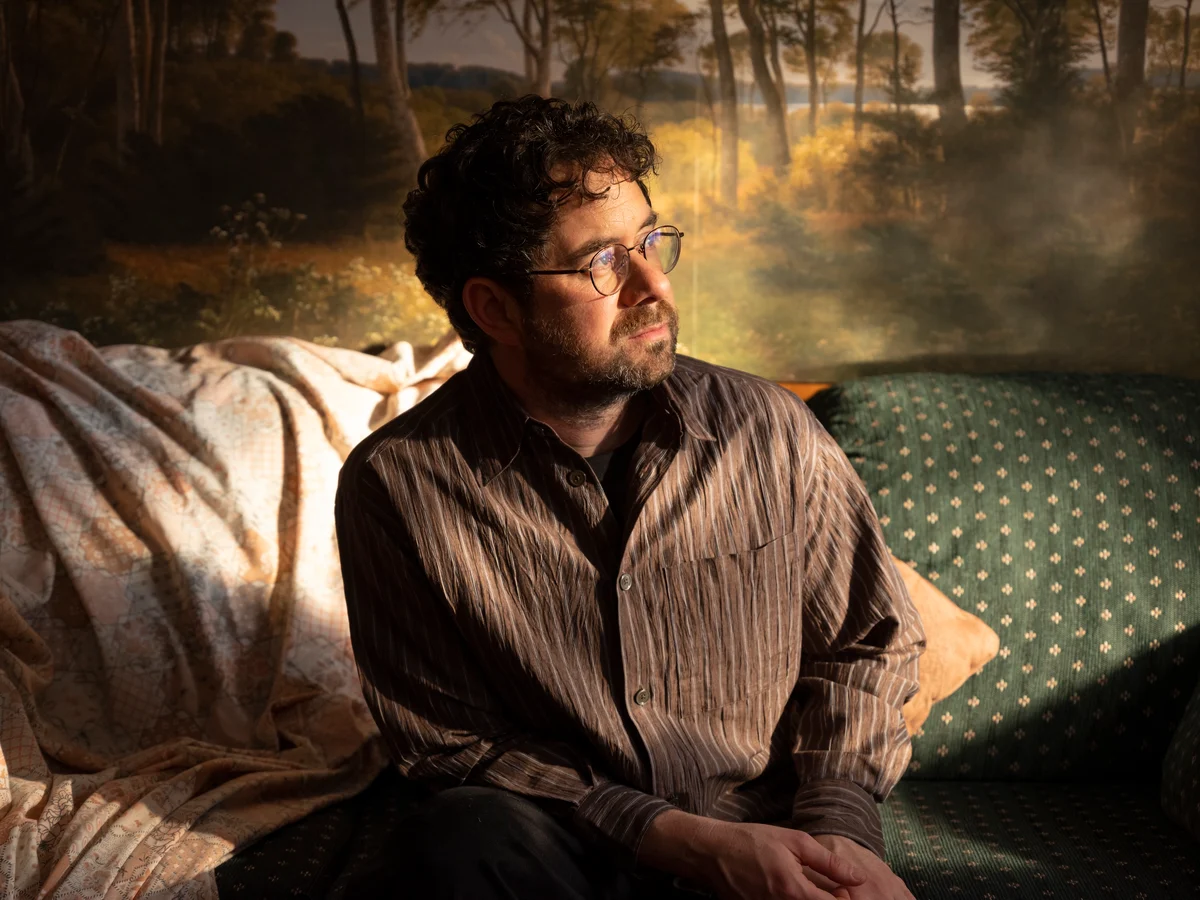

Jean-Michel Blais takes us to his panoramic lookout
Montréal composer Jean-Michel Blais tells Sophie Jarvis how he reacted to the upright, minimal music of his past and trusted in the communal quality of repetition on his latest “book of tales.”
What do The Lion King, Sister Act, and Odysseus have in common?
One a Disney classic chronicling a lion prince reclaiming his throne, another follows a nightclub singer hiding from her mobster ex in a convent, and the latter is a wandering hero of Homer’s epic poem. Maybe it’s the strange predicaments they each undergo, maybe it’s the unlikely alliances that pop up in each tale, or perhaps it’s just the lesson that our experiences and encounters come to shape what we make of the world.
Unlikely bedfellows at first glance, the threads running through the trio of tales untangle into an eclectic moodboard for the musical material of Jean-Michel Blais. In the Montréal-based composer’s hands, they stitch into a loose constellation of references, expanding into the world of his fourth studio album mirador, which transcends the intimate minor-key piano compositions glimmering his decade-long career into a cinematic, symphonic portrait of the breadth of human experience. A choir draws on the grandeur of Henryk Górecki, the exuberance of Sister Act, and the majestic soundtrack of The Lion King, imbued with the ancient voyage of Odysseus and giving the record a sense of detour and return.
“With mirador, I sat and this is what came out of me,” he says. “It was a reaction to the simplistic, upright, minimal music that I’ve done before and will do again. I like an album to be like a film or a story – I consider mirador to be a book of tales. That’s why on some pieces you get fear, happiness, hope, despair – it just connected everything around the thread of the human voice.”
Released in late September, mirador (noun, of Spanish and Catalan origin, defined as a lookout offering panoramic views) revisits familiar piano lines, except now huddled into a cast of wordless Baroque choir, a string quartet, Andean flutes and charango, with traces of flamenco and sacred choral music moving through the arrangements. Blais bought friends and collaborators into the process – alongside the 12-voice ensemble and string quartet, crafted by composer and arranger William Brittelle (LA Philharmonic, The National), while Andean musician Tulio Velazco Villagra’s musical roots brought the record’s South American imagery into focus.
“The album was also sort of answering this experience as a human being now – it’s a non-AI acoustic album; there’s no fake instruments in there,” he says. “So there was a will to really connect with real people, probably as an answer to everything that’s happening now with fake news and so on – connecting with the real.”
On “kyrie”, connection is cast through seafaring human voice. A recurring choral motif gathers new layers, ebbing and flowing until the progression has travelled somewhere quite different from where it started. As a child, Blais was a member of a church Taizé choir. A French commune known for its ecumenical monastic community, Taizé is associated with a form of worship built around simple, repeated chants, designed to draw congregation into meditative singing, and while Blais is now secular, the communal quality of repetition remains a muse. “They sing in loop and you can just add stuff on top of it,” he explains. “You start removing what was there at the beginning and then you end up with something completely different, where you didn’t really know it as a progression because we’re just adding new stuff. I still see the power of the threads you can find within spirituality and religion.”

The record’s swelling sound suggests a shift in perspective. However, the lookout is a place where the panoramic view is a child’s imagination. In his basement in Nicolet, a little city in Québec, Blais discovered classical music at age 12 and used the hideout to escape into the world of make-believe. With three cassettes, an encyclopaedia, and some VHS tapes, Blais found ways to travel without ever leaving home, returning to the same tiny collection of music and cinema over and over, its contents opening onto somewhere new each time. “Not that I struggled, but we didn’t have much when we were kids, especially not culturally,” he says.
“mirador is more a celebration. It was a time where we had no phone, no internet, so what you had was what you had. And there’s something about that that is really powerful. You’re born with curiosity, you’re born with a thirst for more. Childhood needs to lack something.”
The 12-track record arrived with a film in its pocket, a seven-minute eponymous short that compounds live performance with narrative. As a party unravels around them, children play, and the film resists centring Blais or the music and instead the camera remains at the children’s height, their games and imagination muting the static noise of adulthood around them. “I recall as a kid, I had my side project, my side life, whilst the adults had their thing a metre above,” Blais says. “We had our whole world going on, and that [film] was a celebration of that, and of the power of creativity on all sides.”
The film, directed by music video director-cum-filmmaker Adrian Villagomez (Denzel Curry, The Kid LAROI), reminisces the Brothers Grimm’s The Frog Prince, questioning the darker edges of a story softened in its better-known Disney adaptation. Blais, who spent 10 years working as a special educator before making music, is interested in what happens when we remove the unsettling parts of the stories we tell children. “I feel like we pamper our kids too much nowadays,” he says. “We’re protecting them too much and not exposing them to what reality is, and then they’re unequipped to face the world.” There is a curious reversal at the heart of it: “Now the adults are more scared of the monster and the basement than the kids are.” The things that once fuelled childhood imagination can become, with age, things we learn to avoid.
That ambiguity manifests in the film’s monsters, a man contorting and growling in the basement, which some viewers have interpreted as abstract representations of Blais’ own queerness, or of being closeted. He resists the idea of a single interpretation. “It’s more than that. It’s just anyone has those fears, has had those monsters somewhere when they were kids around them. And like, what are they? What do they represent to you?” he says. “It was interesting to revisit childhood and think, with so few, I managed to do so much, you know?”
We talk the day after he’s settled down for a residency in Cove Park, his room nestled in the rugged mountain ranges and lochs of the Scottish Highlands, an artistic rest break from his intimate world tour and a few days after his Spotify profile surpassed 100 million streams. Blais’ twenties plucked him from Nicolet and through Latin America and Europe, where he studied, worked, and immersed himself in musical worlds far removed from the classical repertoire in Québec. It was as Yann Tiersen had gained traction with his Amelie soundtrack in France and Nils Frahm was beginning to fizz in Germany, and in South America in particular, the folk traditions and Andean instrumentations became a journey in and of itself as those sounds in the basement closed their distance.
“There’s a reason why mirador starts with ‘muses’ – ‘muses’ represents the incantation of the music at the beginning of an epic. And the second track is ‘ulysse’, because for me, Ulysses is the archetype of the very first hero in Western civilisation. I see the album as a bit like Odysseus,” he says. “I see each track as an island where you go and experience something there and then you leave and grow from that.”
During his travels, Blais found himself at a celebration on an island in Lake Titicaca, the world’s highest navigable lake – straddling the border of Peru and Bolivia – and home to Isla de La Luna and Isla del Sol – the Island of the Sun, and Island of the Moon. It was here he and his friends were the only outsiders among the families gathered in festivities, dancing. Elsewhere, in Ecuador, a chance conversation in an instrument shop in Quito led him to a festival in Otavalo where three of his favourite artists were playing: Bonny Alberto Teran, Los Kjarkas, and Charijayac. He ended up helping set up the stage before finding himself backstage with the musicians, the technicians telling him, “If you want to come with us, you have to work.”
“It was so beautiful to experience the music from within. And the same goes with all those traditional instruments. They are born with that, it’s not special. It’s really where it’s from. They take the natural materials and transform it into an instrument,” he smiles. “It’s like this music was not proletariat, it was folkloric. It speaks about the earth, the land, the day of work, of those people, and it’s beautiful to take from that and mingle it.”
Villagra and Blais co-wrote parts together, finding ways for the instruments to sit within Blais’ compositions without losing their character. One flute, for instance, needed returning to fit the music’s tonality, and “Tulio tuned it with rice and beans,” he recalls, the grains placed inside the air columns to adjust the pitch. “Rice and beans is just his traditional meal, and so he would put rice in each tube. It was so precarious but also so creative and beautiful. It was just nice to be in the studio with friends and people you can really bond with. That’s the basis of the record.”
The spirit of exchange stokes mirador’s fire, both in practice and in principle. From Beethoven’s piano concertos audible on “laulasmaa” meeting the bright, reedy sound of the Andean pan flute, Blais explores the tension between popular and classical music, particularly the latter’s “historically elitist, bourgeois status.”

“I don’t have Imposter Syndrome,” he says. “[Classical music] is not my will where I’m from, but I know I belong, and I know I can bring more people with me there. It can really create bridges, and that’s something very important to me.”
The orchestration of mirador turns the page on the collaborative spirit of desért, his 2024 record with harpist Lara Somogyi, which emerged from three hours of improvisation at her studio in California. An improviser by instinct (“one thing I like the most is just to sit”), mirador was a deliberate undertaking of arranging, recording, and reworking. “There’s certainly something beautiful about working in a group with other humans, especially as a lonely child,” he says. “Because when you’re often alone, when you write down notes or score for other people to play, then you have to think about them, their personality, each instrument, then you have to test it, take notes, ask for feedback – it’s relational.”
For all the album’s expansiveness, however, Blais is less drawn to electronic production than he once was. While ‘ulysse’ sees the 12-strong choir layered and doubled until its voices amount to 48 through overdubbing, Blais has become increasingly wary of electronic sounds dating a record. “There’s something a bit more immortal about acoustic music,” he says, pointing to a solo piano piece from his debut album, Il, recorded a decade ago, that has recently found its home in a Louis Vuitton advert. An album he made later, with a heavier exploration of electronics, now sounds “very 2018.” Though, he hasn’t abandoned them entirely: sampled organ and fragments of salsa, mambo, and rumba rhythms dapple mirador, but the palpable interaction of working with other musicians is what gives the record its sense of tactility.
With intimate shows scheduled across the globe until October 2027, the album’s arrangements had their maiden voyage in Berlin – where there was no room to bring a piano and ultimately forced Blais and his touring quartet to improvise. Three of the four musicians sing as well as play, dipping between violin, cello, viola, and charango, with voices taking the place of a clarinet, a cello filling in for a French horn. “It was quite a challenge, but I am a very open-minded composer – I always ask everyone’s input, everybody knows better than I – so we managed to do this arrangement that really encapsulates the spirit of the album. It’s been very fluid and surprising. The album has translated magnificently.”
And while ‘muses’ and ‘ulysse’ echo the romance of Odysseus, the process of creation echoed the swaying dips and dives of the Odyssey. mirador was restarted three separate times – even nearly scrapped at one point – due to repeated problems with mixing or timing. Each time, stepping back and adjusting expectations opened up another possibility, and a change of direction eventually took the mixing to the Netherlands, introducing new approaches. “I think every synchronicity comes from the plurality of the obstacles he encountered,” he says. “In trying not to let go every time, but to let go for one day, stop, and try to understand what’s happening and find a solution, it made me a wider and more open person. I’m ready to face more problems.”
The worlds that first opened up in his basement have since become places he’s scrapbooked in his travel diary, languages he has under his belt, and people he’s throwing Christmas parties for; their music, in turn, finding its way into his own compositions. mirador gathers those encounters without trying to replicate them, instead leaving room for each listener to find their own way through it. “The album is not a map of the city where I’m from with each track, the one street name and the store,” he says. “It’s more of a starting point.”
Sign up to Best Fit's Substack for regular dispatches from the world of pop culture