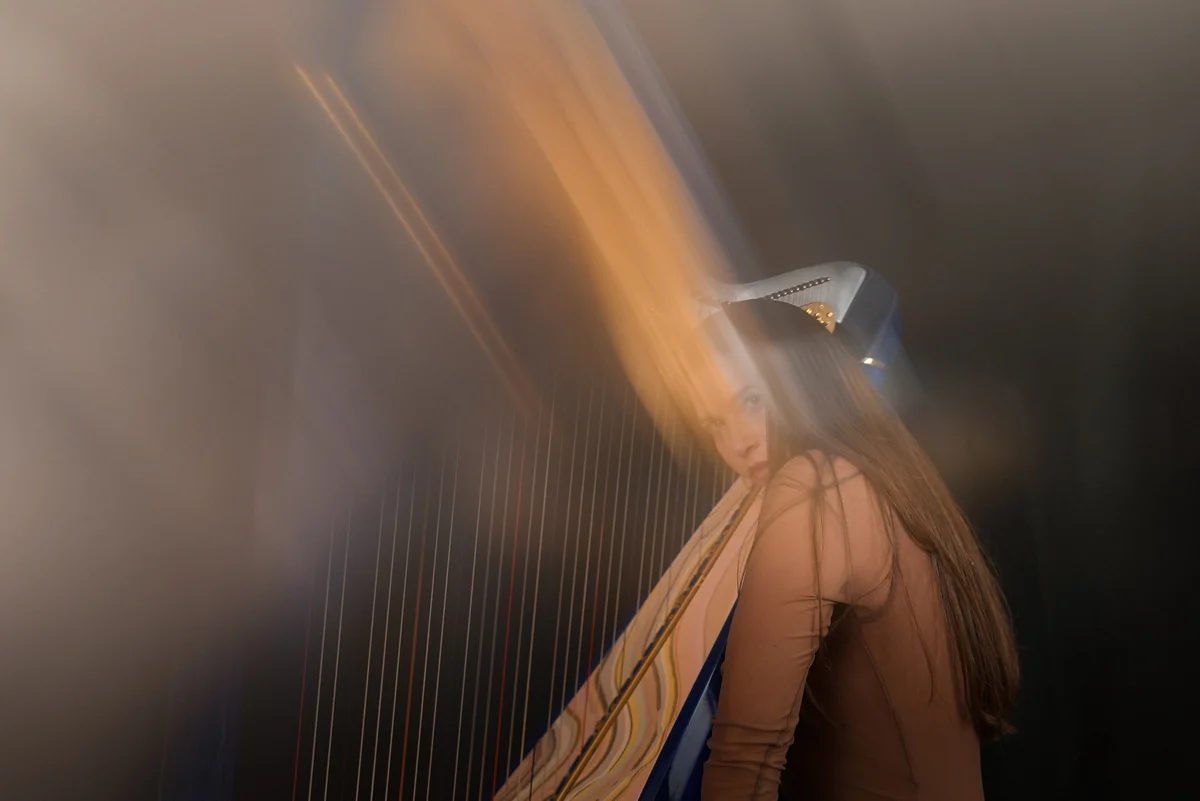

Lara Somogyi’s memory machine
Joshua Tree-based experimental harpist Lara Somogyi tells Hayden Merrick how her creative process has been nudged by every place and person that’s passed through her life.
Lara Somogyi’s new album begins in Hawaii.
That’s where her own story begins. Born on the lush, dramatic island of Kauaʻi, Somogyi uses words like beautiful, relaxed, and communal to describe her childhood. “Fingerprints”, the opening track, takes us back there: a field recording of conversing birds and a serene, approachable harp part evocative of you and your siblings playing by the water. There’s a blurriness to the music that makes the scene feel confined to a cartoon thought bubble, a half-remembered flashback. As it unfolds, the album gets more experimental and “in-the-lab,” but Somogyi assures me a [time] patterned isn’t a sonic autobiography. There isn’t a story arc. Each piece is rather a snapshot or “sonic room” for her to sit in. It just makes sense to start here.
After Hawaii came New York.
The city taught her that most things do not have one right answer. “There’s a pulse underlying that makes you feel like anything is possible,” she says. That included another jump across the water. Enrolling at the Royal Academy of Music in London, she experienced her most “transformative period,” her musical vocabulary growing exponentially. It was here that she started turning to electronics and improvisation, not abandoning her classical footing but augmenting that knowledge and exploring how she might unite both approaches on the harp. She describes it as a process of enchantment.
Around this time, she performed a recital entirely inspired by the colour green (“what does it feel like to play green?”) She started listening to acts like Rufus Wainwright (with whom she’d later collaborate). And she met Brian Eno.
“That, I will always pinpoint as one of the big turning points in my understanding of music, life, being present, and actually sitting with yourself and not rushing, not going through the motions of what you’re blueprinted to do,” Somogyi tells me of her interaction with Eno, having gone on to tackle ideas of predetermination on 2024’s blueprints EP. She remembers how Eno held up a rose petal and encouraged her to look past its initial colour and instead angle it to the sun. “‘Look how the light is coming through the petals. Have you seen that colour before?’,” he asked.
Eno inspired her to consider the granular; the distinctions between different birdsong, for instance, rather than hearing birdsong as a homogeneous background noun. “It taught me to be present in the feelings, to notice more. And how does that translate into yourself, your body, the rest of your actions throughout your day?”
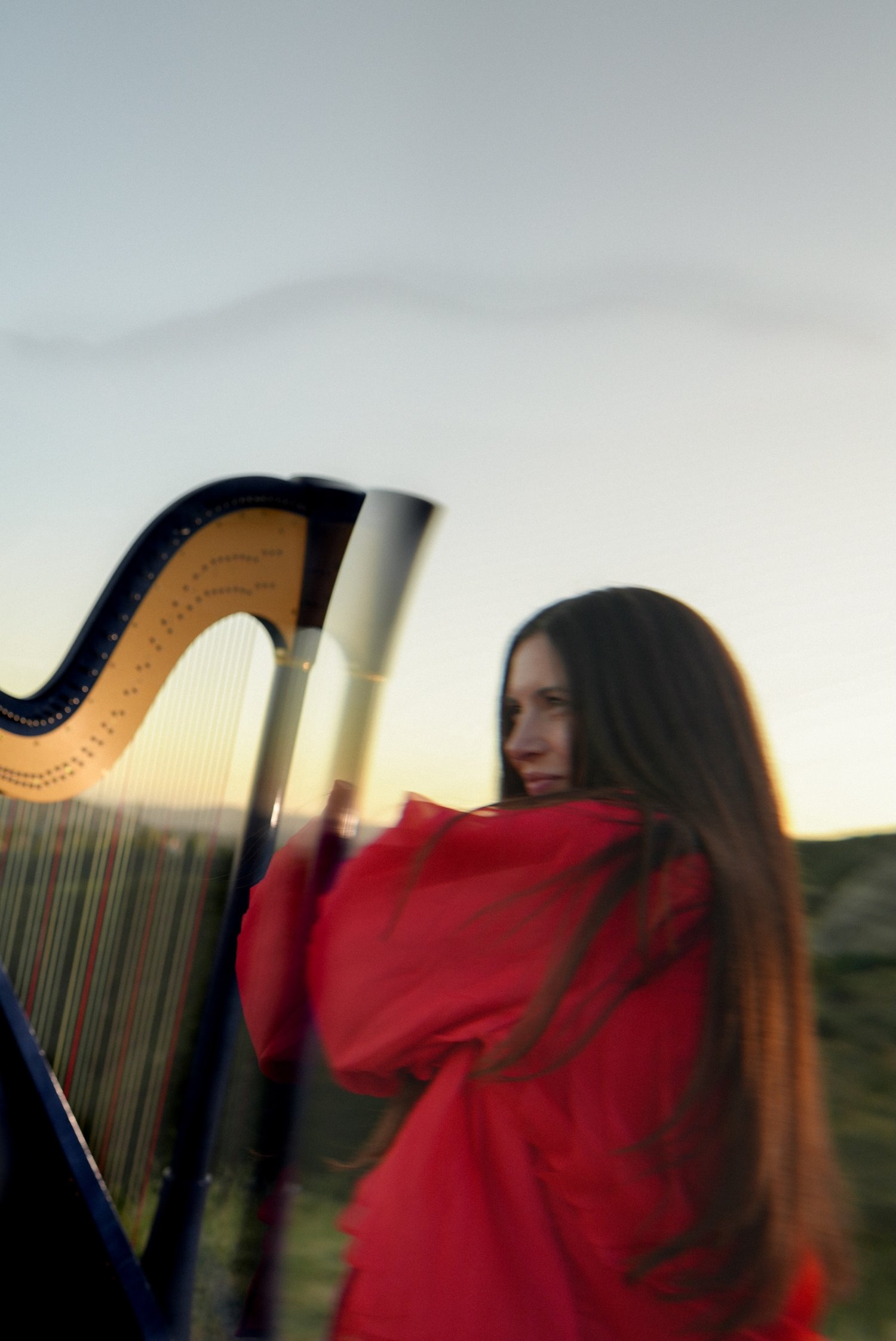
Every location and artist she’s interacted with has plopped pennies in her creative fountain. Her most recent release before this album exemplifies both: désert was an improvisational study of the Joshua Tree badlands she now calls home, created in partnership with Quebecois pianist Jean-Michel Blais. Before that, her debut solo record from 2022 – titled ! and pronounced “exclamation” – was the culmination of all the sonic seafaring she’d done to date, every sound you hear emanating deliberately from the harp itself.
“It was about breaking through traditional ideas of what you think it should sound like. What if you flip it on its head and play in places that aren’t conventionally allowed in a traditional setting?” Pitchfork and BBC 6 praised the record’s boundary-pushing brilliance.
Four years later, Somogyi’s new album, a [time] patterned, is informed by her father, who passed away right as she began writing. Rather than an out-and-out grief record, it’s all about time, with Somogyi resolving to be the archer of time’s arrow, and recontextualising, specifically, a musician’s relationship with time. “I just became curious, because when we only get to spend a certain amount of time with people, how come it continues on? Why does it pass? There were so many questions in my head. As musicians, you spend so much time with time. It’s rhythm. It’s everything. It’s how you create your music – you’re in time; you’re not in time. What does it feel like when you stretch it, when you’re late, when you’re early?”
Somogyi angles her laptop around her Joshua Tree studio to show me the acoustic and electro-acoustic harps on guard behind her, then pans to a nest of guitar pedals and other toys. They’re an integral part of the time-warping process. “A tape loop – how it imprints is how it imprints. You have no control over it,” she explains. “Guitar pedals take time and they jumble it and then give it back to you in a completely different order, which feels really exciting because you’re hearing things that you played into the machine, but it’s not how you played it in. That’s a metaphor for memories and how you’re experiencing things.”
The album, then, is a dialogue with spectres of herself as well as with time, because despite ceding some autonomy to these pedals, she is still the one who’s feeding them – twisting the dials, twirling fingers around strings. “There’s a difference between sitting with the perceived passage of time, or actually being active in it and sensing it.” The second track, “Sojourn”, she cites as a counterpoint to that floaty, friendly opener and demonstrative of the pedal effects. The composition’s quivering glitches are reminiscent of stepping into a butterfly conservatory. Rich, romantic swells like a whale’s slipstream are provided by the London-based string section that features across the record, another break from the harp-only rule she used to abide by.
Even though there’s a practical, technical angle to all of this – programming the division of notes on the delay pedals, say – the way Somogyi experiences time, how she feels, is fluid and free. “There’s nothing about time that’s numerical to me. It’s all sensory. It’s all based on how you’re experiencing things. It’s like: how did it smell that month? The summer that smelled like fresh grass. What was the sound through the trees in that moment?”
That’s how the album feels when you sit with it: divorced from technicalities and content with serendipitous, shapeshifting half-truths. The dream-sequence glissandos of track 5, “elsewhere”, morph into a trigonometric arpeggio and rhythmic pulsations that come and and go. There’s a gorgeous paranoia to “sitting circle”, a collaboration with arranger Rob Moose, who played on Sufjan Stevens’ Illinois and has worked with Phoebe Bridgers and dozens of other indie A-listers. “intimacy gradient”, my favourite, feels so suspended and in-between, like you’re being presented with hundreds of previously inconceivable possibilities. It sounds like she’s holding a vibrating tattoo gun to the strings, which scuttle and stutter asymmetrically.
Certain ambient music unfolds under your nose without your realising; a [time] patterned is consistently engaging without requiring anything of you.
And when you listen, you’re listening with Somogyi, sharing a vantage point. She explains how, for her, composing isn’t over-intellectualised; some of her music could have been made in a dream state. “A lot of it is purely out-of-body. I do sit with it a lot while I’m making it, but then I’m able to release it and then listen and watch it as an observer.” She doesn’t self-critique after the fact either, letting it be. “I’m just really happy and grateful it’s out in the world, because it was something that I said through my fingers, through something else, through the harp, through the electronics. It feels kind of felt rather than thought.”

I wonder, given this, if she ever performs a piece the same way twice. This is when she pulls out her graphic score: a piece of card as wide as a gatefold diner menu, spotted with differently coloured triangles, squares, circles, and dotted lines. It’s a contemporary, non-traditional method of notation used by composers like Brian Eno, Terry Riley, and George Crumb, she explains – “a snapshot of the record in graphic pattern form. It’s meant to not be a linear representation, but more so a sensory one or a decorative one, where it’s open to interpretation, just like everything else. Even when I’m relearning these pieces to play [live], I’m referencing these types of shapes, because it helps me rather than thinking of it in this linear state that time is supposed to be in. That’s another beauty of graphic scores – that they’re supposed to be played differently each time.”
She sees beauty in ever-evolving recollection, an idea that loops back to how we are unreliable narrators of our memories. That childhood in Hawaii could look slightly different – rainier, greener, sunnier, smaller – depending on the day, the mood, where we’re reminiscing from, what we’re listening to, who’s asking.
“That’s so exciting to me because it’s capturing that moment in time,” she says of the one-of-a-kind performance concept. “It’s decorating that moment of what we’re experiencing. In classical music, it’s very much about, did you do it perfectly? Did you express what the composer wanted? There’s such beauty in that art as well – recounting the story that the composer intended. But I can do both. I feel a lot more enchantment doing it the way that’s not exact each time. It feels free.”
Lara Somogyi loves what she does more than anyone I’ve ever interviewed. It’s been difficult to avoid typing the words: The harp is an extension of herself. Few artists spill secrets so readily, are so notably devoid of pretence and pretension. It makes me wonder how many people out there haven’t found their calling, if this is what finding your calling sounds like. As she puts it: “I’m going to be front row at every cool harp concert. The exploration of the harp in a new space has always been in my body, forever. I just knew I wanted the harp to be my life, and to explore it is my greatest joy and my greatest privilege.”
Sign up to Best Fit's Substack for regular dispatches from the world of pop culture