

Tromsø World is rooted in the north and open to all
Lead photo by Marlena Bonin
Booking with its own latitude firmly in mind, Arctic showcase Tromsø World ends up with a line-up that feels local and far-flung at once, writes John Bell.
When I arrive for Tromsø World festival on a late October evening, I head straight for the opening ceremony but get as far as the city’s oldest pub.
To be fair, it’s not just the amber glow, nautical decorations or the stuffed polar bear stuck next to today’s papers that lure me in – though it is a welcome sight when looking to escape the Arctic chill. A mixed group in the corner donning lanyards and sharing small talk convinces me I’m in the right place, and so I sit with them and get cosy for a moment. Eventually, I ask a kind-faced attendee if she’s here for the festival. “No,” she says in a confused tone, “we are with the International Glaciological Society.” The tubes of maps and recent findings most of them are beginning to unfurl should perhaps have been the giveaway.
I find the festival group in a microbrewery next door, and though the chance encounter provides a fun icebreaker to my intended audience, there’s something fitting about a group of glaciologists and eclectic music lovers separated by a pub wall. For the past five years Tromsø World has, by bringing together international artists, industry figures and audiences through performances, discussion and exchange, significantly helped strengthen the city’s cultural pull beyond its Northern Lights tourism (and Arctic research).
I first visited Tromsø in 2024 for Buktafestivalen, when the July midnight sun gilded the town with a round-the-clock radiance. At this time of year it gets dark just past lunch, but from the outside at least, the grumpy old rock venue Bastard Bar doesn’t seem to have changed. And yet on Thursday evening the local metal bands are nowhere to be seen and instead Rizan Said fills the place with his fluttering electronic dabke. Something of a Giorgio Moroder figure in his pioneering use of synthesizer in Syrian music, the Kurdish keyboardist was also influential in crafting Omar Souleyman’s sinuous, energetic sound – that repetitive right hand virtuosic, if not a little knackering even to watch after an hour-and-a-half.
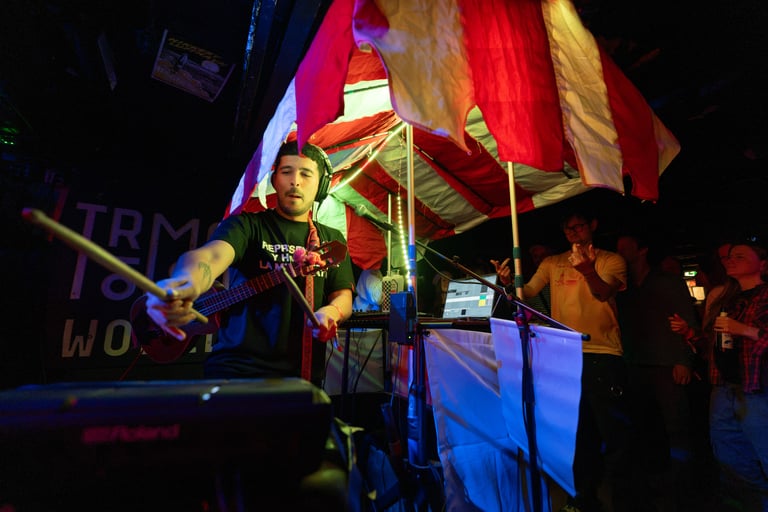
On Friday evening the Bolivian-born, Belgium-based artist Susobrino converts the inside of Bastard Bar into a red-and-white striped anticucho food cart. No beef skewers on offer here, but a modern and multi-layered fusion of Latin American music with plucked charango, deep bassy drum pads and memeified “FAAHH” samples. The chu-chuchu-chu of Suso’s cumbia is one of the few connecting threads to Frente Cumbiero’s own take on the genre, the Colombian band preferring to explore its more cosmic and dub-heavy edges, as on “Cumbia Trosky”.
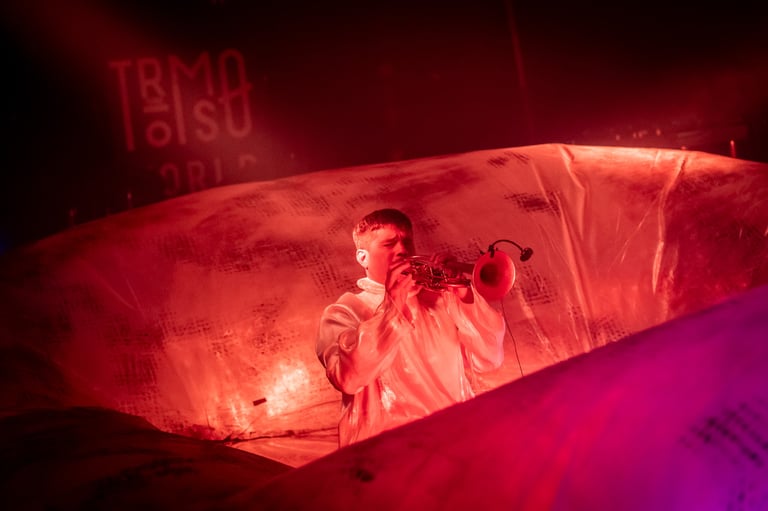
The long sets take a bit of getting used to, and at times stunt the flow of a performance that might normally be half the length. But it’s like this for good reason. The line-up is relatively stacked, and with each venue no more than a 7-minute walk away, it’s possible to catch, say, Argentinian artist Santiago Bartolomé surrounded by an inflatable snake that seems to breathe and writhe to his ambient sound design, and then catch the Tuareg desert blues of Imarhan, whose fresher take on the assouf sound seems to favour teasing dynamism and grooves over the typical hypnotic style.
But more than just a place to discover faraway sounds, Tromsø World is at its most powerful when honing in on themes closer to home. Despite sitting more than 200 miles above the Arctic Circle, Tromsø has been officially twinned with Gaza since 2001, though the relationship really goes back to the 1970s, when a newly built university and hospital attracted politically minded students, medics and volunteers eager to support anti-colonialism and volunteer in refugee camps in Palestinian territories.
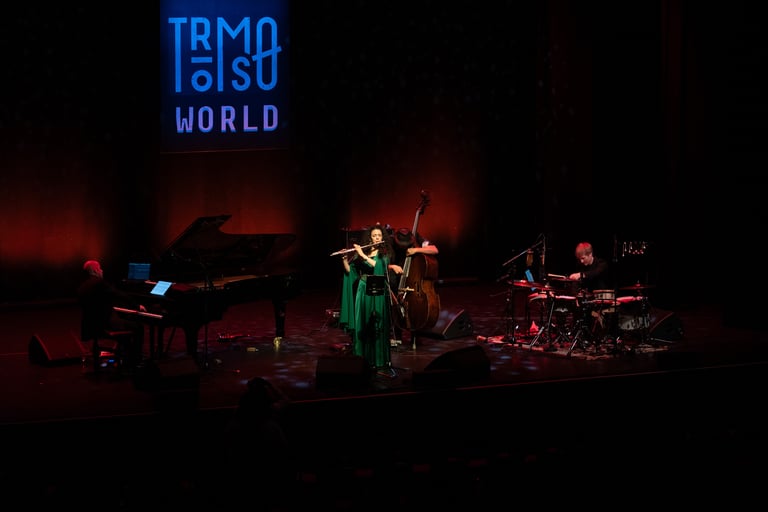
Again in recent years, Tromsø locals protest outside City Hall in solidarity. At the festival, this relationship is embodied by Palestinian singer and flautist Nai Barghouti’s collaboration with a Norwegian jazz supergroup of pianist Tord Gustavsen, bassist Steinar Raknes and percussionist Ruven Ruppik. Barghouti has developed what she calls Naistrumentation, a vocal style that manipulates the microtonal scales of maqam to trill and scat with an instrumental quality. It allows this meeting of traditions to gel not just fluently but with added impact, be that when they play out in parallel or when Barghouti steps back to allow Raknes to sing a vise, a kind of bittersweet traditional Scandinavian ballad. The true counterparts to Barghouti’s voice though are the hands of Gustavsen, eager to give space only to scamper to a level worthy of bringing their owner up off his seat.
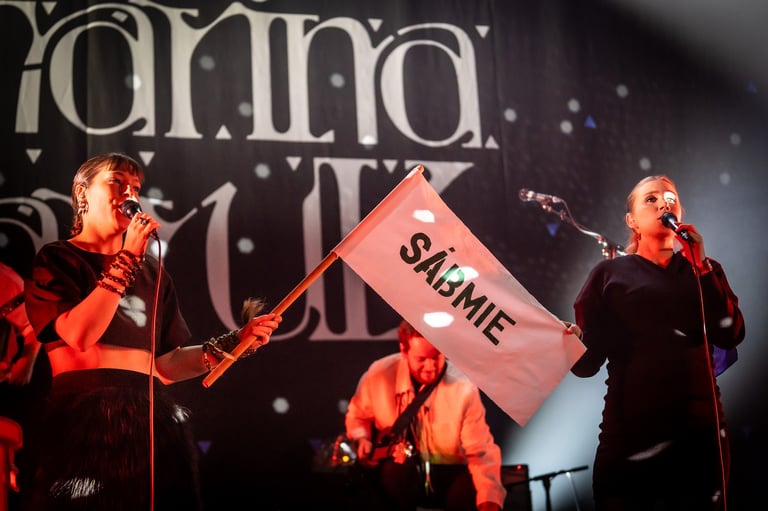
If Barghouti’s performance is an act of musical solidarity, Katarina Barruk’s on Friday evening speaks more to cultural continuity. Barruk is essentially a Sámi superstar; in 2025 she collaborated with BICEP on the soundtrack to the immersive audiovisual project Takkuuk, and became the first Sámi artist to perform at the Royal Albert Hall as part of the BBC Proms. Speaking to Best Fit back in the summer, the Swedish-born singer reflected on wanting to export her craft beyond Sábmie (the indigenous homeland of the Sámi that spans the north of Sweden, Norway, Finland and Russia): “I grew up in a reality where Ume Sámi was very much questioned and not considered. We didn’t have an approved way of writing. I don’t want the Ume Sámi children to experience that. If I work internationally and the world knows more about Ume Sámi, then the people at home can never question it again.”
While outwardly at least Nordic governments have accepted a need for reconciliation for the historically brutal assimilation of Sámi culture, its effects still feel deeply set and, many argue, find new ways to manifest today. Barruk sings in Ume Sámi, a critically endangered language thought to be spoken by fewer than 30 people, but her international success isn’t just down to this scarcity. Embodied gorgeously on “Ij gåssieke”, Barruk pairs the modern sensibilities of brooding jazz, twinkling pop and atmospheric post-rock with an astounding vocal range that she seems to summon from every reach of her body and charges into a joik – a spiritual but highly technical vocal tradition. The effect is purging, something you didn’t know you needed until experiencing it.
I come away from Barruk’s performance at Tromsø World learning more than I knew going into it, but more importantly, I enjoy it. Vasil Gjuroski, the festival’s flamboyant director who cycles around town trying to make each show, tells me this is a guiding principle. “Sámi culture is not something we add to the programme to tick a box. It's part of the identity of this place, and naturally, part of our festival. But I don't want artists to be defined only by their nationality, ethnicity or political situation [...] We invite them first and foremost because they are incredible artists.”
World music can by definition be cerebral and thought-provoking in its window into other sounds and traditions. But the programming of Tromsø World makes sure to remind us it is also visceral and felt, almost doing away with the term. The South African township of Soweto provides two acts to hammer this point home on Saturday night. Just try overthinking a thrashy 28-second-long song by hardcore trio Twenty One Children. “Back home this venue would be getting messed up by now,” laughs guitarist Thulasizwe Nkosi. No chance of that from this polite Norwegian crowd, but they do put some weight behind a mosh on the frenzied “SCAB” and “Looney Bin”.
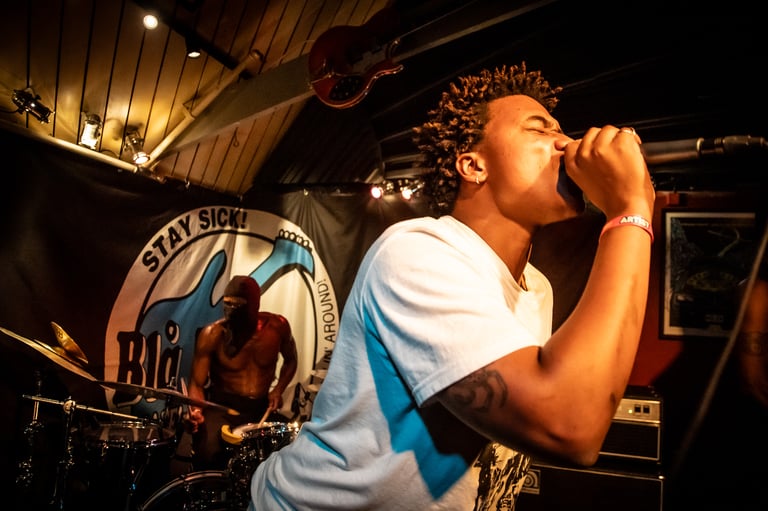
Over the past decade or so, seven-piece Bantu Continua Uhuru Consciousness (BCUC) have hit the European festival scene hard and as a result have earned a reputation for being one of the best live bands on the circuit, singing in all 11 of South Africa’s official spoken languages in hypnotic, often drawn-out revelries. Lead vocalist Nkosi Zithulele, air-strumming his ribs like it makes a sound, is at the centre with a growl that commands the beating of hand drums, wet funky bass and chanting vocals behind him. Up front, the energy is heady and kinetic, and even at its most surreal (for me, the dubby “Pieces of Isht”), he has everyone in his palms.
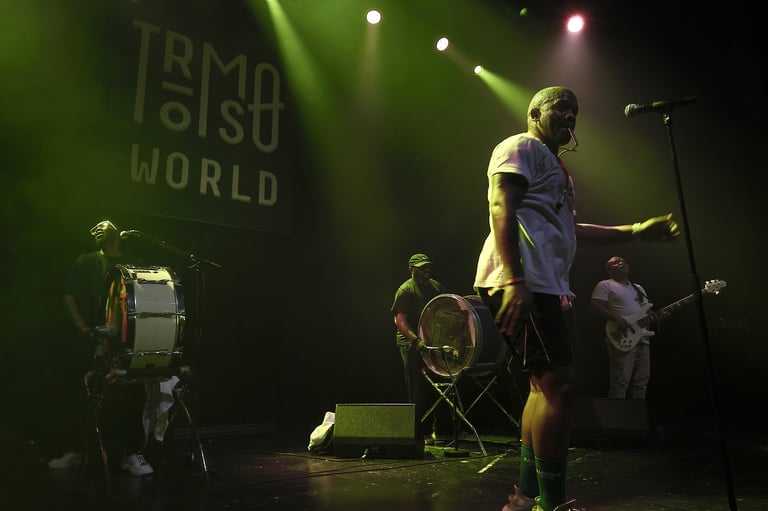
The physical response to BCUC perhaps best captures what Gjuroski means when it comes to sourcing artists for Tromsø World. “Sometimes the programming reflects what's happening in the world,” he continues. “Sometimes it's deeply personal, and sometimes I just hear something and think: fuck, people in Tromsø need to experience this! And that's probably the most important thing. We have clear values and priorities, but we never want them to become a formula. The music has to move us. And hopefully, it moves our audience too.”
Find out more at tromsoworld.com
Sign up to Best Fit's Substack for regular dispatches from the world of pop culture