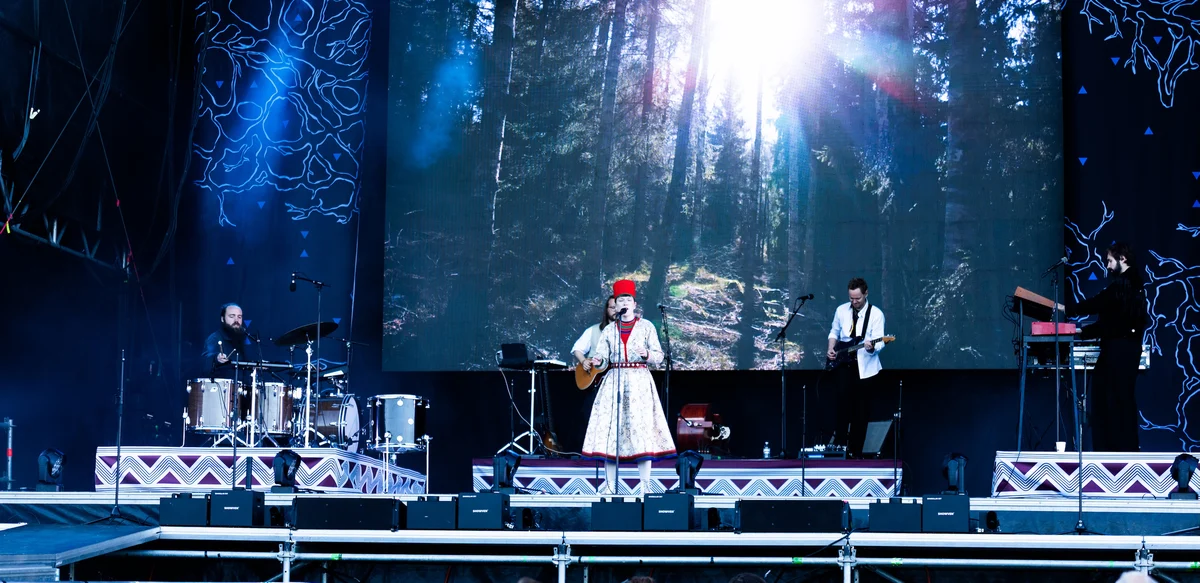

Katarina Barruk joiks for survival
Lead photography by Øyvind Malin
In the remote Arctic community of Vadsø, folk-fusion artist Katarina Barruk spearheads the largest-ever Ume Sámi concert, turning centuries of oppression into empowering documentation.
400 years ago, people who did extraordinary things were accused of being witches and burned at the stake.
135 such people, sentenced to death by fire in the Norwegian county of Finnmark between 1600 and 1692, are commemorated by a memorial on the edge of Vardø. A metal chair is perpetually engulfed in flames, and a long, submarine-like corridor gives each of their names, their alleged crime, and how they died, 135 dim light bulbs flickering sympathetically.
Vardø is in the extreme top-right corner of Norway, spitting distance from the Russian border, far above the Arctic Circle, and further east than St Petersburg. You have to take a tunnel 88 metres under the sea to get there. Hilltop satellites and radio towers keep an eye on Putin, our driver tells me.
The locals call it the ghost town, he says. That’s mostly because of the crumbling cabins and boats becoming splinters, the cars being sucked into the grassland and the army of seagulls perched sinisterly on every available rooftop – but it’s also not a stretch to sense 135 spirits hanging in the air like low, heavy clouds.
Gundelle Omundsdatter. Accused of practising witchcraft. Sentenced to death in fire at the stake.
Anne Mattisdatter. Accused of casting a spell that capsized someone’s boat. Sentenced to death in fire at the stake.
Anders Poulsen. Accused of having used a rune drum to predict the fortunes of travellers in order to help people when they were in trouble. Murdered with an axe while in legal custody.
Our methods of oppressing people we don’t understand slowly became more sophisticated.
Scandinavian governments have long carried out enforced assimilation of the Sámi people, for example. Once known by the pejorative term Laplanders, the Sámi are the Indigenous population of Europe’s high north – the only recognised Indigenous people in the EU – and their livelihoods are centred on reindeer herding and the natural landscape. Their homeland, Sábmie, also known by other names depending on which Sámi language one speaks, swoops like a rainbow across the top of the world, beginning half way up Norway, and kissing Russia at its end after beaming over parts of Sweden and Finland.

Aggressive Norwegianization and Swedification policies have led – and continue leading – to unfathomable cultural erasure for the Sámi, the near-extinction of certain Sámi languages, and loss of control over parts of Sábmie. This government-sanctioned cultural genocide is in some ways comparable to Canada’s residential school system and the general maltreatment of Indigenous Peoples and First Nations across the world.
Depending on who you ask, Ume Sámi, named for the Ume River in Norrbotten County, Sweden, has between 20 and 100 active speakers – the most critically endangered of all the Sámi peoples.
One of them is Katarina Barruk, who is also extraordinary.
She was the first Sámi artist to perform at the Royal Albert Hall (last summer as part of the Proms). Together with Arnljot Nordvik, she wrote the music to the first Ume Sámi theatre show in 100 years, “a tribute to the forest Sámi culture in the Ume Sámi area.” And last week, she spearheaded the largest Ume Sámi concert in history.
This was part of Varangerfestivalen, which has been running since 1982 in the small Arctic city of Vadsø, about an hour’s drive from our seagull-run ghost town and witch memorial. The road between them hugs the glistening fjord as you pass nervous reindeer, unbothered sheep, and lonely cabins with axes leaning against the porch.
Comparatively, Vadsø is a metropolis: a population around 4,000; a beloved antique store where you can buy a century-old sleigh if you want; a restaurant called Påls where you can eat reindeer stew if you want; and a small regional airport where you can take a tiny plane that makes a stop every 15 minutes if you want – the bus plane or milky way plane, the locals call it. I call it the queasiest few hours of my life.

Each year, Varangerfestivalen sells almost as many tickets as there are Vadsø residents, communal cheer imbibing the tiny centre with pop-up food stalls, games, and the “tea time” tent. Varangerfestivalen is generous to fly out a small number of delegates to witness Barruk’s historic, once-in-a-lifetime show, the opening performance on day one of the festival. That slot is always reserved for the ‘Northern Soul’ – a stage dedicated to new music born in the Arctic, establishing the tonality of the next few days. This year, Katarina Barruk has the floor; she is quite literally the soul of the north.
So is Jörgen Stenberg. So is Marja Mortensson.
Barruk has always said that her dream is to watch other Ume Sámi performers on stage. Her mission is not a self-centred pursuit, but an urgent act of cultural preservation, of survival. “The world now is so – and being an artist is so – self-centred that you need to talk a lot about just one person. But there are so many beautiful and important things that I’m trying to say that don’t have so much to do with me.”
That’s why it’s so special that she’s able to loop in Stenberg and Mortensson, who each have the stage to themselves for part of the show. They also perform several pieces as a trio.
None of them is from this region, exactly, even if my western ignorance assumes the Arctic is one homogenous snow globe. “It was a shock coming here to this landscape because it looks completely different from where I am from,” Barruk says. She comes from the forest, not the sea, two days south-west by car. “But I love this place. It’s one of my favourite places in Sábmie, because I think it’s very beautiful, and there are so many different Sámi cultures. You have the Sea Sámi culture. Northern Sámi language. You also have the Inari Sámi language, which has close contacts to this fjord, and also the Skolt Sámi culture.” It’s a culturally diverse region with a fascinating – and, as we’ve seen, grisly – history.

Even before the concert, at dress rehearsal, Barruk feels as though she got what she came for.
“I’m happy now, even before I play, because if we [talk about] ego, it feels healing for me and for my little child, to be able to stand in that room, and I listen to the song of the other artists, and they’re talking in my language.”
Does she mean her inner child?
“How my upbringing was, how I sometimes felt so alone, and how I still feel sometimes alone. And then we created that space yesterday. I felt that it gave something back to me.”
It’s incredible – almost not credible – that she’s managed to become something that never existed before: an internationally renowned Ume Sámi touring artist. As a child, she didn’t have any musical models to look to. Not only that; there is obviously a much wider cultural diffidence or unease that Sámi people have to overcome, entrenched by decades of persecution. Many Sámi people are “closeted Sámi,” she tells me.
“One friend of mine, she asked me, why is it important for you to work internationally and not only be focusing on the Sábmie region? It’s because I grew up in a reality where Ume Sámi was very much questioned and not considered. We didn’t have an approved way of writing. I don’t want the Ume Sámi children to experience that. If I work internationally and the world knows more about Ume Sámi, then the people at home can never question it again” – in other words, they can feel a sense of pride in their heritage because there’s evidence, finally, of it being accepted.

As Barruk’s band takes the stage, her voiceover echoes the words on-screen: “When I was a child, I did not have the possibility to listen to music in my language, in Ume Sámi.”
“What can I do for the little child, so that they don’t have to feel alone?”
Barruk walks out with two long austere plaits draping down her back (later imposed over footage of rivers and forests, blurring the line between her and her home) – and the answer to her question unfolds over the next hour.
“Sing, sing! Joik, joik!” the voice says.
Her music is a restless, spellbinding fusion of the two: what you might call alt-pop with what my vocabulary struggles to capture – something earthy, innate, mystical, almost Celtic-sounding. It transfixes you like no other genre.
Joiking is the foundation of it. If you know anything about the joik, you might know it is a traditional form of song typically tied to a person or place. I always assumed that meant an ode, a eulogy – but no.
“If you’re going to joik a person, you don’t joik about them. If I would joik you, I don’t joik about you. I joik you. So I’m more on the inside, looking out, than looking at you. It is you.”

Some of the pieces she performs are modernised versions of century-old joiks, glossed with atmospheric synth pads, wandering bass lines, and thumping, body-jerk percussion. One, “Umealven” – “Ume River” – channels the river where she grew up. She tells me how she never knew the river before hydroelectricity development. It now has 13 power stations. “When I joik, I can see how it was when it was running freely.” She’s never actually seen-seen it, but “the joik is also a way of remembering. It sort of tells the state of that person or place in that time.”
One of Marja Mortensson’s performances is a joik of her grandmother, named Malages, or – if I misunderstood that in translation – she certainly talks about her. Mortensson, from Innlandet county in southern Norway, would accompany her grandmother on journeys through stories, she tells the audience, Malages passing down tales of reindeers and rivers and songs.
“We carry the knowledge forward,” she says. And that’s kind of the whole point: the first book ever published in any Sámi language was in Ume Sámi, back in the 17th century, so Barruk and her peers are extending the Ume Sámi peoples’ long history of documentation and preservation. If not them, who else is going to do it?
Barruk tells me about how artists such as herself, Mortensson, and Stenberg – the latter a renowned joiker who’s singing for the first time tonight – have been forced to become more political, because “you fight for your culture on a daily basis.” There’s almost an inherent politicisation to everything they do. Whereas traditional joiks would centre on people and nature, now, there are other things they must discuss and put focus on through their art or the discourse around it.
“We see it now, with the right wing going over all of Europe, and also Sweden and Norway, that it becomes harder to be Sámi, unfortunately. That is a reality that we live in. But I wanted to make music from a human standpoint. I can make whatever music I want to. But now as I get older, it becomes a little more political.”

Still, Barruk masterfully tightropes between tradition and modernity, human stories of heartbreak and transcendent ones of history and the unexplainable. For the finale, she comes back on stage wearing a modernised spin on the gápttie dress, designed by Anna-Stina Svakko, a larger-than-life character I have lunch with earlier that day. Svakko was only given two weeks’ notice last time she designed something for Barruk, for her Roskilde performance. Barruk laughs when I remind her. “It’s very common in our culture that we really step up at the last minute and make stuff together.”
She explains that, usually, she only wears her traditional regalia in private or on 6 February, the Sámi peoples’ national day. “But when I knew that I’m going to try to make this Ume Sámi concert with other Ume Sámi artists, and I want to show how beautiful our culture is, then it was very natural for me to ask her to make regalia. So it is traditional regalia, but very modern too.”
Back onstage, the concert climaxes as road signs of place names are brought out – Ubmeje, Likssjuo, Malage, Mahvie, all places in Sábmie, in their Ume Sámi names – and the repeated refrain, “Mijan gieres sabmie.” It translates to “our beloved Sábmie.”

Katarina Barruk struggles to write songs back in Oslo, where she’s lived for several years. For one thing, she’s not immersed in her language. Norwegian is her third, English her fourth.
“When I start making new music, I always want to start at home.” She and her partner – in life and music – go on writing residencies in Sábmie, near the Ume River, sometimes staying in Barruk’s family home, where she can speak Ume Sámi with her father. Sometimes she rents a family friend’s place.
Artists always want to do a residency, she says, to get out of their natural habitat, but “I want to go to a residency at home, to Sábmie, because everything in my music stems from the land where I’m from, in some sort of way.”
Oppression pushes people from home. Katarina Barruk had to spread her message, fight for her culture, in a way she couldn’t without the music industry’s framework.
Many Sámi people have had to leave home to follow the reindeer, migrating because of climate change. “Everything that affects the reindeer affects us, because the reindeer carries our culture and makes the connection to the land,” Barruk says.
For others, a deliberate, top-down initiative was the cause, such as the thousands of kids removed from home and funnelled into the segregated church-run school system – these were closed in the 60s but the collective trauma remains.

Other people are pushed from home via overt, explicit violence rather than the systemic, quieter violence against Indigenous communities. For example, the young guy driving me to the airport is from Ukraine, a recent arrival in Vadsø. He can’t help his people back home, he tells me, but he can help here – so he volunteers for the festival, driving me two hours to the airport before heading two hours back and then spending the rest of the day dismantling the stage and cleaning up.
So while methods of oppression have become more sophisticated than “burn them at the stake!”, so has the resistance become more valorous. The goodness deeper, the desire to help stronger, the documentation and education more exhaustive. That’s what we hear and see when we try to control extraordinary people: the unstoppable, wild, and free.
Find out more about Varangerfestivalen at varangerfestivalen.no
Sign up to Best Fit's Substack for regular dispatches from the world of pop culture