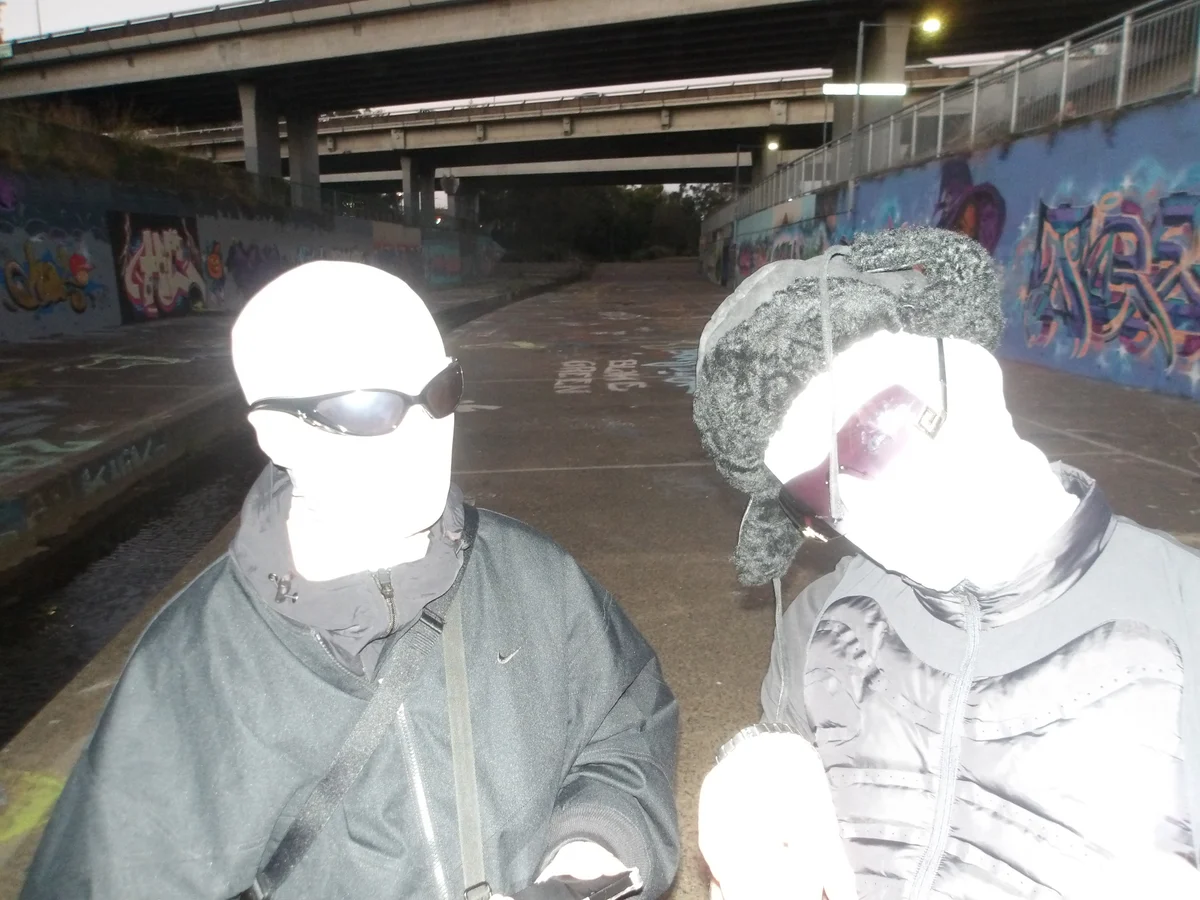
Two Shell would rather soothe a frightened world than soundtrack its collapse
After seven years of music that mirrored the gloom around them, enigmatic London duo Two Shell decided their listeners deserved a place to exhale instead, they tell Douglas Jardim.
Duping with decoys at Boiler Room DJ sets, Two Shell have long dared the versed populace to decide whether they’re dance futurists, or just very committed to the bit.
Their mythology as anonymous techno trolls has often threatened to eclipse the music itself. For £1,000, you can get hold of a notorious “boring rock” sold via Bandcamp. Now, they’ve added another provocation to the pile: AI-assisted production, packaged in an upbeat vision of ultramodern, feel-good party pop.
The early reception to their second album, Infinite Now, has been bruising to say the least. Paste Magazine related its sound to a “tinny, uncomfortable flatness”, “smooth-brained” and “dead-eyed”, deserving of their first-ever F+ score. Toying with their electro output since 2019, the fruits of their labour finding themselves in a willing, favourable raver fanbase at Glastonbury’s IICON stage and RALLY’s scaffolding structure, the question has now become one of jeopardy.
As the gimmick threatens to swallow the music, Two Shell are finally letting their masks slip a little. Am I the first journalist who hasn’t been sent imposters? I’m not allowed to say much, sworn to secrecy by their publicist as to protect their identities. But by choice, at this rate, who’s to say a big reveal isn’t imminent? It’s early September and I’ve been called to Young Space, the base of their record label operations, where I’m privy to rare all-access treatment. A genuinely pleasant armchair interview with the pair, their most frank yet, and, to my disbelief, not a stunt in sight.
Although provocation has always been part of the point. Two Shell's discography has unfolded through a series of digital breadcrumbs to be deciphered, their own shell.tech website has become a laboratory for this kind of investigative research. Disappearing releases, alternate versions and elaborate unearthings turn the mere act of a listening session to Reddit thread scouring. “A lot of it was to do with just wanting to make fun experiences for people with music,” they explain. “At the time we started releasing music, what were our options? SoundCloud, which is obviously incredible, but is there a way where people can hear our music that’s a bit more of an experience?”
Two Shell are less interested in handing listeners a finished, tactile product than orchestrating forever moving parts, even after the music leaves their hands. It’s largely the motivation behind their multiple Infinite Now+ streaming drops; what seemed like a never-ending expansion of differing track types and new additions. Currently standing at a total of 55 songs, it released two weeks prior to the final album in early October. A callback, it seems, to 2024; the mysterious distribution of their self-titled debut album involved USBs in grey putty and multiple advance versions sent out to press.
An extension of the studio, they continue to treat the internet as the perfect place for freestyling. Testing ideas and playing with the relationship between artist and audience within their own world, even if it’s a double-edged sword. “We've always wanted to keep things different and moving, and we've always wanted to release a lot of music because we make a lot,” they stress. “It's also fun playing around with which song is the real song, which song is the original, who gets to define that.”
One can picture a covert Two Shell riveted by the endless possibilities around refusing a definitive version. A track can evolve, mutate or return in a new form; its identity is never fixed, never certain. The listener becomes part of the process, determining which ideas have the staying power to exist beyond whatever the duo could’ve imagined.
This openness translates into the new music; where early EPs and even their moody Glastonbury follow-up, last year’s surprise-release IIcons, indulged in atmosphere and abstraction, Infinite Now comparatively leans into uplifting vocal hooks and sample work made with the latest in generative technology. To the dismay of those disappointed in its synthetic detachment, it’s an audio adventure akin to a sort of UK funky-UK garage in the style of Craig David. The record’s vibrant old skool nostalgia is deliberate, if not entirely straightforward. Inescapable, like the unmistakeable rush of hearing a song for the first time in ages and somehow remembering every word, as though it's been circulating on the radio for decades.

Initially cynical about the prevalence of nostalgia in contemporary culture, Two Shell eventually came to the decision that by resisting it, they would miss the intended target. “It's almost like a new thing for us with this album, doing that, and, yeah, it's felt pretty good,” they reveal. “It's like the future nostalgia, almost, is how we thought about it at times. Everything is kind of a version of something previous now, because of the speed of how quickly things reference outside of where they started.”
For all the conversation surrounding its creation and confusing marketing, the objective of Infinite Now is one of simplicity; to make the music connect with instant familiarity despite all its outward futurism. Even in an internet culture where musical references of every era are deconstructed, recombined, and endlessly recirculated, the familiar can still be recontextualised. “Simplicity as a reaction to the complexities of everything going on. We can’t speak for other people, but we’ve felt the world is not in a good place, and in making it we’ve found a lot of peace and joy.”
It’s a sentiment that runs through “The Nightmare”, the big beat track that helped establish the direction of this new era. Appropriately apocalyptic for the moment – we are, of course, a world in permanent crisis – its Eurodance floor call offers a brief escape from the despair all around us. “We were going around playing a lot of that properly nihilistic music, like things are fucked, and we got to the point where we were a bit like, ‘Is this what we're bringing people?’ We're not here to bring that, we're here to bring good shit and make people feel good.”
There is, they argue, value in acknowledging the state of the world in their music by making room for pleasure, precisely because everything else feels so difficult to process. They point to personalised algorithms as a source of fragmentation, where people living next door to one another inhabit disparate realities. “Having spent so long thinking about all this stuff and feeling like it's not getting better, it's like, okay, what are we meant to do? Make something that feels good.” Environmental anxiety, technological acceleration, and socio-political division all contribute to what Two Shell render as “the nightmare”.
Infinite Now’s lead-in first cropped up in February, as Two Shell took over Brixton’s Phonox club across 4 Fridays; a special guest behind the decks in Jack Harlow. Their connection with the Louisville rapper began when they received a direct message offering his number. Two Shell responded by sending a barrage of beats, encouraging Harlow to experiment more in his own music. They expected the suggestion might cause friction; instead, Harlow welcomed it. “We've just built a really beautiful relationship with him, really. We love the guy, very very special soul.”
This impulse to merge seemingly dissimilar musical worlds is a running pattern in Two Shell’s career; two of their most successful hits are collaborations with FKA twigs and Sugababes. Ahead of the official release of 2024’s “Talk To Me” with FKA twigs, Two Shell found themselves in a bit of a pickle for sharing various versions on Bandcamp and SoundCloud featuring AI-cloned vocals in the likeness of Frank Ocean, Taylor Swift and BTS’ Jungkook — the latter prompting a cease-and-desist letter.
On Infinite Now’s “Closer To The Sound”, Cecile Believe carries a special significance as a credited lyricist and vocalist. Her association with SOPHIE is particularly resonant as a major influence for the pair: “‘Immaterial’ is one of our favourite songs, and there was something in the essence of that song that felt right in terms of the message.” Believe’s involvement should come as no surprise, considering the album’s interest in fluid identity and pop as a space for infinite possibility.
And yet Two Shell’s approach to technology remains the album’s most contentious dimension. Infinite Now sits in the shadow of Tyga’s ‘80s-inspired, Suno-prompted $TARFACE concept record, panned for a similar creative embrace. Taking up AI tools as advanced materials available to music makers, Two Shell seem to care more about the sensation of a particular sound than who, or what, produced it; they describe the female/male vocals on songs like “Dance” and “Thing About You” as a mixture of different processes.
Habituated to DIY thinking, Two Shell have long resisted the idea that electronic music expression should be reserved for those with expensive equipment or formal training. Their populist philosophy: “Everyone should be able to express themselves; you shouldn’t be talented or skilled to do that.”
A June report from the United Nations University (UNU) in Shibuya warns of a growing catastrophe that threatens our freshwater, land and climate; AI infrastructure is projected to generate up to 2.5 million tonnes of e-waste annually by 2030. Creating heat islands and worsening regional droughts, when asked about AI’s environmental costs, the duo acknowledge that the concerns are legitimate: “There's a lot of scary and bad stuff within that that's much bigger than music.” They see their work as an engagement with the technologies of the present, rather than an endorsement of the institutions driving them forward. Stepping tentatively, “There’s so many contradictions within all of it, really, that we’re just kind of sitting within the contradictions.”

It’s an answer that will likely frustrate readers searching for a thorough moral stance, especially given how closely Two Shell’s new sound and visual identity are tied to the technological moment. In the same month as UNU’s report, Two Shell sat down with RA Exchange for a conversation that fleetingly addressed their comfort with AI, something they admitted to using for years. Leaning further into ironic objectivity, the background of the podcast recording is a data centre full of server racks. But, in their defence, the duo are aware that simply ignoring the issue would be its own kind of evasion. “You’ve got to continue to check your morality and educate yourself,” they assert. “We’re learning as we go.”
After the public backlash from their RA blunder, the catalyst for an ongoing debate around creative integrity, Two Shell are attempting to repair their relationship with those watching. “We never wanted people not to trust us. We care a lot about the music, and whatever we can do to get it to connect, and for people to believe in it. Finding methods of more trust, building more trust.” The internet that provides an ideal playground for their worldbuilding is a much harsher place, it turns out. With remarkable candour, “We try and stay offline as much as we can, just because we can be quite sensitive to stuff and it just affects our mental health,” they confess.
“There's multiple reasons why we've experimented and been anonymous, but the public eye, it's a crazy place. People can just say whatever the hell they want, and they're entitled to, and that can be dangerous if you're a sensitive soul. Even probably if you're not.” Their words carry a contradiction, promoting a project around digital participation, but Two Shell are learning where to draw the line. “Obviously being completely disconnected, it is important to listen to your fans and the people that care about your music and engage with that stuff.”

Two Shell’s Infinite Now universe will be experienced live later this month, playing at London’s Outernet with visuals from Weirdcore – the artist behind Aphex Twin’s face-mapping distortions. They lament the capital’s shrinking nightlife, the licensing struggles of venues, and the personal struggle of making a living while touring. “That’s been the hardest thing, working out how to keep going. We didn't get any training for this; you're learning how to keep your energy good. How to balance so many things going on that are kind of alien, like travelling a lot, performing to a lot of people. It takes time to understand.”
“That's been a real challenge, to maintain good health, it can take its toll. You have to have a good support network to learn that a bit. Like when to stop caring. Releasing music, that can be even kind of crazy.” In spite of the scarcity of spaces, they remain grateful for opportunities to play at places such as Venue MOT, and for the residencies and club nights that give emerging DJs room to experiment.
Amid the noise of technological change and negative comments on video posts, “The present is the most amazing thing,” say Two Shell. “Obviously being present and not overthinking or getting lost in things that aren’t real.” From a coupling whose reputation is one of pranks, puzzles, and Easter eggs, the closing message for their record is uncomplicated. “A lot of it is ultimately about love, and lots of different types of love. It's about love and connection, and trying to present that with some kind of purity and clarity.” Are you ready to go Infinite?
Infinite Now is out now via Young; Two Shell play London’s Outernet Live on 7 November
Sign up to Best Fit's Substack for regular dispatches from the world of pop culture