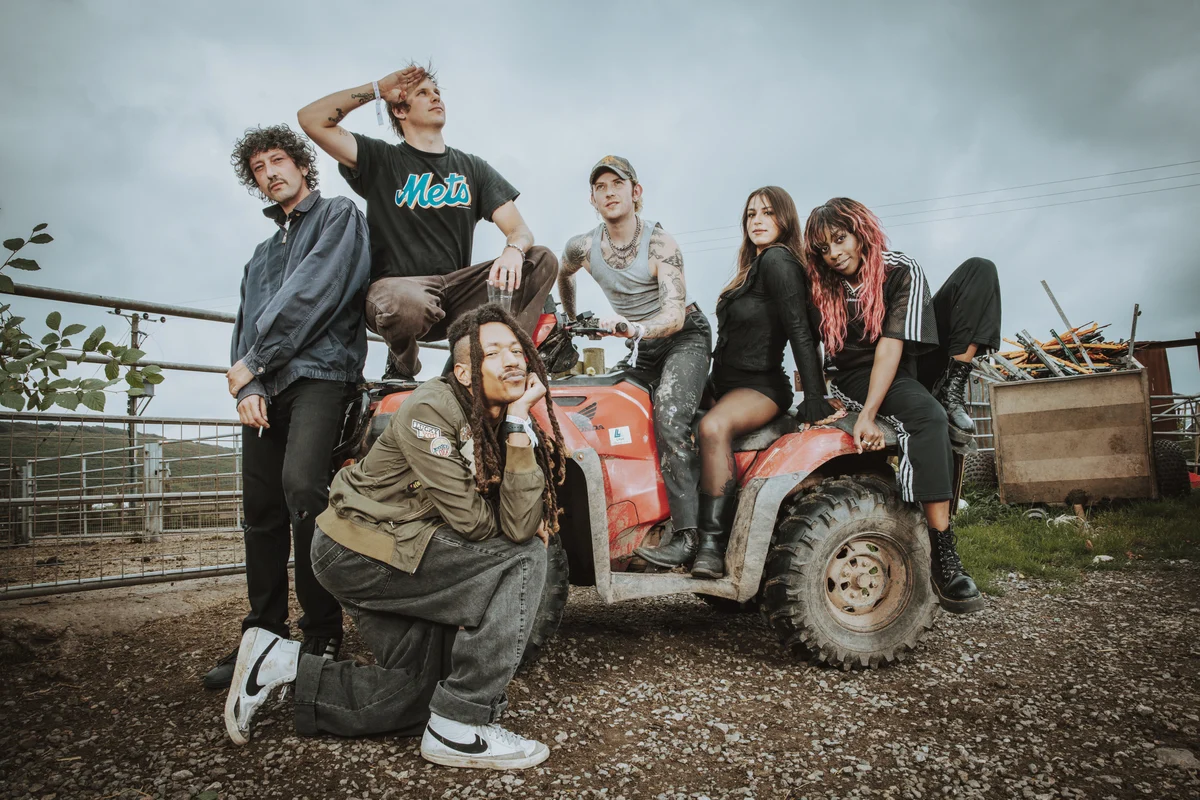

The pastoral facade of TVOD
As TVOD tackle the absurd reality of American life, vocalist Tyler Wright tells Jess Arcand about the Orwellian threads weaved into new record The Farm.
There’s a small piece of TVOD history sitting on the shelf above Tyler Wright’s head.
When asked about the Brooklyn band’s beginnings as his basement recording project, Wright points up towards an old four-track recorder, stands to retrieve it and brings the old TASCAM closer to the camera. “That’s like the very first one,” he says. He once had two, but sold the other for cash.
What began as Wright’s solitary recording project in 2019 changed shape through lockdown and New York’s sprawling DIY community. Eventually Jenna Mark (synths, vocals), Mem Pahl (drums, piano, percussion), Denim Casimir (guitar, vocals), Serge Zbrizher (guitar) and Mickaela Piccirillo (bass) became TVOD’s fixed lineup. “They’re my best friends,” Wright says. “We’ve been together for like five years.” Then, with a laugh: “We all hate each other equally and love each other at the same time.”
Seven years removed from that basement, Wright is still building infectious post-punk earworms. TVOD’s 2025 debut Party Time gathered songs written across years of the band’s existence, filtering the disillusionment of New York nightlife through the perspective of some of its most enthusiastic party animals. It was playful and tongue-in-cheek even at its most cynical, finding plenty to celebrate in the same scene it was busy skewering. Its follow-up, The Farm, was different. “This one was a lot more naturally planned out and thought of beforehand,” Wright explains. “I knew what I wanted it to be before we even started.” He thinks he may have even made the album artwork before they had fully finished the record.
That sense of intention is apparent from the moment The Farm opens. Rather than immediately throwing listeners into TVOD’s jagged, danceable punk, “Welcome to the Farm” leads us there on foot. Field recordings of the ground crunching, with sheep bleating in the distance. Two voices greet one another: “Hello Billy.” “Hello Sally.” A domestic question follows: “How was your day, love?” The answer is blunt: “It was bloody shite.” The real frenetic album opener, “Clorox”, detonates the pastoral illusion.

“Here comes Billy / And here comes Sally,” Wright sings as the record launches into the kind of disorienting, body-moving post-punk TVOD have made their own. Soon the nuclear family is colliding with voices in your head, obedience and a “power hungry president.” Whatever peace the farm promised lasts roughly a minute.
The setting was another element that came to TVOD rather unexpectedly. While touring France, TVOD found themselves consistently surrounded by farmland, Wright staring endlessly at hay bales from the van. “We were on so many fucking French farms and we were just like, ‘God, we love this so much’” he remembers. With two days off, the band rented one on the commune of Neufchâtel-en-Bray and began working through demos there.
“There’s such a parallel to this farm and that fucking Animal Farm book that I’d read as a kid,” he says. The band formed a short-lived book club and reread George Orwell’s allegory together. As a child, Wright remembers taking little more from it than pigs and other animals behaving like humans. Reading it again as an adult was different. “Holy shit, this whole thing is very political,” he remembers thinking. “We’re living through this time right now and it’s the Orwellian time zone.” The paranoia, however, isn't entirely new. On Party Time's “Super Spy,” Wright imagined a surveillance-state caricature unstuck from time, riding through Texas with JFK while declaring himself “the spy from 2064.” On The Farm, those flashes of espionage, authority and control begin to look less like absurdist scenery and more like the system that surrounds us.
The idyllic farm consequently mutates across the record into something unstable: refuge and prison, somewhere to escape to and somewhere to flee from. On “Rerun,” Wright is “stuck on the leash,” walking the same street before deciding it is time to go “away from the farm and into the city.” He doesn't particularly care who he becomes, provided he doesn't become a businessman. “Wet Brain” condenses dead-end employment, cheap substances, boredom and romantic wreckage into barely more than two minutes, as Wright repeats “Get a job / Go insane,” before arriving at the song’s surprisingly vulnerable centre: the desire simply to become “a real human being.”
The songs may be bleak, but they are also ridiculously catchy. That contradiction has always been fundamental to TVOD. Genre becomes less useful than physical description: guitars jut out at odd angles, synths swirl and hypnotise the mind with the psychedelic camp of a 60’s spy movie, while the bass and drums keep the whole thing barrelling forward. Even when Wright is singing about self-loathing, authoritarianism or drinking himself into oblivion, TVOD soundtracks the point in the night when a room stops behaving itself.
The album was recorded over two weeks at Nave Studios in Leeds with Adult DVD’s Danny Blackburn; after TVOD befriended the band while touring Europe. After repeatedly crossing paths with Adult DVD on the road, he and Blackburn started talking about recording. “I trusted him,” Wright says, before immediately undercutting the sincerity. “Maybe I shouldn’t have trusted him, but I trusted him. And it worked.” The band flew to Leeds and slept at the studio while making the record. It wasn’t their first creative exchange. In 2025, Adult DVD remixed “Party Time,” with rave-inspired squelching electronics that sound made for the arcade or a heated round of Street Fighter.
When asked what else inspired The Farm, Wright's answer is immediate: “All of Europe.” Then he considers home. “The United States as well, but not as much because…” He pauses. “I mean, a lot more, but in a negative way.” More than particular bands or records, he points towards the people TVOD encountered night after night. “Almost every night is like a new adventure with new people. Anyone that we’ve had the pleasure of hanging out with definitely inspired the shit too.”
Sometimes those encounters enter the album in much stranger ways. Arriving around the record’s halfway point, “Natalie Portman” sounds like the setup to an inside joke. Initially, I wondered if her presence was a nod to the rebellion of V for Vendetta. The real story is considerably stranger. While sharing an Airbnb with Atlanta band CDSM at SXSW, Wright was shown a play his friend Tyler had directed in high school. Its plot involved a mad scientist resurrecting Natalie Portman’s ghost. At one point, the character attempts to contact her telepathically. “Natalie. Natalie Portman. Can you hear me? Natalie Portman,” Wright reenacts, laughing.

Like this absurd reference to Natalie Portman, despite its lonely connotations, Wright’s humour keeps the album from collapsing under its own dread. There were, apparently, limits. “A lot of songs didn’t make it that were a little too funny,” he says. His bandmates intervened: “This is too corny, man. You can’t do this.”
Still, humour becomes another survival mechanism for the band. “Meetings” transforms romantic devastation into a feverish spiral of making your liver sick and driving a car into the river. Wright has described it as an attempt to numb a broken heart with whiskey and his older brother’s F-150. It is simultaneously pathetic, funny and genuinely sad – a recurring emotional cocktail across The Farm, and even at his most self-destructive, Wright rarely lets misery get in the way of a good hook. Its video also brought TVOD back to yet another French farm. With a day off between shows, the band decided to stay there and film it themselves. “It was really cute,” Wright remembers. “We got to pet the farm animals and there were a bunch of cows. There was one cow there that was a day old. It was wild. And the music video came out like a week after we filmed it.” They even got to name three newborn cows – “Billy, Brooklyn. And another B, I want to say like, Berry or something,” Wright shares enthusiastically.
The cover of The Farm is a particular highlight, as it’s a 12-by-12-inch diorama Wright constructed on his kitchen table. “I grew up with a kid that loved model trains,” he explains. “We used to just look at his train sets. And for some reason, when I listened to [the early demos of] The Farm for the first time, I was like, ‘This instantly conjures up a model train set for me.’” It also curdled into something considerably more sinister. “I wanted to kind of recreate a scene out of Animal Farm or something, where it’s this deranged hellscape of, like, animals killing people.”
In doing so, it evokes an accidental panoptic quality. A farm might promise privacy – a retreat from the city and the outside world – yet here, the maker and viewer hover above this miniature world, able to survey it all from a privileged position outside it. Everything is contained and everything can be observed. Wright hadn't consciously designed that perspective as another extension of the record's interest in control and power, but when the interpretation is put to him, he laughs at how neatly it fits. “It just happened to be like that."

Maybe that is the uncomfortable joke at the centre of The Farm. We can recognise the absurdity when it is miniaturised in front of us, but living inside it is harder. You cannot physically retreat somewhere idyllic because contemporary life follows you there through phones, social media and constant connectivity. “I think the whole world is going through the rot right now,” Wright says. What matters to him is paying attention to it, considering how you might change and “be a part of something good.” His ambitions in that regard are refreshingly small-scale. “Any part I can do to not be a part of that – to be a part of making someone’s day better – would be good.”
By the time The Farm reaches “Counting Sheep (Bed),” the frenzy has dissipated. The record's closing song is slower, softer and startlingly exposed. Wright wonders what it might feel like not to be trapped inside your own mind all the time. There may be no sense in this world, the song suggests, but perhaps that senselessness contains its own version of strange freedom. Its repeated final thought lands like a ton of bricks to the face: you make your own damn bed, and you still have to construct a life for yourself inside a world that makes absolutely no fucking sense.
Perhaps that is also why I kept coming back to the battered four-track Wright holds up at the beginning of our conversation. The Farm might stare out at a world of surveillance, authority, burnout and recurring catastrophe, but TVOD itself began with one person quietly making something in a basement. Six years later, they’re playing venues around the world. At the end of the day, the rot may be everywhere, but TVOD are still pushing forward, making something inside it.
Sign up to Best Fit's Substack for regular dispatches from the world of pop culture