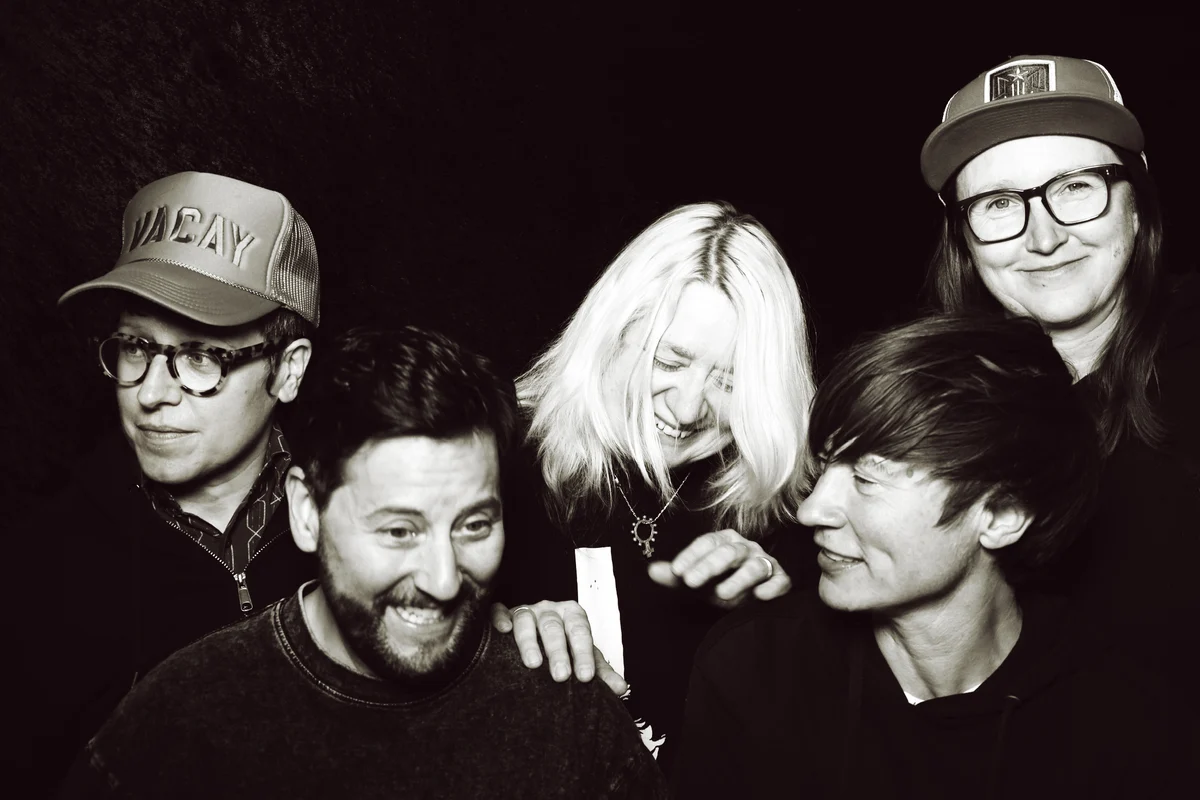

The Team Dresch encore we didn’t know we needed
Team Dresch were able to capture a slice of the ’90s underground queer zeitgeist simply by making music alongside zine culture – but where does that leave us today, caught between analogue IRL coolness and pressure to move with the times, writes Vida Hasson.
Team Dresch’s decision to write an album after 30 years erupted from spontaneous combustion.
“Jody [Bleyle] had a freakout and didn’t want to play the old songs anymore,” drummer Melissa York tells me. This moment, captured by bandmate Kaia Wilson (guitar/vocals) in a winsome comic, began the band’s quest to return to their creative output of the 1990s. Furthermore relinquishes Team Dresch’s storied past in favour of creating the present.
But first, some quick history: Queercore – the social movement-come-genre à la riot grrrl – sprouted in earnest from a series of chain reactions. Rooted in Toronto’s queer/punk/anarchist/art scene, the nominal “homocore” came from GB Jones and Bruce LaBruce’s zine JD’s. That then evolved into the titular Homocore, Tom Jennings’ gay/punk zine from San Francisco. When the zine morphed into a scene, the name took on the more inclusive “queercore” label, which is where we find Team Dresch.
Of course, queercore existed in spirit before the name. Posterity loves its labels, but all that stuff is history, over and done, until you make something new, as Jody Bleyle (guitar/bass) tells me. “We started Team Dresch because we wanted to play music with people we wanted to be in a community with. You miss out on [community] if you’re not making new music, talking to people about it, and meeting new bands to play with.”
Team Dresch continued to tour and perform together between their previous album, Captain My Captain, released in 1996, and Furthermore, their new one. Back then they had more time and practised five days a week. The band was shocked this time around at how difficult it can be to conjure the creative spirit. “You’re jumping from your other life to this life,” York explains. “It’s not as smooth as it was before. The magic isn’t right at the finger tips.” York estimated that the magic, on average, is at about T minus two days.
A lot has changed in music technology since 1996. Much of the album’s early stages began on Zoom. York is exuberant about the possibilities these new technologies offered: “The process we did to write this album was very unique. I live on the East Coast. The whole band is on the West Coast. I worked on things virtually with [Wilson]. For me, I created things that were different because I wasn’t in a room with everyone. The whole process is what I’m jazzed about. It was fresh.” York, who splits drumming duties with Marcéo Martinez, spent a lot of time on Zoom with Wilson trying to clap in rhythm against the tides of Zoom. Polyrhythms and frustrated laughter emerged victorious.

The album cover functions as the meeting point between the 1990s and wherever we are today. Taken backstage at a now defunct music venue, the cover pictures York warming up for a gig. “I love watching her warm up,” Wilson gushes. “She’s just air hitting and doing her kick drum. I love playing the game of guessing what song she’s playing. It wasn’t hard until now because we only had so many songs. I took a picture of her because I liked the framing of the mirror and all the colours.”
In the image, framed by bold capital letters, I see Wilson crouched on what could be anything – from toilet to couch – behind York in her headphones looking down at her phantom drum kit. On the counter in front of them lies a pile of clothes, what I imagine is an emotional support water bottle, and a neat juxtaposition between past and present: York’s metronome and an iPhone. The cover symbolises “our version of photo-copying, messy zine stuff from back in the day,” York says.
Simply by creating their music, Team Dresch were able to capture a slice of the underground queer zeitgeist of the 1990s. Zines and independent record labels epitomised those days, as did Team Dresch – but where does that leave us today? It’s mostly young hipsters who want a return to the inaccessibly cool analogue IRL days. The old farts either never left or evolved with the times. Bands like Bikini Kill and Bratmobile could take a page out of Team Dresch’s book and tell us where they are today, or just keep singing “Suck My Left One” – honestly, either way is fine. More music isn’t always better music. Nevertheless, as all three bands know, staying true to your muse always brings the house down.
Team Dresch are still motivated by the same fire as 30 years ago: the fire’s just “a little older. A little bit more experienced with tragedy, trauma, the rollercoaster of life. We might just be a little bit more tired.”
The new music retains their pop-punk/emo sound with an aged and wiser voice. Most of the album captures the growing (older) pains without the over-the-top queerness that was their signature. “Back in the day, we constantly wanted to make every signifier: We’re queer! We’re queer! Because we were desperately trying to reach people,” Bleyle says. “We wanted to be explicit. We didn’t do that on this record. We were like, let’s call this ‘One Song’. Everyone knows we’re queer. Who knows, if it had been 1994 we might have called it ‘Super-Deluxe Gay Fuck You Come Hang Out With Us’.” (The song “Fagetarian and Dyke” from their 1994 album Personal Best comes to mind.)
If you hear the name Melissa York as you read it, your brain might be playing Le Tigre’s feminist anthem “Hot Topic”, where her name is sandwiched between David Wojnarowicz and Nina Simone. After Team Dresch’s first stint together, York and Wilson went on to form The Butchies, another iconic queercore band mentioned in the song. “There are legends walking among us people!” Bleyle tells me of Uncle Phranc, aka Susan Gottlieb, pioneering queer artist and leader of foundational punk band Nervous Gender. Team Dresch is no exception. Donna Dresch (bass/guitar), whom Bleyle calls the band’s “arbiter of taste,” has inspired innumerable artists and bands. But what good is a reputation if all you do is sit on it?
Towards the end of our conversation, York reflects on Furthermore: “I’m just darned proud of this thing. I am so proud of us that we are still going. Growing up and seeing how hard that is and that we are fortunate enough to keep going. It’s really cool. Back in the day and now, people will say, ‘You saved my life.’ I can cry about that now.”
Team Dresch trusted their butts and gave us an encore we didn’t know we could have. As Wilson puts it so succinctly, “We still got it!”
Sign up to Best Fit's Substack for regular dispatches from the world of pop culture