
On the Rise
Solana
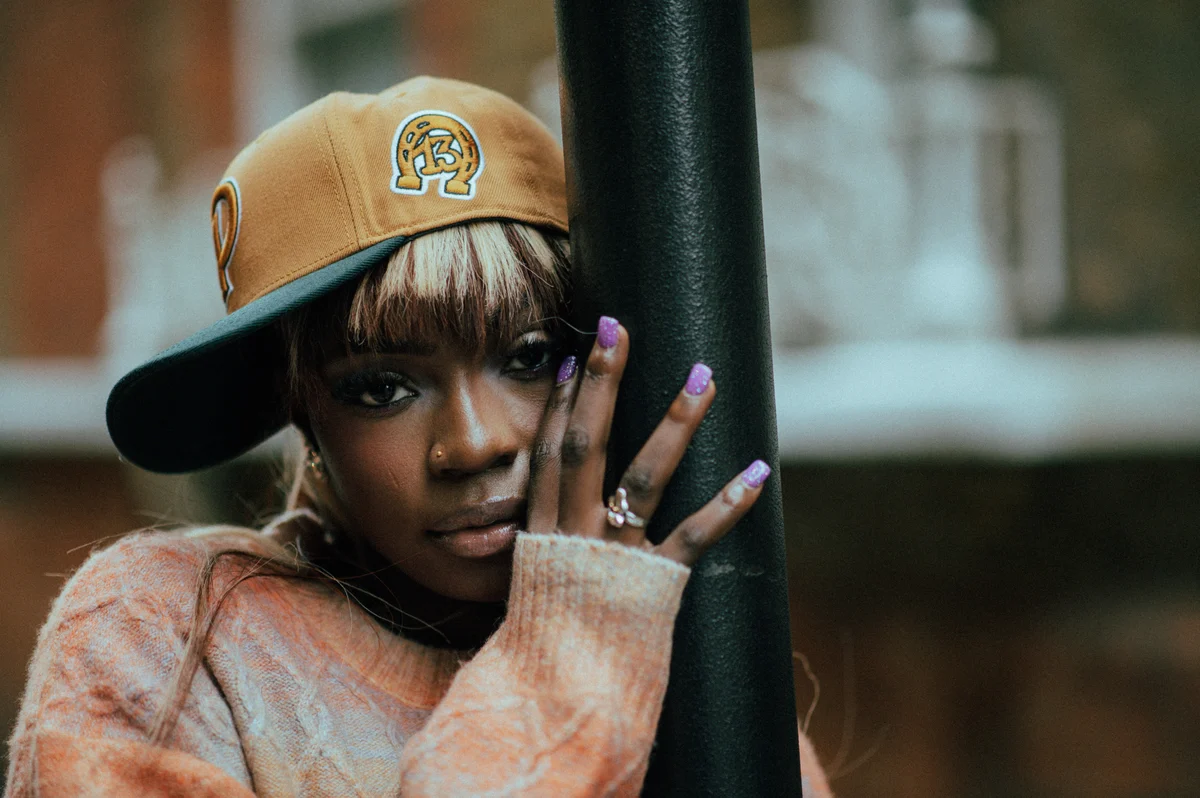
Drawing on percussive local traditions, Yoruba lyrics and the shine of global pop, Solana has found her groove with a sound that travels well and needs zero translation, writes Kayla Sandiford.
Ogunlana Oluwabusolami Habibat has never waited to be called forward to speak her mind.
As a child at school in her home of Lagos, Nigeria, she would walk to the front of the class unprompted and ask everyone to listen to what she'd written. That early confidence never faltered, as the Yoruba singer-songwriter better known as Solana is sharing her music the same way — in her own language and on her own terms.
"Even before I went to the studio, I was always the one in school that would just go to the front of the class," Solana tells me. "I was like like, 'you guys should listen to this. Listen to what I wrote." She beams with a reliable self-assurance, noting that even as a child, nerves never came into the picture when it came to exposing the more creative facets of her world. “I don't think I've ever been nervous. And I think my music has always done what I wanted it to do, in terms of connecting with people. They always feel it. They get it.”
The nature of the city that raised Solana seems to explain her unwavering confidence, as well as her desire to make music that connects with people without abandoning her culture. "Lagos is a fast-paced environment. It's fun," she says, and the sound of it was around her from the start. She was surrounded by Fuji music, a percussion-driven Yoruba genre that came out of Lagos in the 1960s and 1970s and has been a fixture of the city's parties and radio ever since. The music combines call-and-response vocal sections and references Islamic poetry and philosophy, backed by traditional acoustic and percussive instrumentation. Years on, the genre persists, disseminated through contemporary styles such as Nigerian Afrobeats and hip-hop.
"If you grow up where I'm from, in Lagos, Nigeria, we listen to a lot of fuji, and I think that was one of my first intros into music," Solana recalls. "And then after that, I was just watching TV, watching music channels." While Solana notes being drawn to pop and R&B music at this time, she doesn’t commit to a lane. "I literally listen to all kinds of music. If it's something that grabs my attention, I just go for it.”
Musical impulse has followed Solana from a young age. She wrote her first song at six years old, and the ink just kept flowing. She filled notebooks throughout her childhood, utilising music as a way of just getting through the day. And those books are still where everything starts.
"Music has always been a form of therapy for me, like my safe space," she says. "I think it just came naturally, because music was me expressing myself. If I have something I want to say, I write. If there's something I want to express, I write. It's like a second language, a means of communication for me and for other people. If I'm feeling a certain type of way, I write about it."

Using music as a form of early expression served as a necessary reaction to solitude in her youth, as well as learning how to process confronting emotions and experiences. Having lost both of her parents at a young age, Solana was faced with both loss and isolation. "I was just that child that was always by myself,” she remembers, "it was just me, my sister and God". However, she persisted when it came to seeking out the good in any situation, instilling a positive outlook that would inform her developing perspective of the world.
And as the songs kept coming, Solana eventually decided that it was time to give them a place to go. She recorded her first song in 2016, as she recalls: “It was really beautiful, because I've always been writing. When I went to the studio and made my first song, I was super excited, and then people were like, 'oh, this is really cool! You should come next time!' And it's just been going since then."
“Now I can share my music with other people, not just myself,” she continues. “Other people can listen. I can see how they feel and if they get it.”
The next stop for Solana was Mr Eazi's emPawa30 initiative, the artist-development programme responsible for placing a lot of emerging African talent in front of an audience. It's where she met Killertunes, the producer she has worked with since 2019 and now counts as her closest collaborator. "We kind of get each other's sound," she says. “It was super easy. It was fun, just experimenting, trying out different things. Literally like drinking water.”
Her first official release, 2020's "Far Away", came out of that circle, with Nigerian singer-songwriter Joeboy on the track. "I had just joined emPawa30 by Mr Eazi, and I started working with Killertunes then," she recalls. "We made the song, and Killertunes sent it to Eazi, and he sent it to Joeboy, and that was how that came about. It was really, really beautiful." Working with other people, she says, changes what a song can become. “When you collaborate with people, you bring different things into the project, and it's just always beautiful. A new, different dimension.”
“Far Away”, rooted circular Afrobeat rhythms, saw Solana and Joeboy primarily trade off English verses to chronicle a love lost. But her breakthrough came from a song that she nearly kept in the vault. "Okunkun" was written in Yoruba in 2023. The title means “darkness”, a representation of one half of the light-and-dark tension that courses through her writing. A dark synth pulse ripples underneath Solana’s seamlessly fluid delivery on “Okunkun”, a dynamic follow-up to “Far Away”. Yet, For three years it stayed in the folder, because the people that Solana she played it to weren't convinced it would work.
"We sent it to people and they were like, ‘Good song, but I don't think it's commercial.’ It's not what people are listening to in Nigeria,'" she says. "So we just kept it in the folder." There was a pressure that fuelled this decision, Solana notes, one to make music "for everybody" when "not everybody understands what you're saying".
But by the time she released the song back in June, she'd stopped listening to the doubts. It wasn’t her responsibility to make music “for everybody”, but instead to honour what she needed to say — even if that meant being misunderstood. "When I finally put it out, I don't think I was under any pressure, because I was in that space of, I'm just going to do me and put out what I like," she says. “I'm glad we got through that phase.”

To Solana’s surprise, after releasing the song with no promotional budget, the reception was immense. Suddenly, the shelved single received shares from SZA and Tyla, it soundtracked more than 12,000 TikToks and it passed a million streams. By this point, Solana realised that her words do have reach — namely at their most authentic. "The song started taking off after the second or third video I saw on Instagram, and I was like, 'Yeah, that means we're not crazy’,” she laughs.
Yoruba is a tonal language, and the pitch of a word shifts its meaning. When a song is sung in Yoruba, it asks the melody to do some of the talking. That's part of what Solana is working with in the sound that she calls Yoru-Pop.
"It’s me bringing my culture, putting my culture into my music, because my music is literally me, and my culture is a huge part of me," she explains. When I ask what parts of Solana’s culture she appreciates the most, and what she focuses on showing through the music, she shares with an open sense of appreciation: “My language is really beautiful. The fashion, our dress sense is really beautiful. I think I just took bits from everywhere and put it into my music.”
Among those points of inspiration is Nigerian singer and rapper Asake, who has brought fuji’s rhythms into mainstream pop, and King Sunny Adé, singer, songwriter, multi-instrumentalist, and the pioneer of the Yoruban genre jùjú pioneer, a style of music influenced by what is coined as palm wine guitar music and dance drumming. Solana also takes influence from popular Western music, including Rihanna and Doechii — who, in a full circle moment, sang “Okunkun” on her Instagram live.
The momentum doesn’t stop at “Okunkun” for Solana. It contributes to a larger body of work, her debut EP, Girl From The West, a collection of songs which serve as a definitive introduction to Solana’s Yoru-Pop sound.
"I think this is a perfect time for it, because people are more interested in coming into my world and seeing what Solana is about, and I'm excited to bring them in," she says. "You get to experience life from the lens of a girl from the West." When I ask her to describe that world, she reveals just enough for intrigue, but leaves space for the songs to tell her story: “A girl growing up in the western part of Nigeria, and how she has experienced life, how she has seen things, stories she has to tell. It’s a whole lot of fun stuff.”

Under the fun, however, is a message that Solana keeps coming back to. "As humans we go through a lot. Things will always come our way where we're like, 'I think this is the end,' but then it's actually not the end. I'm also talking to myself. I've been through quite a number of things, so I always have that mentality that there's always light at the end. So, don't give up. Go towards the light and live your life. You're meant to live life." Solana’s faith is a key motivator to her ability to hold this mentality up. “I believe in God, so I believe in light as well. Once I know there's light, I know that it's always going to get better. I keep trying, and I keep trying, and I keep trying, and it always works out.”
The EP's second single following “Okunkun”, "O Rimi", takes its name from the Yoruba for "you see me". It’s one of the more vulnerable depictions of Solana on the EP. revealing the intimacy that comes with growing closer to the person that you’re in love with, and truly being seen.
"It's basically about love," she explains, "like how this person sees you, loves you so much. Like, 'oh, I'm in love again, are we really doing this again?' It's just a beautiful love song that I feel so many people can relate to." Including it as an early single was deliberate, as she didn’t want the softer side of her to get buried. “I didn't want it to be drowned in the project. It just felt right to put that out.”
Elsewhere, "Don't Want" comes at love from the other direction, showcasing the dichotomy that Solana holds. "It's a song about how I'm putting myself first, and I'm not going to just take whatever love you bring," she says. "I'm not doing the bare minimum. If you're not giving me the love I deserve, then please, you can go."
"I've always been that person that knows how to pull myself out of things,” she continues. “If I think about it in my brain and it's not aligning, I'm like, ‘Okay,, bye.'" She also wrote it with other listeners in mind, a prompt for anyone lost in accepting less than they deserve to return to themselves. “I know there are so many people that can relate to this, and it would help them as well.”

Despite always seeking out the light in the dark, Solana makes a point to note that the process isn’t always perfect. She’s simply leading with what brings her joy in the moment. “You don't have to get it 100% for you to show up. You don't have to be so, so, so perfect. If it makes you happy, do it. Just show up for yourself, and what will come to you will come to you. That's how I've always lived my life."
And in going with the flow, she hasn't mapped out what she'll write next. With ample material stuffed in years worth of songbooks, she’s unfazed by the proposition of what the future holds. "Whatever comes, I put down. Whatever comes, I give," she muses. "That's how I've always lived my life." Similarly, she has no expectations on how her introduction is received with Girl From The West. She’s simply ready to open up her world, and allowing listeners to take it as it comes.
“I want them to interpret it how it resonates with them. I'm just bringing them into my world. This is Solana. There's so much that comes with Solana, and so much that Solana wants to put out into the world. Just take what you can take.”
Years later, Solana is still marching to the front with an indelible steadfastness. But now, she isn’t standing at the head of the classroom. She’s preparing to command stages, reaching tens of thousands of people across her online presence, and her message is at its most defined yet. Making music, for Solana, is an uncompromising life line, one that she’s always been ready to offer out.
“Music is my safe space,” she asserts. “I feel alive when I'm in music, and I want to share that with everybody.”
With Girl From The West being her first full offering, Solana talks about it the way you'd talk about family. "Music is like my baby," she notes. "It's like saying, have you seen my beautiful child?"
Sign up to Best Fit's Substack for regular dispatches from the world of pop culture