
The small mysteries behind Grumpy’s big gestures
As Heaven Schmitt reveals the tangle of romantic connections surrounding his New York-based indie rock group, Madelyn Dawson suggests that Grumpy could only write about love by cutting the syrupy and sentimental with cynicisms and specifics.
I have a lucid memory: A few years ago, talking to a friend about the Beatles, he said, “They started with silence. And they made ‘Strawberry Fields Forever’.”
I couldn’t argue; it was a momentous feat to begin in a room, bereft of all noise, with guitars and drums (and a cello and an Indian swarmandal and a Mellotron), and emerge, somehow, with “Strawberry Fields Forever”.
I understand this is an oversimplification. Enthusiasts not unlike myself have written, at length, about the complications in this equation – about how the track’s final version combined the band’s 7th and 26th takes, even though their keys and tempos did not match up. About the fake-out and the coda and even the “Paul is Dead” nonsense. I understand all of that, but still I know an undeniable truth: first, there was nothing – and then The Beatles came along and did something – and then there was “Strawberry Fields Forever”.
When I speak to Heaven Schmitt, the songwriter and bandleader of Grumpy, he describes a similar train of thought. I’d ask him about the song “Crooked Teeth” from Death Cab for Cutie’s 2005 confessional indie rock masterpiece, Plans, a song he had previously said was the one that got him to start making music. “I always think about that as the first moment I was ever like, Whoa, someone had to come up with this for me to be hearing this song. Somebody wrote this,” he tells me. “I never really thought about the person behind the music.” In other words: first there was silence. Then Ben Gibbard and Chris Walla came along, all quick chords and “You’re so cute when you’re slurring your speech.” Then there was “Crooked Teeth”. Now there is Grumpy.
Led by Schmitt, Grumpy has been making music since Schmitt’s 2020 solo project Loser. If Schmitt’s voice sounds familiar, it could be because he sang harmonies on Zach Bryan’s 2025 country behemoth “With Heaven On Top” (note what you will about the title; all I will say is that Schmitt sings the high line). When I spoke with Schmitt, he was in his apartment in Bushwick, about to leave the next day to play a show in Arizona, and off the following day to Iceland, where he’d be recording music with some friends. Behind him, I could see his radiator; sitting on top was what looked like a figurine of a well-dressed guy in a funky hat. Schmitt, too, was wearing a funky hat. On the front of his T-shirt was the word “victim” written in black block letters, with a big red circle around it, and a line through it – like on a no-left-turn or no-smoking sign. “This shirt I got on tour,” he said. “I would give anything to know who made this.”
Schmitt has been living in New York for four years now, but he’s originally from Charlotte, North Carolina. “It’s a big transplant city,” he says. “But I come from southern people. I was a 7th-generation Charlottean when I lived there.” He made it to New York by way of Nashville, where he studied songwriting at Belmont University.
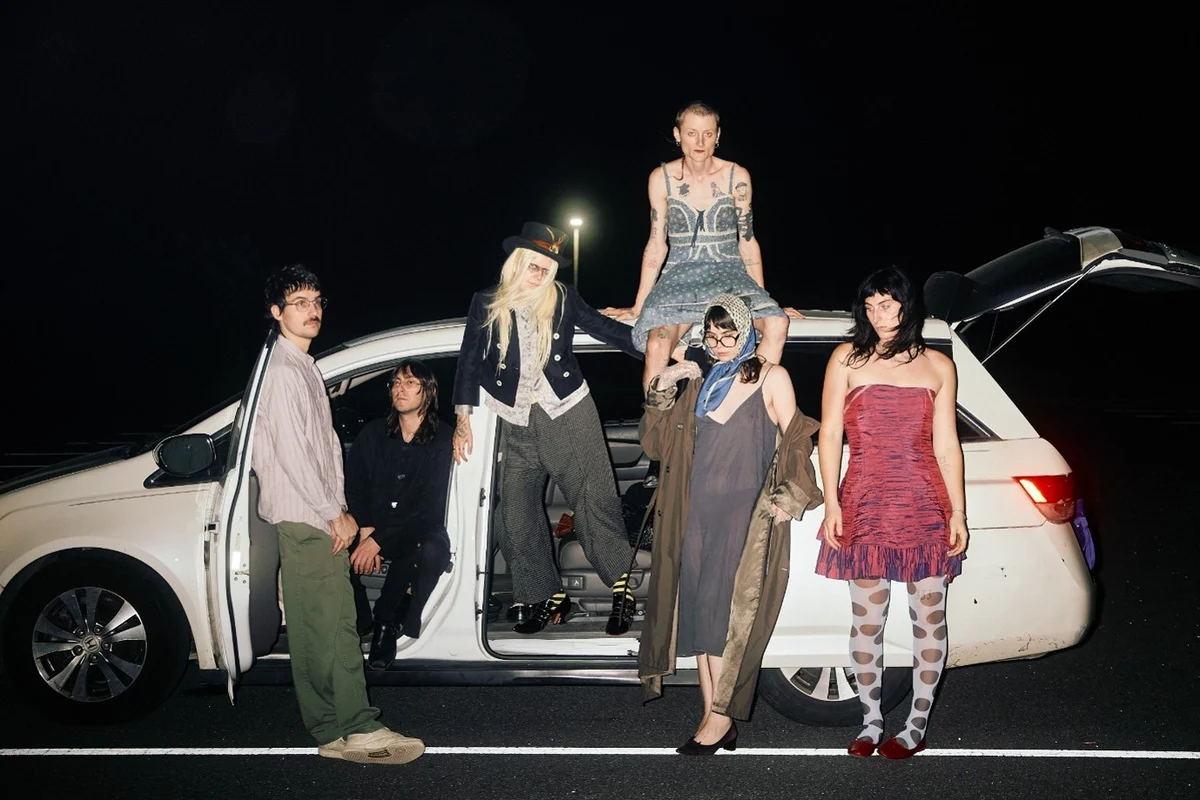
He’s always been the guiding force of Grumpy, which began as his solo project, and now performs as a six-piece outfit – five of the six members are trans – blending the hooky melodies of indietronica and alternative rock with the folk sounds Schmitt grew up admiring. Schmitt’s girlfriend, Ellie Long, plays bass for Grumpy, which – barring the horror stories about the Moores and the Gordons and the Buckinghams and the Nickses of the world – wouldn’t raise any eyebrows, especially for a band of Brooklyn experimentalists. But Grumpy’s drummer (and, in Schmitt’s words, their “resident normal guy”), Austin Arnold, is Schmitt’s ex-husband.
What’s more: Their synth player, producer, and art director, Anya Good, is Schmitt’s ex-girlfriend. Lane Rogers, their keyboardist, is also Schmitt’s ex-girlfriend. (Do you see a pattern emerging?) The only member of Grumpy that Schmitt has never dated is guitarist Diego Clare. “We spend so much time together,” Schmitt says. “And we’re all, you know… it’s cliché, but it really makes you a family.” He follows up quickly: “Especially the fact that I’ve, like, dated pretty much everybody.”

“I always say to Ellie: girl, if you ever break up with me, that's going to be the most devastating album,” Schmitt tells me. I laugh, but I don’t doubt for one second that he knows how it feels to write through an unfathomable pain, to sing songs of heartbreak alongside the person who broke his heart. After all, Grumpy has made music together through, among other things, divorce. The even more difficult thing has been to make music that feels momentous in the face of unexpected joy. On “yr bitch”, a quirky, electronica-influenced track, Schmitt sings, “I keep trying to turn you into art. But you’re too good to me, and it’s so simple.” Who among us hasn’t had the cathartic ecstasy of metabolising our bad relationships, our mishaps and misgivings, into that gauzy shape called narrative?
The seeming simplicity of the good things in life has posed a new challenge for Schmitt, for whom it has always been easier to write about pain than happiness. “It’s really hard for me to figure out something to say that feels original about love,” he says. “I’m currently confronting, like, how do I make compelling art about the mundane. But I think there’s a lot of juicy stuff there.”
There’s a tendency for a poetics-of-the-mundane to lapse into bathos – for an artist to doubt that the realities of their everyday are important enough material for their art. The impulse to stay down to earth; the simultaneous impulse to treat earth as if it is some sort of heaven. To, in one breath, be having a Coke with you, and to, in the next, pretend as if that Coke is something more than a Coke, and that they are something more than just another person, sharing it. In Grumpy’s case, resisting that impulse to venerate the mundane has yielded some of their strangest, and most exciting work. “When I see somebody texting in a movie, I’m like, eugh.” Schmitt shudders – and I agree. And yet the characters that populate Unfindable Ring aren’t looking at photographs; they’re taking pics. They don’t say, “I don’t like that”; they say “I don’t claim this energy.” They zoom in on each other’s posts. They text. They are, as Schmitt sings plainly on “OBL”, “eating normal foods at regular prices.”
“An early mentor in my songwriting life taught me a couple pillars of songwriting that he swears by,” Schmitt tells me, “And one of them was writing how you speak. I think it can be kind of jarring to say something in a song, exactly how you would speak it.”
Grand gestures seem more legible than plain speech as measures of care. Schmitt describes himself as a “big grand gestures guy,” with a pattern of “wanting to be so amazing for someone and really needing to sweep someone off their feet.” His girlfriend, though, didn’t know how to accept such displays of adoration. As such, the idea of the unfindable ring was born. “Like, ‘There’s no ring I could give you to make me worthy of unconditional love’,” Schmitt explains. On Unfindable Ring’s opening and title track, a cinematic introduction that layers increasingly frenetic electronic whining over a simple, five-note guitar theme, Schmitt sings about a “grand gesture that didn’t have the intended effect.”
“That song, lyrically and sonically, felt like such an overture for the whole album,” Schmitt says. It’s a slow-burn of a song, one in which minor variations on the major theme offer shades of meaning beyond the words themselves. When Grumpy recorded the album, the six of them sat together, in a tiny, stinky practice room on the border of Bushwick and Ridgewood. “It’s not a bad place to be,” Schmitt says about their ersatz studio. “Like, it has a weird smell. And there’s nowhere comfortable to sit. But we made an awesome album together there.”

The band would be recording and producing their tracks at the same time, sometimes not even being able to hear what the other members were working on. Sometimes Long would be tracking bass in one corner of the room, while Good would be on headphones, on a separate computer, adding textural layers and abstract electronic elements to a song. As the title track progresses, Good’s textures find their way to the forefront: a mechanical whirr, a crunching, a crushing, a springing, a gong: banging, heralding Grumpy’s arrival.
“There's the warmth of remembering Halloween as a kid. It’s like the warm flash photography from the early 2000s and late 90s,” Schmitt says, about the record’s aesthetic palette. “There’s such a saturation and warmth.” If the last Grumpy EP was inspired by R.L. Stein’s Goosebumps, kid-horror, and things that go bump in the night, Unfindable Ring is all “kid-mystery,” Schmitt says.
And in its unfolding, rather than in grand gestures, theatrical displays, or seismic shifts, Unfindable Ring finds meaning in its small movements and in its subtle, slant intimacies. Listening to a song like “25”, it’s nearly impossible to imagine Schmitt having trouble finding something interesting to say about love. The track – shoegaze-inflected and one of the record’s hardest-rocking – was inspired by a conversation Schmitt had with Long. “We were just talking about time travel,” Schmitt said. “About being trans and transitioning at different phases in life, and she said she wished she could go back in time and transition as a kid.” Schmitt characterised his initial reaction as somewhat selfish: his first thought was that if she had transitioned as a child, perhaps they would never have met. “That’s the only concept of the song,” he says. “Just saying like, ‘Alright. If somehow you get this chance to go back in time, make sure you can leave a clue’.” And so tenderly Schmitt sings, as if we’re all in on the joke, “When you travel back, leave a clue so that / You can still find me when you get to 2025.”
I had a writing teacher once who, like all writers, teachers, and writing teachers, wasn’t particularly fond of sentimentality. She, like the rest of us, wanted pure sentiment. She had an easy solution: pickles. She was from the Northeast; she boiled her own maple syrup from the sap of the trees around her. A Massachusetts delicacy was sugar on snow: maple syrup frozen across the top of that winter’s frost, turned into a chewy candy. It was served with pickles, to cut the syrupy sweetness. Thus, for any bit of writing that could seem too saccharine, syrupy, or sentimental, a writer needed their fair share of pickles – ironies, cynicisms, jokes, specific details – to cut the sweetness.

Grumpy has no shortage of pickles. They come in the form of the crunchy, blown-out riff and vocoder-modulated singing that opens “yr bitch”, and in the first couplet of synth ballad “Cool Ranch”: “I wanna get Punk’d and split my pants / I wanna get dunked in homestyle ranch.” You can bite into the choral triplets populating “Solicitor’s Rights”, the absurdist collage of “The Whale”, or the glitchy vocal-as-synth on interlude “WTF”, intoning “What the fuck was that / I don’t claim this energy.”
Or, you can take the single “OBL”, a folksy, alt-country number – with a session fiddle player – that arranges itself around a repeated chorus of “We’re so happy we could die.” You can hear a whisper of Karly Hartzman in the flip in Schmitt’s vocals (his response: “I, too, am from the Carolinas”), but his humour is all his own when he sings, “She pulls a sword out of my throat and fifteen dollars from my ass.” Yet here, as throughout the rest of the record, it’s the attention to detail, the slight inversion in the syntax that carries the song’s weight. He moves from “We’re so happy I could die” to “They’re so happy we could die,” and back again, the second time with a renewed strength.
In the space between, Grumpy stages subjection. They sing about touring, as a trans band, and the discriminations and aggressions they face. There’s a morbidity to the pronoun shift that demands your attention: in this climate, at this hour, under this administration, when rights that should be incontrovertible are under attack. But they don’t let it temper their joy, however ill-timed. It’s something of a cliché to call joy an act of resistance, but it still smacks of revolution. They’ve got the whole world in their purview, but when they’re together, there may as well be no one else in it.
Speaking of revolution, Schmitt is a huge Joni Mitchell fan. Her name comes up time and again: when we discuss influences, when I ask him his favourite of her albums (he’s not a big albums guy, but we both agree “Help Me” is one of her best tracks). “Comedy and melody are the things I value most in music,” he tells me. “There's this Joni Mitchell lyric: ‘laughing and crying, you know it's the same release’.” He’s talking about the track “People’s Parties” from Mitchell’s 1974 Court and Spark.
There’s another lyric from “People’s Parties” that I was made to think of while talking to Schmitt. Towards the end of the song, Joni sings, “I wish I had more sense of humour, keeping the sadness at bay.” For Schmitt, humour isn’t so much a means of keeping the sadness at bay, but his way of proving – to himself and to those around him – that pain, while present most of the time, isn’t all there is. “Being a songwriter, an artist of some kind, can really demystify the scariness of pain,” Schmitt says.
For instance, the understated, plodding “George Clanton” showcases perhaps Grumpy’s most masterful command of build and release – and is maybe the most wickedly funny. The chorus repeats a psychedelic Beatles-esque chant of “Nothing’s gonna get in my way.” In the verses, Schmitt rhymes convertible with uncomfortable, as in “My friends pull up in a convertible / My outfit is uncomfortable.” The dreamy indie rock number is an homage to the group’s augmenting fame – and in classic indie rock humility, Schmitt sings, “My biggest fan is my uncle Peyton / But it’s not so sad / he’s got great taste in musical acts and artists / just ask ‘em.” (Supper’s on him, I guess, their record just went aluminium!) “I wanna rock like George Clanton,” he sings. “I’ll swing my cock like George Clanton,” calling out to the vapourwave pioneer, but also affirming their vision of fame as a necessarily trans one – and a damn swagged out one, at that.
Tenderness, too, trickles in at unexpected moments, through sidewinding wisecracks and slant discoveries. Unfindable Ring’s closer, the stripped-back acoustic and keyboard ballad “Queens”, delivers the line, “’Cause you’re insane and I’m a pervert,” and by god, I don’t think I’ve heard anything more romantic. Schmitt sings, now without the textural layers of production, without the vocoder modulations or mechanised synth lines. Simply, his voice soars over, “Everybody thinks we’re in love / But we’re only practicing kissing.” The record refuses to go out with a grand gesture, instead leaving us with an ironclad image of love’s labour, without the stakes undergirding a quest for perfection.
Sign up to Best Fit's Substack for regular dispatches from the world of pop culture