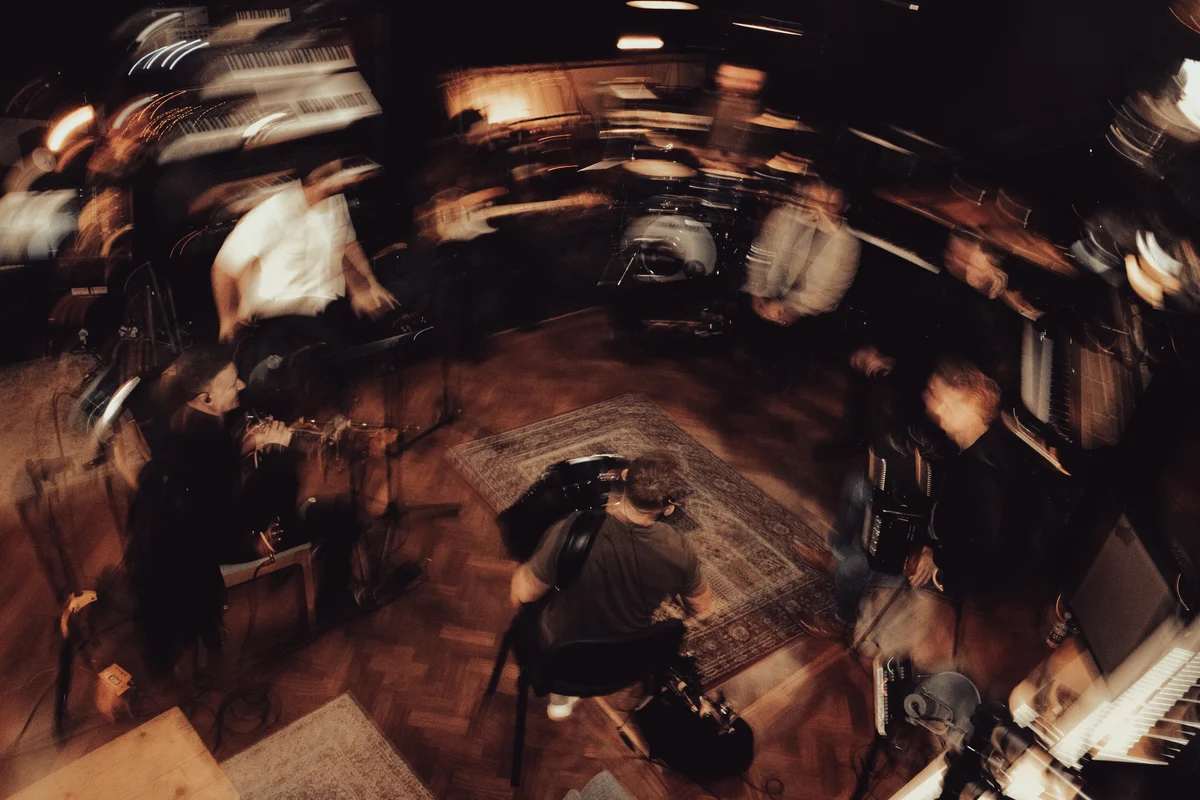
How Skerryvore turned a student side hustle into ten albums
Alec Dalglish, the frontman of Celtic rock re-inventors Skerryvore, tells Steven Loftin why pipes and fiddles make sense to strangers far from Scotland, and carrying ona tradition has never meant guarding it.
Skerryvore may be a lighthouse off the coast of the Isle of Tiree, protecting passing vessels from the rocky shore. But its namesake band was born from a collision between two very different Scottish musical upbringings.
The eight-piece ensemble is the unlikely result of two pairs of teenagers from very different Scottish backgrounds finding each other. What began with four teenagers would gradually expand into an eight-piece band, but the story starts with vocalist and guitarist Alec Dalglish.
As a young teen raised in West Lothian, Dalglish was from a relatively ordinary family. While his dad had a guitar he would strum upon, alongside the occasional singing moment, for the most part it was a standard 80s Scottish upbringing. But Dalglish was different. Traditional music wasn't an absence from his life, exactly, but it wasn't its defining soundtrack either.
"I remember being in primary school and being the only boy who was in the choir at school," he laughs, now in his early forties. “I just remember the joy that you could get from singing. I just loved it.”
As he entered his teens, that's when guitar came into his life. From here on, Dalglish knew he wanted music to be the future, and given he was known as the music kid at school, it was preordained: "That's all I really put my time and effort into. With the guitar and singing, I was like, I'd love to do this as a job."
At 17, through playing music at school, he met drummer Fraser West. It would be a chance holiday with the West family up to the Isle of Tiree that the idea of being a band began to tentatively emerge. It's here they would meet the Gillespie brothers.
Daniel and Martin Gillespie are the key ingredients to Skerryvore. They grew up on the remote island of Tiree, a close-knit community of only a few hundred people where Scottish traditions remained deeply embedded in everyday life. This included the pair growing up learning accordion and bagpipes, respectively.
Dalglish recalls meeting the brothers as an eye-opening experience. For Dalglish, traditional music was something he encountered through the radio, specifically BBC Radio Scotland's weekly Take The Floor show. For the Gillespies, it was something they lived.
Neither pair knew it yet, but the meeting had brought together two musical worlds that would eventually become Skerryvore.

Dalglish had always entertained the idea of being in a band, but he hadn't imagined it would happen this way. "I especially didn't think it would be via the route of being in a traditional Scottish music band that we somehow subverted into what we are now," he explains. If it were to happen at all, he presumed it would be playing blues or rock music, the standards he was raised on, like Eric Clapton and the Beach Boys. “But then Skerryvore happened and figured it out for me, and we all sort of rolled with it.”
The magic lay in how four lads from different parts of Scotland found common ground, bringing two very different musical worlds together without knowing exactly what the result would be.
When it came to bringing both backgrounds together, they began with Dalglish adapting to the brothers' traditional offerings. "We weren't really trying to be anything in particular," he explains. “I didn't really know what people were doing on the guitar with that because I'd never heard it before, so I'd just do whatever I think works. It didn't feel like there could really be any wrong answer.”
The four first played together in the early 2000s, when Dalglish's headteacher needed traditional Scottish musicians for an event. One phone call later, the foundations of Skerryvore were in place.
Eventually, all four moved to Glasgow, a decision Dalglish sees as pivotal in turning Skerryvore from a casual project into something more lasting. Tiree, he recognised, offered limited opportunities for the band to grow.
"It wasn't until meeting them that we started a band, literally for fun and beer money," he remembers. It was ceilidhs and pubs that the four-piece honed in on, the perfect place for them to hone their traditional sounds. Whereas most bands would start with their own material, road testing it wherever and whenever, Skerryvore instead became tight-knit around songs that had existed for hundreds of years, playing to their home crowds and letting the music do as it always had done – bring people together.
"The fact that we all got to the one place, we genuinely just thought, why don't we see if we can get another couple of things like a few pub gigs, or if people want us as their wedding band, we could have some money while we're at university," Dalglish continues. “And that was 23 years ago.”
In that time they've also doubled their number. First, in 2006, fiddler Craig Espie and bassist Barry Caulfield joined to round out their ceilidh arsenal. Then, in 2010 – the same year they founded their own label, Tyree Records – Alan Scobie joined on keyboards, followed by Jodie Bremaneson filling the hole left after Caulfield in 2014. Finally, Scott Wood joined to give the Scottish trad element more presence with bagpipes and whistles.
The time between moving to Glasgow and now is a perfect example of something larger being at play. The fortuitous nature of the West family visiting the Hebrides, the four hitting it off and locking in, resulted in an Official Charts Number 1 Record award posted up behind Dalglish as I spoke with him.
Their success is the product of years of graft and an enormous body of work. When we discuss the band's forthcoming album, Dalglish isn't even sure which number it is.
When it came to making things official, a debut album was the first step. Released in 2005, West Coast Life drew on the traditional repertoire they'd already built up, but the band also felt it was time to try something original. "Which seems ridiculous to somebody who's in an indie band or whatever because of course, you're just going to write all your own songs," Daliglish chuckles at this disparity. "But when you're from our background, it was more of a novelty of being like somebody better have a go at writing a song."
Given he was the vocalist, that duty fell to Dalglish's feet. He had to find a way of writing a song that would fit into the world they found themselves in, while also reckoning with the idea of how do you actually write a song? “I wasn't a 14-year-old angsty teenager who always wrote poetry in his room. It was via actual necessity within a proper band.”
When he finally got a song down and heard it come together, Dalglish was elated. He phoned his bandmates to play them what he'd written. Their immediate support gave him the confidence to keep going, and his songwriting career was under way."I'm sure they would tell me if they didn't like something," he laughs. “But they've always been right from the start, really supportive of you know, the stuff that I've come forward with.”
Released on Skipinnish Records, West Coast Life offered the group a chance to properly start touring. While it was exclusively Scotland to begin with, it was a world away from bouncing around the party scene, playing to ceilidh crowds who expected a certain kind of evening versus performing shows and offering up your own material. It wasn't a clean break. For several years, the band had to balance the expectations of ceilidh crowds with the demands of touring and performing their own material. "We were a bit scared to fully go, 'Don't call us a ceilidh band anymore,'" Dalglish admits.
It's understandable. Their traditional roots had given them an audience, but those same roots threatened to define them. "From the very start, we've always tried to be the kind of band that gets to know our fans quite a lot," Dalglish says. “Nowadays, that's being online and talking to people, but then it was literally going out after the gigs and meeting people. We'd always go and meet fans, and a lot of our fans became friends. We've literally done it completely grassroots, old school, just bit by bit, word of mouth type thing.”
"Originally, it would have been people who loved the traditional thing, or who wanted to go to ceilidh or whatever, and then once we started to do our own ticketed gigs, they would come along because we won them over from years before by being this band," he says. “But it took a very long time before we got to the point where we developed a song that was known quite well across the whole of Scotland. It wasn't until we got to the point of writing like 'Take My Hand', which is probably still our biggest song at the moment, that we could see a rapid increase in the fan base.”
Giving that up and moving into new territory was a bold move. "We didn't want to lose that side of ourselves or lose the work that we had in the early days of being that kind of band," says Dalglish. “There was a back and forth a bit from the first album into the second one, where we eventually went, no, we're just going to say we're just a band. We don't need to be called a ceilidh band anymore.”
Skerryvore emerged from a Scottish traditional music scene that had already spent decades negotiating the line between preservation and reinvention. Bands from the 80s, such as Capercaillie, had already shown how Gaelic song and traditional instrumentation could sit alongside contemporary sounds, helping bring the music to new audiences. Skerryvore would find their own place in that ongoing conversation – not through some grand plan to modernise the tradition, but by following their instincts, moving beyond ceilidh gigs and discovering what happened when they began writing songs of their own.
It wouldn't be until 2023 that they'd properly get their flowers, with that chart-topping record, Tempus – the last release on their Tyree records, before signing with Cooking Vinyl in 2022. This was a "turning point", as Dalglish puts it. "It was a little bit fresher and poppier than what we'd done before," he admits. “I'm not saying we left any of the folk side or trad side of ourselves behind, but there was a little bit less of that influence, which perhaps gave us a bit more of a broader appeal than this niche sound that you have when you've got bagpipes in your band, which is about as niche a sound as you can get!”
Getting playlisted on BBC Radio 2 opened Skerryvore up to a wider audience, but in the back of their minds came the inevitable questioning of what direction they were heading in and what that meant for the fan base they'd diligently built up over 21 years.
"It was another scary moment. We care about the fans a lot. We're always worried that we might upset them because we've got such a good thing going," he admits. “But again, we've learned through the years that you've got to do what you think is the best for yourself, and that's all I'm ever trying to do.”
They've always been keenly aware that their appeal lies in this cultural blend. Their Scottish roots run deep, but they want to nurture those traditions without restricting themselves to being a purely traditional band, even if their evolution has drawn criticism from those who would prefer they stay closer to their roots.
"Eventually we learned to not really give a fuck because we're too old now to be bothered," he laughs. “We just do whatever we want.”
This mindset has carried them through nine albums. Now, their tenth, Beautiful Mistakes, marks another new dawn – perhaps their most expansive yet.
Beautiful Mistakes opens with the sonic equivalent of the morning fog clearing on a still sea, as the music swells, revealing a bountiful land. Hyperbolic, perhaps, but there's something ever so majestic about traditional Scottish instruments finding their cacophonous beauty harmonising with modern instrumentation. Skerryvore's charm shows no signs of stopping.

After two decades, Skerryvore are now old enough to see the musical landscape they entered as teenagers changing around them. Dalglish is reluctant to take credit for the emergence of a new generation of acts drawing on similar sounds. Still, he recognises that the musical space Skerryvore have occupied for two decades is now being explored by others, helping carry traditional influences into a new generation of music.
He's noticed that when they go abroad to events, there's a kinship people find in their deep-rooted sounds. Perhaps this helps explain why the music resonates in places far removed from its Scottish origins: its appeal isn't dependent on knowing the history behind it.
People who should have really no affinity to Scottish music or Celtic music or whatever, they love it," he says. “There's something primal about it because it is such old music in a musicological way. The actual scales that are used are quite old, so it does make people feel they've got an affinity with it.”
This is where Skerryvore's importance comes into play. Certainly their music is doing what all good music should do, entertain. But it's also a historic signpost, pointing people back to their past, and Dalglish humbly acknowledges this reality.
"I think for quite a lot of people, I don't mean this in a big-headed way at all, but I think we have been quite a lot of people's introduction into that world," he says. "Maybe they didn't know this world of music existed until they heard us, especially because we've toured so far and wide. We've taken our music to places that it probably wouldn't have been before. They certainly wouldn't have heard Scottish stuff in Abu Dhabi or whatever places we went over the years," he laughs.
Alongside entertaining, they're also cultural examples for people who, as Dalglish said, would otherwise have no idea. That role as an introduction to Scottish traditional music is relatively new to the band. For much of their career, they were playing at home, where the sounds they carried were already familiar and their cultural context largely understood.
“There's this weird affinity people have. I think we're fortunate in Scotland, and Ireland as well, that our traditional music does travel well and is enjoyed throughout the world. I don't think it would necessarily be as easy if you were a traditional Spanish folk band to play places and people absolutely get what you were on about. Whereas somehow, with jigs and reels, people go, 'I don't really know what it is, but I get this somehow. I can dance to that' or 'it sounds familiar to my ear for some reason'.”

In a sense, the way Skerryvore's music brings people together echoes the social function that traditional music has served for generations. Long before recordings made music widely reproducible, tunes could be passed between musicians by ear, sustaining a shared repertoire through performance and participation.
Skerryvore's unlikely journey has taken them from Tiree ceilidhs to international stages, but the thing underneath it has never really changed: music as a way of bringing people together.
"There's no point taking yourself that seriously," Dalglish reckons. "Music is meant to be enjoyable and entertain people and bring us together. That's why you're doing it." For Skerryvore, keeping the tradition alive has never meant standing still.
Sign up to Best Fit's Substack for regular dispatches from the world of pop culture