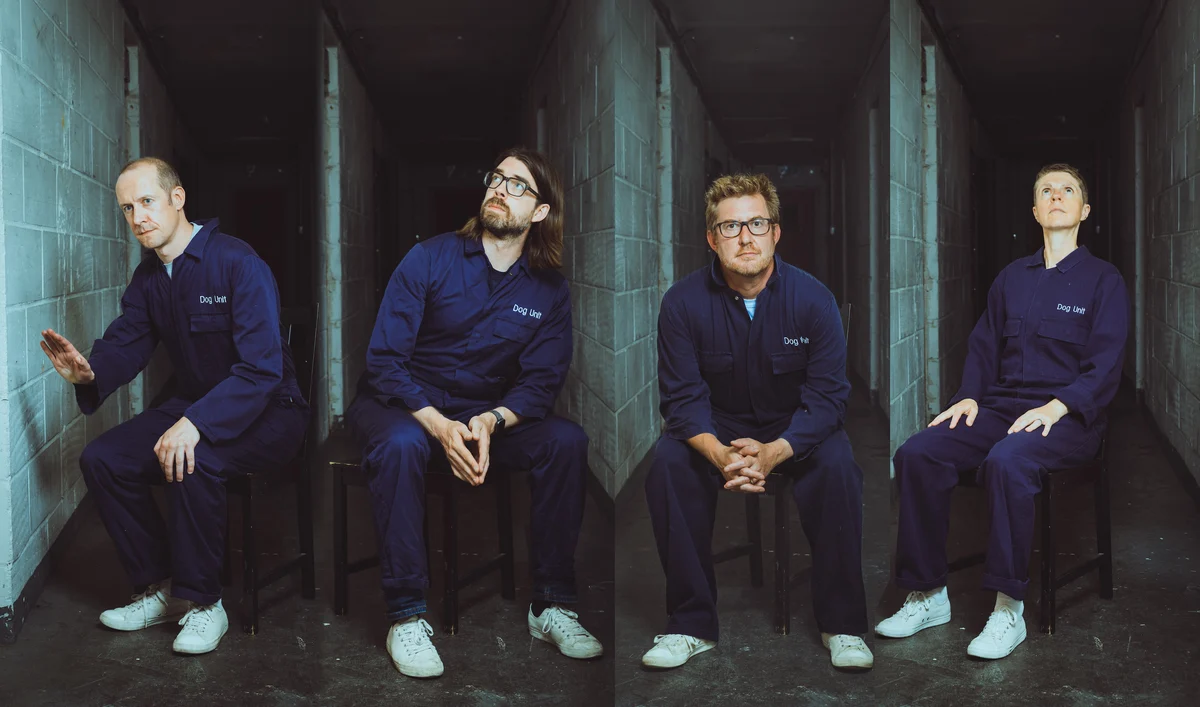

Searching for the ghost in the machine with Dog Unit
Dog Unit are city people making city music, they tell Tom Morgan ahead of their emotionally resonant second album Runners.
Best Fit’s conversation with the machine-like art/post-rockers opens, fittingly enough, with a discussion about technology.
Whilst explaining this writer’s simple but effective system of recording Zoom interviews (hitting record on Garageband), guitarist Sam Walton interjects. “I wouldn’t knock Garageband – loads of records have been made on it. Grimes made her first three records on it. Then she ended up having kids with Elon Musk.” “Correlation doesn’t mean causation,” adds fellow guitarist Henry Scowcroft.
The band, rounded out by bassist James Weaver and drummer Lucy Jamieson, would possibly take umbrage with the term ‘machine-like’, given that it can connote cold and/or unfeeling; incorrect descriptions of Dog Unit’s ultra-melodic motorik vistas. However, the tight, intricate instrumental rock of their second full-length Runners does conjure images of the 1932 classic Modern Times; those iconic scenes of Charlie Chaplin (a famously emotionally resonant filmmaker) caught up in the gears of a huge factory machine. Dog Unit’s music has the same ability to wrap you up in its machinations. You feel yourself moving lock-step with its momentum, your brainwaves synchronising with the elegant turning of its many gears and cogs.
This aesthetic is explicitly amplified by the matching boiler suits that Dog Unit all wear. “I think, for me, it’s about the idea of being a collective,” Walton explains. “We’re all equal partners in this. It’s also a nod to that motorik/kosmiche aesthetic and I suppose collectivism is a big part of that genre.” The band initially wore the boiler suits at their “first proper gig” – a friend’s small farm festival. On the origins of this show, Scowcroft elaborates that “we played [friend and festival owner] Steve some of our stuff and he liked it, so we thought, shit, we need to come up with a name and some actual songs.”
Digging deeper into the (aesthetic and philosophical) influences of Dog Unit, Walton highlights the school of minimalism, particularly composer Steve Reich and the “non-hierarchical nature” of his famous Music For 18 Musicians, as an influence on his and Scowcroft’s guitar playing. “They’re all playing together; they’re all on the same level,” he enthuses.
This notion of being a unit working towards the same goal isn’t something that artists are always in sync with. The line between ‘creative’ and ‘worker’ is sometimes a cavernous one. Filmmaker John Carpenter once jabbed at the silliness of being called an ‘auteur’, instead insisting that he was simply paid to do jobs and did them to the best of his ability. “He has a point,” Jamieson responds. “Making films or music is a creative endeavour, which I don’t think John Carpenter would disagree with, but it’s also graft. If you’re playing live, people are paying money, there is a transaction, we are working.”

Jamieson also stresses that it would be “pretentious” to act like Dog Unit were “proletariat” factory workers. However, she explains that Dog Unit “have rehearsals where we’re bashing out lots of not very good stuff, like writers who treat their writing day as a work day, within which hopefully there’s a kernel of something good.” Walton posits that the dichotomy can be flipped around. “The creative stuff is when we’re writing, while the gig is the work,” he suggests. “Maybe it speaks to the state of the creative industries in 2026 that there’s such a distinction between work and art.”
In a landscape of dwindling venues, shrinking funding, and the ever-expanding vice grip of technofeudalism, being a professional musician today is harder than ever. However, during the creation of Runners, Dog Unit found themselves facing up to some of the more eternal struggles that skilled, determined artists face. Walton describes several rehearsal sessions as “proper fear-and-loathing stuff,” where the band found themselves “stopping every half hour or so and agreeing that what [we] were doing was shit.”
The four members talk with lucid, intelligent candour about their creative process. Jamieson caveats Walton’s description of those challenging sessions by sensibly pointing out that “it’s an enjoyable endeavour, but not every moment of it can be enjoyable,” which the rest of Dog Unit agree with. They also recall numerous moments of magic, such as the brilliantly-titled “Three Hundred Bears”, which came together in, according to Walton, “what felt like one practice.”
Dog Unit’s usual writing process involves jamming for extended periods of time, then listening back to recordings and picking out small sections. As an example, they cite a 90-second passage of one of these otherwise unusable sessions as being repurposed and fleshed-out into “the first third” of album centrepiece “Everyone Has A Favourite Pin”. Other tracks arrived more spontaneously. For example, interlude track “Push Alert” was recorded by Scowcroft on his phone, before Walton added a string section. “I’d just bought a new amp and wanted to show it off to the band,” Scowcroft laughs. “We didn’t even re-record it. That’s that exact recording.”
Aided by these interlude tracks, Runners has a fabulously well-sculpted shape to it. It ebbs and flows beautifully, moving through the gears like a well-oiled engine. There’s a visual element to it. You can picture its structure – both the whole creation and the specific tracks within it. Do the band have visual ideas or reference points in their head? “Probably not as a band, but individually, yes,” says Jamieson. “For ‘The Knowledge’, to me, it’s like a big bouncy ball, bouncing along a road.” It’s a recurring idea that is echoed by the album’s layered-meaning title; a momentum-driven journey, dynamic movement, linear propulsion.

“We’re not very pastoral,” Walton points out. “We’re city people.” This taps into something about the London-based band’s music. Instrumental rock, particularly post-rock, is often accompanied by natural or ecological imagery. Dog Unit’s music, despite its prettiness – its light, sometimes effervescent touch – rarely conjures images of natural landscapes. Dog Unit seem pretty resistant to the idea of attaching direct visual imagery to their music “We’ve had a few people ask us about putting videos behind us while we’re playing live,” Walton explains. “But, for me, the tunes are so auditory, I don’t want to cross the streams.” Scowcroft adds: “Just let people close their eyes and create their own video in their heads.”
Walton cites the influence of Godspeed You! Black Emperor on his younger self, “but when you attach images of abandoned railway tracks and stock exchange crashes, it applies so many semantics to this otherwise abstract music.” Jamieson has a slightly different take on this auditory/visual relationship, describing how, like the aforementioned bouncy ball image, she sees “colour, shape, and texture” within Dog Unit’s music. “Maybe it’s more of an emotional landscape,” Walton suggests.
This is perhaps the key to unlocking Dog Unit. Their music has an emotional centre, a beating heart vigorously pumping away inside the precise, finely-tuned machine. “It’s got to be emotionally resonant,” Walton explains. “A three-note melody was good enough for Beethoven and it was good enough for The Beatles. It’s certainly good enough for us!”
Sign up to Best Fit's Substack for regular dispatches from the world of pop culture