Rhiannon Giddens' Personal Best
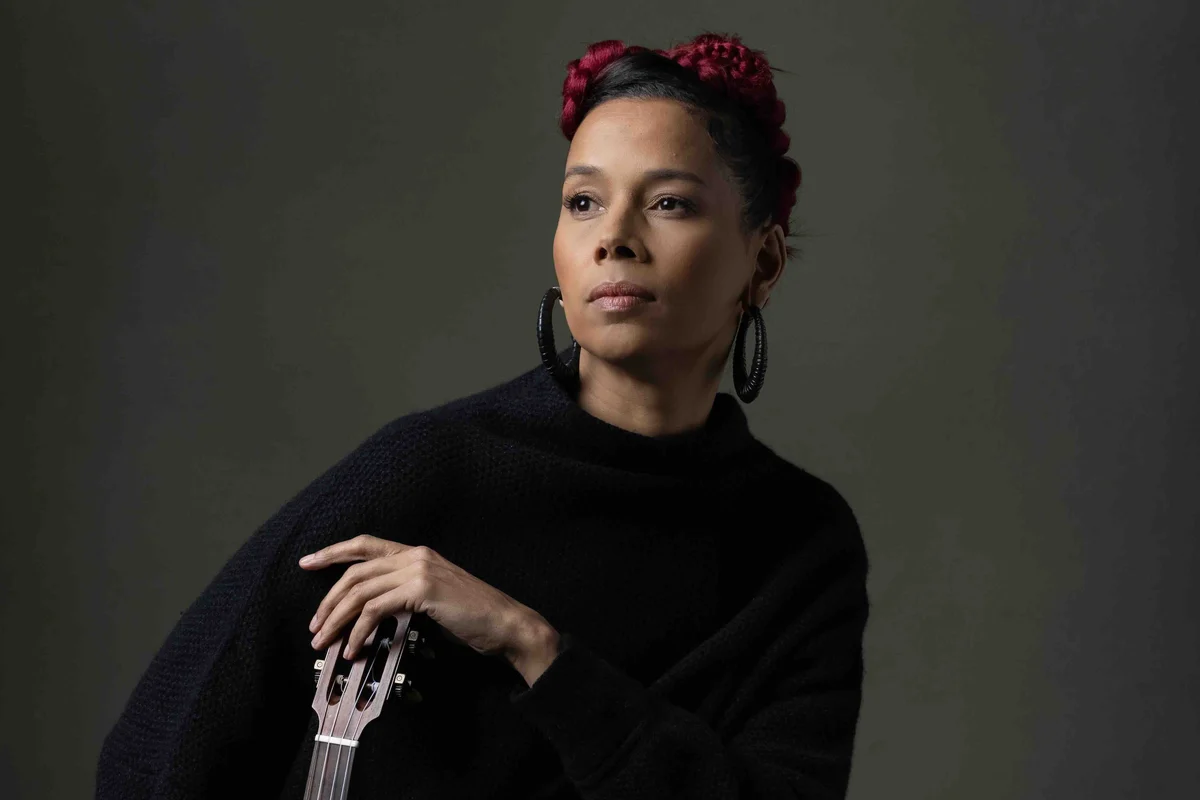
Rhiannon Giddens looks back with Alan Pedder on a life spent crossing musical boundaries, and forward to a future where hope lies in the act of doing meaningful good.
Rhiannon Giddens has never been particularly interested in sticking to any one musical lane or building a career – if we must insist on calling it that – that follows modern logic.
She describes herself instead as an artist of the 1960s, in reference to how many musicians of that time were creatively unconstrained, free to follow their curiosity wherever it might lead, even if their audiences didn’t always tag along. Think Van Dyke Parks moving promiscuously between baroque parlour songs, psychedelic pop, and The Jungle Book soundtrack, or Frank Zappa using rock as a gateway to just about everything else, from orchestral work and jazz to musique concrète, high satire, and other avant-garde experiments.
Giddens’ discography may be less unruly than Zappa’s – let’s face it, whose discography isn’t? – but a restless curiosity is one of its bold-type characteristics. Having trained at Oberlin Conservatory in Ohio as a classical singer before pivoting to old-time stringband music with the Carolina Chocolate Drops, her work now spans eight albums bearing her own name, including collabs with Francesco Turrisi, Silkroad Ensemble, and Justin Robinson (a fellow Chocolate Drop), plus film, ballet, a video game soundtrack, and a Pulitzer-winning opera.
And that’s not even touching her scholarly endeavours, like the early Black music songbook Go Back and Fetch It, or her Biscuits & Banjos Foundation celebrating the African diaspora within American culture.
Giddens is a busy woman – also a mother of two teens – and she prefaces our chat with the caveat that she doesn’t “have a good brain for discography.” “I’m already thinking two albums ahead,” she says, laughing, so it’s rare for her to sit and take stock of where she’s come from in a feature like Personal Best. But her new album Hope is the Thing with Feathers, out next week, does lend itself to a little reflection, prompted by a sense of the music industry eating itself into oblivion with the onslaught of AI, and by the need for us all to refocus on “next door,” to invest in our real-life communities as much as we have on social media platforms.
“I’m as guilty as everyone else,” she says. “But my mum has always said to me that what we focus on expands. There’s a lot that’s shallow and ephemeral about our society, and there always has been, but it feels like that element has expanded in direct correlation to the reconcentration of power. We’re leading these sorts of shadow lives, separated from the earth, separated from larger patterns of communal life. And now, with AI exploding, it feels like we are at a real crossroads.”
Named after the much-loved Emily Dickinson poem, which she sets to music on the title track, Hope is the Thing with Feathers is emblematic of simpler, more human-centred times. Recorded over several sessions spanning around two years, and co-produced with longtime collaborator Dirk Powell, she says it’s a record in the purest sense of the word, capturing a series of moments among her “musical family,” with locusts and birds in the background when they chose to sing along.
“Making a record with my musical family is harder because I can't just plug in somebody else,” she says. “Everybody has their own unique thing, and I've developed these musical relationships with them over years. So when we get together, we create music that can't be created by any other group of people, and I think that’s a really special thing.”
Although the five songs she’s chosen for her Personal Best date from 2009 to 2024, the Dickinson piece is a bonus sixth, a recording she describes as “one of the most beautiful experiences of my song-making life.” She’s far from the first to set the poem to music. There are dozens of examples of this from choral music to country and folk, but in the context of Black Americana, Alice Randall’s co-written “Many Mansions” – recently covered by Allison Russell on a Randall tribute record that Giddens also contributed to – is one that stands out, though it’s not the full poem in that case.

Giddens first encountered the poem while on tour, in a hotel room, and instantly a melody appeared, as if downloaded into her brain. “It just felt so natural,” she says, describing how she then took it to “genius” Niwel Tsumbu, an Ireland-based Congolese guitarist, who instantly tapped in too. Later, at the studio in Louisiana, Francesco Turrisi added “the most beautiful accordion line” and Brady Blade “some sort of bongo thing.”
“I was like, oh my god, I could just listen to this all day because it doesn’t want to stop,” she says. “And that’s kind of the point of hope, that it shouldn’t stop. It can get really small, but you want to hear it running like an engine. So, for me, this song is really representative of how I feel, and a kinda perfect union of all these things I value.”
At 49, Giddens says she has a more pragmatic, midlife view of hope these days, and that she started to look ahead and make decisions about how she wants to spend the rest of her life, whether that’s another 20, 30, or 40 years. “For me, hope now is about not losing sight of the fact that, no matter what’s happening in the world, if you have the ability to make something good happen, then you can have hope,” she says.
“That good thing can be small. It can be huge. It can be medium-sized. It can be personal or political. It can be artistic. But as long as we can do good in the world, we should do it, and that’s that.”
"Snowden's Jig" by Carolina Chocolate Drops (2009)
RHIANNON GIDDENS: I think this song is a beautiful encapsulation of what the Carolina Chocolate Drops was about, and what all three of our individual careers have subsequently been about.
“Snowden’s Jig” was a really seminal moment for all of us, and for how we work with academics. In this case, there was a very specific connection to Howard and Judith Sacks, who wrote the book Way Up North in Dixie, which is really the bedrock of the scholarship around this tune, and even around us renaming it from “Genuine Negro Jig” to “Snowden’s Jig”. That was because of their work in discovering this Black string band family, the Snowdens, who lived in the same area as a guy named Dan Emmett, who was the one who wrote the tune down.
For the Carolina Chocolate Drops version, I adapted the notes for fiddle to suit my own style of playing, with all the different variations. We also had Dom’s brilliance on the bones, Justin laying down that basic but incredibly important rhythm, and Súle Greg Wilson playing a ‘triangle’ made out of metal discs from an old computer. The fabric of the song is not very produced but everybody adds their part and turns it into something of the moment, but also connected to very old ways of making music. For me, that’s part of the brilliance of the song, and it made a very old tune alive again for a whole ‘nother generation of people.
Cristina Gatti, an academic whose work about the early days of the banjo I’ve used a lot, was at a jam somewhere and someone asked if she knew "Snowden's Jig", and she said it made her so happy that it was now in the general lexicon as “Snowden’s Jig”, making the family come alive again.
We know so few names of the Black people who played this kind of music, and the whole point of this song was the act of reclamation. At the time we had no idea what was going to happen, we just knew we wanted to honour that whole chapter, so to know that it has worked, in a way, is kind of amazing.
BEST FIT: Has the song ever put you in conversation with descendants of the Snowdens?
From memory, there are no descendants because there were no other Black people around for them to marry into. They were the only Black family in that area, so I don't think that there is a direct line of descendants, at least not that we know of.
Are there other surviving examples of their music?
There are family scrapbooks that they put together, which is how the Sackses argued that “Dixie” should be partially attributed to the Snowdens, and I think the Smithsonian has got Lew Snowden's fretless banjo too. So there has been continued work in trying to safeguard their legacy.
Do you still play this one live, and has it changed much over the years?
The vibe of it does change, depending on who I play it with. I haven’t put it in my sets, as a general rule, since the Chocolate Drops folded. It has definitely had its day, but it’s always there to be played.

"At The Purchaser’s Option" by Rhiannon Giddens (2017)
BEST FIT: This song still hits as hard as it did almost a decade ago. It’s so cleverly written and, as you've talked about many times in the past, was inspired by a slave trade newspaper ad that was so grimly banal for its subject matter. What earns it a place here among your Personal Best?
RHIANNON GIDDENS: If you’re lucky as a songwriter, you get to write a song that makes an impact that goes way beyond you, and for me this is that song. Whatever else I have written or that I get to write, I definitely feel that this song is the one that I was meant to write.
I didn't start writing songs until I was in my 30s so this was early in my songwriting career, and it was directly correlated with consuming all this material about the transatlantic slave trade. I was trying to make sense of it artistically, trying to find the human voices in that, and trying to find the connections with today. Because it’s not about revelling in the awfulness of what people went through. It's my responsibility as a descendant and future ancestor to make a connection with what we're doing now. There's no point talking about these stories unless we're trying to point out things that we need to improve today, that are still happening, like slavery.
With this song, I have very clear memories of not wanting to use antebellum imagery. There’s no cotton, there are no fields. The idea of slavery is ever present, the extraction of labour is ever present, sexual violence is ever present. People having their children taken from them is ever present, as we see still now with ICE raids. We're all living uncertain lives. We can be hit by a bus tomorrow, but there's an extra uncertainty about a life under siege, and that is the experience of a lot of people right now, and always in human history. “The Purchaser’s Option” was inspired, obviously, by this ad for a person, but I wanted it to be able to live outside of that too.
This is a song that I will sing until I die. I still do it in my sets. I've done it in lots of different ways, and I hope it continues to grow, you know. People have told me many times that they teach it in their class, which means everything to me. I'm never gonna have a top 50 hit. That ship has sailed and I've come to terms with that, and to be honest I've never really cared about that. But the fact that people are teaching my work in their classes as a way to connect with their students makes me so proud.
I also feel that way about “Another Wasted Life”, which I wanted to put on this list too. That one and “At The Purchaser’s Option” are the songs that I’m most proud of from an activist standpoint, from the point of view of work that other people can and do use in what they are doing. I’m still getting letters from people in prison about “Another Wasted Life”, so this is the work that I’m proudest of in terms of impact.
BEST FIT: You mentioned that you performed the song in quite a few different ways. When you were arranging this original version, what did you want the music to do, or not do, in relation to the words?
Each song has its own animus, its own soul, so I don’t really go into a recording session with a preconceived notion of what I want. I trust the musicians that I’ve put together to help create that.
Dirk has a very instinctive way of working, a very great musical mind, and we've created this way of working in the studio of just letting the song be, letting it happen. It’s about letting people feel safe enough to do their thing in the moment, without putting an idea on it, and then refining later if needed. The whole Freedom Highway record came out like that.

"Factory Girl" by Kronos Quartet & Rhiannon Giddens
BEST FIT: This is quite an unusual song in your catalogue in terms of its journey. How did working with Kronos Quartet change the way you heard the song that you’d already made your own, in a way, on an earlier recording?
RHIANNON GIDDENS: Well, I was really so grateful because Kronos Quartet were the first to really encourage me to compose, and without that experience there would be no Omar, which is my opera. So, working with them was really an important milestone for me. I’ve been very comfortable in the liminal space between folk and classical, because of my background as a classical singer, so I have the ability to sort of pick and choose what world I want to exist in at a particular time.
With “Factory Girl”, I started by taking the old folk song and rewriting the lyrics to connect it with the Rana Plaza disaster that happened in Bangladesh. Then, when I started working with the quartet, Gabe Witcher’s new arrangement gave it a whole new emotional colour. When I performed this song with them live, I actually cried on stage, which I think was probably the first time in my whole life because I’ve always been a very contained person. I could feel the building almost shiver with that drone and the menace in the arrangement.
Working with Kronos, for me, was such a beautiful coming together of the intensity, the intention, and the detail that comes with classical music, with the power of a folk song, and my attention to vocal detail, which is partially informed by classical. It all came together in a really beautiful way that highlights the emotional damage of the story.
It’s astonishing, really. When you were rewriting the lyrics, if you can remember, what was it about the factory girl from the original folk song that you wanted to hold onto or embellish?
Well, the original “Factory Girl” tells a very personal story and I wanted to keep that idea. From my side, the story really came from seeing pictures of people buried in the rubble of the factory collapse, which was just so horrible and so preventable. All those people lost their lives for cheap clothes. It was a horror on a scale that was hard to comprehend, and the person in the lyrics became a stand-in for all of us. Probably we don’t know anybody involved in the tragedy, but I wanted the song to make it feel as if we were in love with all of them.
I've sung so many traditional songs that writing in that idiom has become almost second nature to me, so the story pretty much wrote itself, you know? I felt like it was literally the very least I could do in that moment. It's so little, but that's what makes it so important to me. Like, if that’s the least I can do then I better do it, and I better do it right, and I better do it in a way that will extract the most emotional connection that I can.

"Black Swan" by Rhiannon Giddens with Francesco Turrisi (2019)
BEST FIT: This is another quite unusual song in your catalogue because it’s one that you reworked from a post-war aria. What was it about this particular piece of opera that made you want to bring it into this other musical world?
RHIANNON GIDDENS: I remember having a discussion with Joe Henry, the producer, about what the material was going to be for this record and I was like, “Okay, this might seem a little weird but what do you think of this?” and I played him Nina Simone’s version of “Black Swan”, and he was like, “This is ridiculous. What is this? This is amazing!”
People talk to me as if my career is something singular, but whatever I have done, Nina did it first, you know? She was active at a time when the classical world, the folk world, and commercial music were much closer together than they are today. I mean, it’s not like she was making pop music, but she was far more mainstream than you would imagine for someone doing the breadth of what she was doing. I always say that I’m an artist of the '60s, because I’m just doing what they were doing back then and somehow managing to eke a career out of it. I mean, Nina was doing arias. She was doing songs in different languages. She was doing folk songs, modern songs, activist songs, and “Black Swan” was such an interesting choice.
It’s a song written by Gian Carlo Menotti, and it’s very disturbing. I remember singing this aria as a freshman in college and it’s stayed with me this whole time. The thing with Nina’s version is that she left off the middle part, so I thought, well, I love the vibe here but what if we did the whole thing? It’s funny because there are all these old jazz recordings where the singers leave out certain verses, which are often very interesting, and I’ve always been a bit obsessed with that. So that became my whole thing with this, like, what can we do for the middle part?
One of the reasons why I included it – and it was really this or “Si Dolce è'l Tormento”, which is another favourite aria that we recorded our own version of – was because I wanted to include all the words, as they were written. But the other is that making this song was really one of the purest moments in the studio that I’ve ever had. We got in there without having made a plan for the middle part, and I just kept singing as Francesco was playing the ostinato. We just made it up on the spot, because it didn’t exist in Nina’s version, and I think it’s freaking weird. It’s very mid-century classical, and I love it so much.
The funny thing is that I had to relearn how to sing it afterwards, because I was really in another space at the time. It was my first time really releasing myself to improvisation in that way, and that’s a big deal for a classical singer who was taught that there’s only one right way to sing, which is to sing the notes that are written. We weren’t really allowed to be co-creators of the music. But I’m now able to work in that improvisational space more, and I’ve gotten better at it, and I have to thank Francesco for bringing that into my life.
With Joe Henry at the helm and working with Francesco, I felt very safe to try it. Francesco and I have a very instinctual way of making music together, and that’s allowed me to find spaces as a singer that I never would have found on my own. So that’s why I wanted to include “Black Swan” on this list, because it’s not one that people necessarily will know from my catalogue, but there’s a lot going on there that’s interesting.

"Swannanoa Tunnel / Steel Driving Man" by Silkroad Ensemble with Rhiannon Giddens (2024)
BEST FIT: This is another great choice. What made you want to bring these two songs together in the first place?
RHIANNON GIDDENS: It was a hard choice between this one or “O Death”, but I chose this one because it’s from my tenure with the Silkroad Ensemble and it feels important in the sense that I’m a tradition bearer now. I’m not an elder yet, but I am holding tradition for the younger set, kind of 1.5 generations on.
“Swannanoa Tunnel” is a song that came out of a collaboration with academics. They had done all this work to show how this song had originally come from Black railroad workers and had been totally turned into a white bluegrass anthem, with the origin sort of forgotten. I discovered it through a post on the Bitter Southerner website, and the work they did was really incredible. So I wanted to bring that into the American Railroad project, which was my first flagship programme for Silkroad, and put it together with "Steel Driving Man", which is Joe Thompson’s version of the Joe Henry story.
I feel like it’s such a beautiful, pure collaboration between banjo and tabla, and the idea of how we find these moments of connection. It was one of the first times where I felt like I could bring my whole self into a space full of people with their own incredibly complex and beautiful traditions, and I could really situate that moment in North Carolina [where the Swannanoa Tunnel tragedies happened]. So that’s why I included it here. Is it the best recording I've done with Silkroad? I'm not sure. But for me, again, it felt like a real watershed moment.
It’s also interesting on a conceptual level, because on one hand you’ve got the John Henry legend and on the other hand you have these people whose names history doesn’t even remember, so it’s again feeding into your long pattern of looking at who gets remembered and whose stories get passed down.
Yeah, and that reminds me of another thing I love about this piece is that there’s so much connected to the railroad in terms of colonialism, imperialism, extraction, and exportation. That’s something I really learned much more about by bringing this to Silkroad and listening to Sandeep Das talking about what the railroad means in India as a relic of British colonialism. On the one hand it connected India, but how was it made? How many lives were lost making it? The railroad isn’t only good or only bad, but what does it mean to connect these similar struggles when there are also different connotations in India than there are in the US?
So that, for me, was a very powerful moment too, because it's only knowing each other's story that we can each learn something about what it is that we're both needing to fight against.
There's always lots of story and background that goes into everything that I do, and I'm always telling the same stories over and over again, because we have to. These are the kind of conversations I like to have about recorded music, you know? Because for me the record is not the end result. It’s just a part of it, but an important part, because it’s hopefully a doorway into something else.

Sign up to Best Fit's Substack for regular dispatches from the world of pop culture