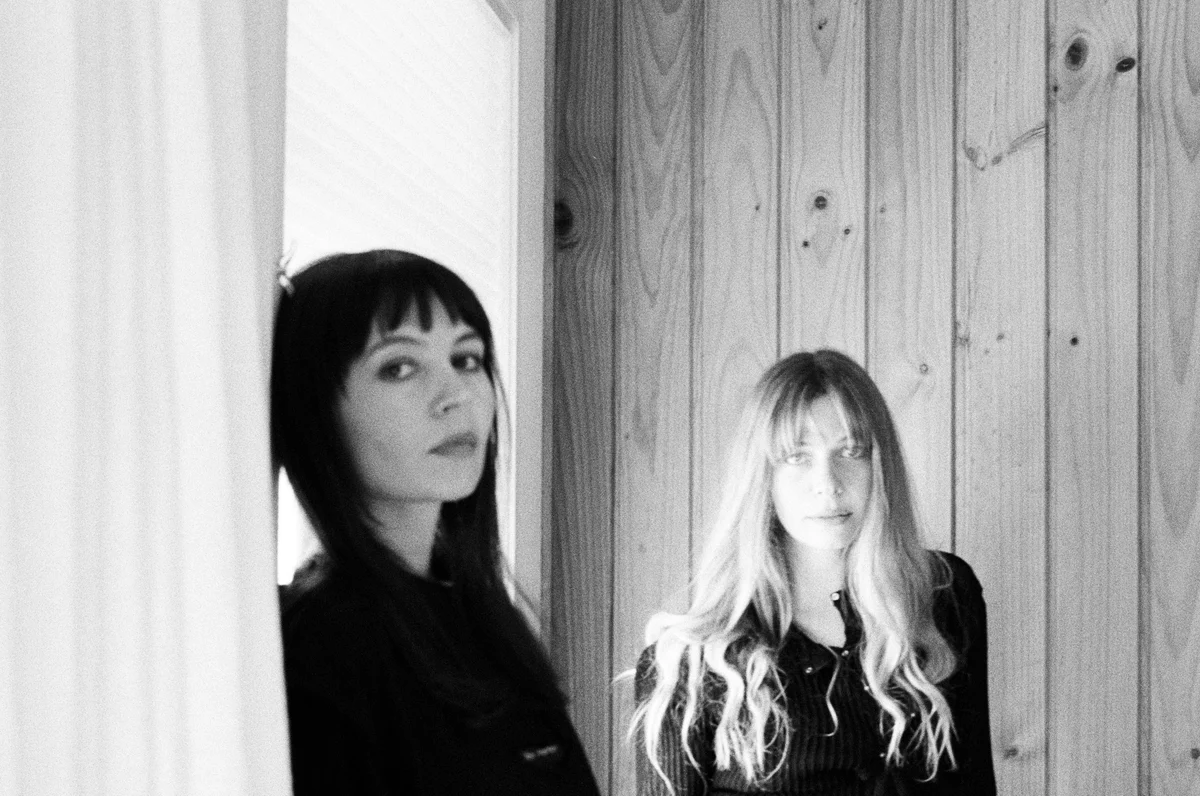

Purple Pilgrims’ corner of the world
Purple Pilgrims’ music exists as its own planet – in 1966, 1986, and 2026 – writes Elise Soutar as she hears how the New Zealand sibling duo returned to the untamed belly of the land to make their timeless new record.
Folk music, as I’ve come to understand the broadest meaning of the term, is an ancient, timeless concern.
I mean “timeless” in the sense that these songs could have been made during any period and still carry the same weight and relevance, sure, but also that the song exists out of time and possibly apart from our world – trapped under the sealed glass of a snow globe and untouched by the outside. Most of the genre I find myself connecting with actually serves as somewhat of a time capsule, reaching back to eras so detached from current trends in the singer-songwriter realm that it reads as alien, even when depicting human foibles. In a slightly pre-psychedelic ’60s, when Dylan had wrung out the Guthrie tradition for all it was worth and plugged in instead, “folk” then morphed into something almost archaic, where the likes of Donovan or Marianne Faithfull could record albums of medieval chamber ditties that belonged to a different century. The disconnected containment becomes the point, as if to make a love sound as old as the earth beneath it, all-consuming and isolated. The “people’s music,” then, becomes a planet unto itself.
When Valentine and Clementine Nixon, two sisters born into a lineage of New Zealand folk singers before being shuttled to Hong Kong and back in their adolescence, sing “I dreamt of life as a folk singer” as the duo Purple Pilgrims on their song “Wherever You Go”, they’re not just wistfully casting themselves in the role. Given that the latter sister believes they’ve been pulled towards the genre “purely on some DNA level” through their familial history with the profession, they seem called to craft songs that exist in a clear lineage – part-way between the Baez-led folk songbirds of the ’60s, Flying Nun and the experimental strain pioneered in their home country, and brooding 4AD dream pop circa 1986. Yet, it’s the way they blend these sounds that places them in a snow globe of their own construction, and their fourth studio album, Given to the Night, exists as its own planet, apart from the indie-friendly folk of 2026.
Maybe I’m only imagining hearing the record as such a unique entity because it’s been coloured by knowing about the album’s creation, for which the sisters did, in fact, shut themselves up together in the bush, opting out of the project of modernity and “turning off the internet” to see what they could conjure as a twin force. “We did record the album in a very isolated place – we’re still here, actually,” says Valentine over Zoom, leaning slightly out of the frame to reveal unending ploughs of green leaves on the country's North Island. “After some travelling and being in the city, we’d moved back out here and started writing and recording. It was quite a transitional time for both of us, and we decided to just throw everything into this record, and that included sort of… locking out the world a bit.”
“We wanted to keep it very pure in that way, where we weren’t being pulled in any direction other than what was coming out of us at the time,” Clementine, a dark-haired mirror image of her sister at her side, laughs a charming, easy laugh. “We enlisted one other person who was ‘allowed’ to come into the studio.”
In the twins’ clear resemblance and connection, there is an obvious sense of creative telekinesis – where both halves simply play and form the sound without question or pause. Certainly, artists tend to make music based on unconscious hunches, but as someone who regularly has to try to get them to extrapolate on why or how they did it, I know they can usually mark moments when the project finally clicks or begins to take shape, at the very least. The sisters Nixon, however, have trouble just identifying what song they first completed during the writing process, giving the impression of simply channelling once behind closed doors, letting the liquid, ephemeral song cycle of Given to the Night unconsciously take shape.

“Romance is dead / I dug its grave,” they announce to open first single “Innocence Lost”, setting the table of a record charting the push and pull of romantic relationships, coaxing us into their mind-melded creative flow with sunlit guitar lines and rounded, gauzy vocal harmonies. In their search to assign sound to the break and rebirth of the heart, the music is ephemeral, but contained, as if these songs could only breathe and survive in the greenery of their makers’ solitude. They exist in 1966 and 1986 and 2026 – of no time and place and of any time and place. A “Be My Baby” backbeat will render one song a sepia-toned postcard taped flush in a scrapbook, but the lyrics will read like a cult’s ritual chant, willing love to the voices in our headphones. If these songs did, in fact, come together so eerily fast in the duo’s hands, it might only have been possible through unspoken alchemy, blending long-banked memories of pop history with the fresh tear of romance found or lost, alive or buried. The heart can sing without consulting the head first, as the sisters would know.
If anything, the approach to writing and recording not only felt steeped in music’s past, but in Purple Pilgrims’ personal past – as their formation, too, came both out of necessity and by accident. “Valentine was studying folk music and singing, and I went to art school,” Clementine remembers, “and we very naturally merged those two disciplines. We didn’t like to think too much about it. We were really young and it just happened. I was working at a gallery, and there was a support act needed for this experimental show, and someone suggested, ‘Why don’t you and your sister [perform]?’ Because we’d been messing around at home.” Their desire to create “something new,” in her words, was largely inspired by the decades-long lineage of Christchurch’s alternative forbearers, pulling from the likes of The Dead C and Roy Montgomery, the latter of whom has since played with Purple Pilgrims. In curbing their folkier impulses, which Valentine says are still “ingrained in some kind of past-life way,” the pair were able to reveal something discordant that their union stirred within them, unconsciously pulling threads of desire in the way only telekinetic sisters could.
In these early performances and writing sessions, Clementine recalls, “the intention was more loose, and we were working through ideas and feelings and as they came, instead of forcing any sort of outcome. Sometimes, we didn’t necessarily think about anyone hearing them.” Years later, having released several full-length efforts on Flying Nun and fully ingratiating themselves into their home country’s experimental lineage, it took returning to the untamed belly of the land to create that unconscious friction again. The result is less noisy or challenging than their earlier releases, but does sound as if it could only pour out of a blood-bound connection, where stopping to conceptualise or tinker might thin the creative flow.
Given to the Night is, on paper, an album about relationships, but untangles them with the language and reverence one might save for singing about saints. “Outside”, for instance, begins as a woozy guitar waltz that splits itself down the middle without warning, letting a delicate reverie of flutes and chimes hover, suspended in space, as if to hold the relationship with caring hands before returning to the serenade’s sway. “Universal Love” plays as a fairly simple strummer about an attempt to eschew memories of a lost relationship, but its lyrics read as a religious vow to rid one of all its earthly and unearthly possessions, where the purge must be biblical in order to stick: “Forget the places that we went, forget the messages we sent / Forget these four green painted walls, forget the sighing chest that falls.” “Look to the Moon” grapples for a freedom only a natural force can grant the women, wafting in waves of dreamy reverb as it throws itself into the ocean. Each song knows the seismic shift of a relationship lost or gained, how it threatens to rearrange the atoms of one’s being, and tries to recreate the feeling, if only in subtle touches.
Purple Pilgrims’ experimental origins come through most clearly and strangely on “Unseen”, a gorgeous, eerie nursery rhyme chanted over twinkling, half-tuned plucking, calling for love both profane and holy. It is a witch’s spell and a psalm lost to time – as well as one of the band’s favourite songs on the record. “A lot of our writing is based around storytelling, I suppose,” Valentine says, “but that was especially based around this specific idea, and it all came in one go. All the lyrics and the melodies sort of just came out of nowhere.” Clementine, too, remembers “deconstructing guitars and synths” until the track had fully grown into its own strange skin, but they both speak as if they know the technical process is beside the point. A prayer can’t be dissected or explained in full, and surely not when others are around to hear it.

In its most wily turns, the record is a siblings’ secret pact we’re only half let in on, as if to spell out any expression of love is to spoil it all together. The music glides over the melodic, warm trill of the Nixons’ voices intertwine both in clichés and abstract musings, placed in a dollhouse-like diorama – creating a record about love and humanity that is not so much carnal, but held at an unknowable arm’s length. Our repeated mistakes come in the crash of a cymbal, conveying one’s longing or guilt or pain or sense of betrayal in only a syllable of sound. Such universal experiences don’t need to be spelled out, especially when you’re communicating them with your sister who can know how you feel with only a look. Love may be out of reach in these songs, but we’d all want to have the musical, emotional bond that created the songs, if given the chance.
When Clementine notes that they “spur each other on and feed off of each other in an unspoken way,” after I’ve probed at the distance they hold between us and the isolated, ancient sound they’ve forged together, Valentine agrees: “I think we make each other braver. Without this close bond we have, the ideas wouldn’t see the light of day. We’re able to go quite deep emotionally and share things with each other easily and freely. A lot of the songs we write feel kind of prophetic, for want of a better word.” In Purple Pilgrims’ future, then, there is a rabid chase for a love that races just out of their reach, leaving only a conversation between a pair encased away from the rest of civilisation, finding the truth in their snow globe apart. Maybe the dreamed version of love they sing of, both remote and deeply felt, can never truly exist. Maybe their mystery can only be a planet unto itself – in which case, we are lucky to have an ear to sound their friction creates, even if it’s only for the length of a record’s twin sides.
Sign up to Best Fit's Substack for regular dispatches from the world of pop culture