

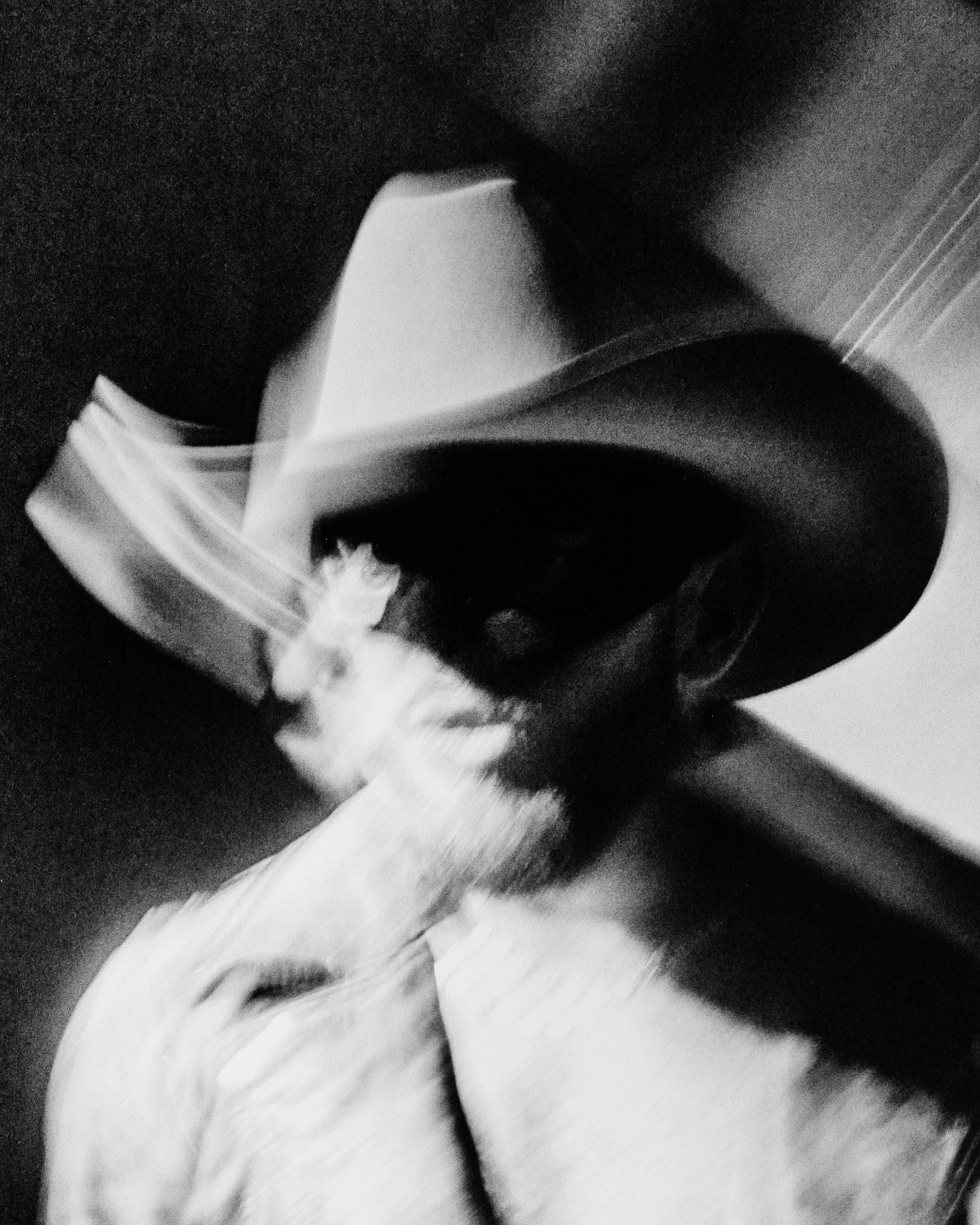
Orville Peck's mask can't hide the man
On his new record Mule, Orville Peck reckons with the gap between his public self and his private one – and the result is a gesture of hope and gratitude, he tells Laura David.
A mule is a hybrid. Half donkey, half horse — a mutation that leaves them belonging to both species in part but neither as a whole.
They’re also workhorses, historically used for hard manual labour but also often underestimated. To be a mule, then, seems to mean to be a kind of benevolent, misunderstood freak of nature. A being often needed — and even used — by all but not quite allowed to rest or to be held with care. And occasionally, mules are even used as metaphors for smuggling and addiction, associated with dark deals, addiction, and illicit activities.
Over the last few years, Orville Peck has felt like all of these things. There is, of course, the mask, a physical representation of the double-life that the Peck sometimes feels he leads, one that oscillates between expert-grade theatrical performances onstage and, in the reverse, slow, at times even lonely, nights spent alone at home. There’s the work — the perhaps never-ending work — of touring, spending months on the road away from familiarity, striving for perfection night after night. And then there’s the addiction, a theme that marked his pandemic and post-pandemic years, culminating in a “big rock bottom” near-fatal overdose before a show in New York in 2023. That all of these disparate fragments could make up parts of the same man often felt unbelievable. But it’s that idea that Peck set out to explore on Mule, the 38-year old South Africa-born artist’s latest record.
In a way, all of Peck’s albums are self-titled. Each named after a kind of horse and mired with Western metaphor, Peck’s masked cowboy alter-ego steps in as the conduit for conveying the major life events of the man behind. The horse names are chosen deliberately, each corresponding to that era’s overarching theme. It’s a way of capturing the mood of a period in Peck’s own way. The characters and embellishments always work in service of the feelings underneath.
Pony, for example, saw Peck “frightened and new,” fitting for a debut. Bronco dealt with Peck’s untaming, his break from constraints and reckoning with a past abusive relationship — a spectre still present in his writing today. Mule sees these previous personas break down, documenting when Orville’s public and private lives were pushed to their limits. On the cover, Peck is stripped down to his underwear and a white tee, a stark contrast from his usual elaborate rancher costumes and a visual reminder of the year he was laid bare.
“The one topic on the album that I explore is this divided connection between like me as Orville, the performer, and me when I take off the mask and go home and I'm a normal person sitting alone in my bedroom, like everyone else, you know, and what that feels like, and the distorted lens that that can create for a lot of people in terms of I just guess you know what what we show people and what we really are,” Orville tells me. “I'm incredibly stubborn, and I just felt like I was kind of yeah trapped between some worlds and struggling with a lot of stuff, and that just felt like a mule to me, I guess.”

After his overdose in 2023, Peck got off the road and got help. The crash came after months of drinking to excess and drinking to numb, both habits Peck picked up to haul himself out of the fallout of an unhealthy relationship and the struggles of the pandemic. “I started drinking to cope with how hurt and how much crisis I felt I was in,” Peck explains. The whims of the entertainment industry only exacerbated Peck’s habits. In other jobs, drinking at work (or to prepare for work or to celebrate every night after work being done) would raise questions. On the road, it’s entirely normal — even encouraged. To drink, for Peck, became a way to feel better. The solution to being overworked, heartbroken, stressed out, burnt out, or anything else at all became to consume and erase with substances. Looking back on it now, the scariest part may not have been the tendencies themselves but rather that Peck was, in the moment, convinced that it was all just frivolity — a story he kept telling himself even after everyone else stopped believing it.
Peck’s drinking slowly became like the Jazz Age before the market collapse, or like the later-day parties of Anthony Patch and Gloria Gilbert. The parties started grew tainted with darkness, but even then, even when they stopped feeling good, he couldn’t quite bring himself to quit. As he sings of the period on “Big Ol’ House”: “Headed out to another show / Never watch bands anymore / Drink all night and start a fight / Take someone home that / I don’t know / I live alone, honey / Big ol’ house and it’s full of ghosts I used to know.”
Only that genuinely “dark and scary” moment prompted recourse. Even then, it was at the behest of others. In the end, it was his day-to-day manager who convinced him to get off the road. “They were like, ‘we’re seriously worried about you, and we’re not going to let you do this [tour].” Other than COVID, Peck had never cancelled a show in his life. But he did it anyway. He accepted the help, even though at the time he still wasn’t fully convinced he needed it. Now, he recognises making that choice saved his life.
Written over the course of three years, Mule tells the story of Peck’s recovery in chronological order. As Peck describes it, it’s kind of a country concept album about rehab. Sure, much of the record takes place in a treatment centre, but why not visualize that with a choreographed dance routine at the facility? Who else could do that but Peck?
“I do like to do things my own way,” Peck says and giggles, a cheeky departure from his usual baritone. “Sometimes to my detriment!”
It’s those lines between utter rawness and flamboyant excess that Peck has always straddled so well, a skillset that, as a writer and performer, has made him so magnetic. He rose to prominence riding the wave of his seductive baritone and outlaw aesthetics, championing the conventions of old-school country music charm but also subverting them with unabashed infusions of camp and queerness. And he did all of this years before its big-time break into the pop music mainstream, marking him as one of the original architects of this current country crossover era. Any Nashville “puritans” who may have disagreed with Peck’s entrance into the genre — either his identity as a gay man, as someone raised between Canada and South Africa, or his penchant for rhinestones and fringe — have quickly found themselves disarmed and outnumbered. The genre’s legends — including Willie Nelson, the original outlaw, and Emmylou Harris, who appears on Mule — have emerged in droves to support Peck, and his old-school jukebox charm was topping the charts years before the great summer reign of “Choosin’ Texas.”

“Sometimes people who are not familiar with me will be like, ‘So, is it mostly a gay audience you have?’ And I'm like, ‘Not really!’ Like, of course I have a big gay audience, but in my [shows] you can look out and see country fans in their 80s coming to see me because they just like my voice. They think it sounds like Elvis or whatever. Real country fans get it. I have never had a problem with the real country fans,” Peck explains.
As Peck sees it, real country has always been about performance. Of course, the genre did originally emerge from a way of life. Rooted in the traditions of rural Appalachian folk music, country is not just a style but also a tradition and an identity. Those traditions became the basis of a Nashville machine, turning country into one of the most profitable genres on the market. In the 1970s, this identity eventually bore a rebellious offspring, morphing into the idea of the “outlaw,” a progressive pushback against the Nashville commercial establishment that had grown so large. Champions of this version of country sought refuge in the rascal freedom of Westerns, blending the hippie mindset of the time with the image of the lone ranger. And it’s that identity which Peck has helped revive. Far from detracting or mocking country, the theatrics, he says, are what brings him closest of all to the genre’s legacy.
“The real tea is that I have met a lot of the Top 40-type country people. Most of these people don't even like or listen to country music. … They are doing more of a pageantry than I am doing. That is the actual hilarious part,” he says. “Everything I sing about is like way more personal than whoever on the radio is singing about, like, my truck, my truck,” he comments. “I’m singing about real shit, but I’m wearing a mask. So, suddenly that makes me inauthentic? It doesn’t make any sense.”
“It just comes naturally for me,” Peck says of his own affect. “I obviously love everything theatrical and dramatic. I’m the teenager who used to rewind the sad part of the song over and over to cry even more. I’m a sensitive, dramatic person. Like sorry, I’m gay! I don’t know what to tell you!”
He points for an historical example to Dolly Parton, who died a week after our conversation. As is now well-documented history, Parton faced ridicule early in her career for her clothes, her style, her flamboyance — everything that eventually captured hearts worldwide and made her the gold-standard of country music. “Dolly is not playing a character; she's being herself, but it's this heightened showmanship of herself, and that's what I'm doing,” Peck says of her impact. To be country is to make a spectacle of the mundane, to grapple with the everyday and the everyman and turn it into something bigger. That is what Peck and Parton and their contemporaries seek to do. And that is often where country music is at its best.
“I just like people who take creative risks. Like, isn't that the point? And that could be anything. That doesn't mean you have to put on a mask with fringe, like by any means. Like you could be wearing jeans and a t-shirt and still be super creative and like and concerned about making something interesting and authentic. My problem is when something is just sort of lazy and like and not creative. I'm not interested in that,” Peck says of his view on the genre and its future. “I was recently featured on Shaboozey’s album and like, you know, I love Boozy because like he had one of the biggest songs of the decade that was played in every fucking bachelorette party on Broadway, and then he decided, ‘For my next album, I'm gonna make a fucking Western noir concept album!’ And I'm like, ‘Good for you!’”
"My addiction affected so many people. It affected people’s jobs, it affected people’s livelihoods, it affected my family, it traumatized people... so the album feels like this ‘thank you’ to some of my friends and family who went through that with me."
Mule itself is an exemplary piece of country songwriting, only bolstering Peck’s claim to mastery of the scene and of the genre. Pulling from bluegrass, power balladry, and man-on-the-run twang, Peck used the flourishes of country to produce his most honest album to date. And what else is country if not parabolic storytelling done at the highest level?
The record begins with a sort of chant on “Prologue (Eulogy Of A Man Turned Mule),” calling back to the genre’s oral folktale beginnings, imagining what might have happened had Peck actually died that night in 2023. Sung by Emmylou Harris, Noah Cyris, and Allison Russell — all Peck’s dear friends — the song is a “eulogy,” both for the life Peck once led and for what might have become of him had he continued. “I had this idea where I kinda wanted the album to start with this Greek chorus, almost like these voices singing an old Appalachian hymn,” he says.
When asked, Peck can’t even quite remember the number of songs he wrote for the project. His best guesses place the number around 60 or 70, though maybe even more. “When I started, it wasn’t originally even supposed to be this chronological event. It wasn’t necessarily going to be all about that year, but naturally every song I was writing was sort of about what happened that year, because I had these massive events happen in my life. It was impossible not to want to write about all this stuff,” he tells me. The more he wrote, the more the timeline emerged. From there, the concept solidified. “I keep joking it’s my Tommy by The Who. It’s sort of like my rock opera or something.”
Peck resolved to only release the album when he could communicate its message exactly as he wanted to. In between the year Mule chronicles and its eventual release, Peck took breaks to pick back up acting and try a stint on Broadway as the Emcee in Cabaret. He released Appaloosa, his 2025 EP, to tide him over. In the background, he was writing and beginning to record Mule, working as hard as he could to get it just right.
“I knew that there were songs about each period, and I knew what each period had to feel like,” Peck says. Tracks like “Already Gone” and “Rehab Blues” chaotically chronicle the downfall, a time when Peck was nearly forced into getting help he wasn’t so sure he wanted or needed.

“‘Already Gone’ is when I was in rehab and I was super entitled,” Peck says. “I [tried to] display that in the music video, where I'm just dancing and acting like I'm unique and I'm not like these other people who are all sick. This woman's like crying next to me in the meeting and I'm just annoyed, wondering, ‘Fuck, when's lunch?’ That was sort of my attitude in rehab. So, that's me trying to confess a character flaw of my own, that I think I'm so unique and I'm not like anybody and I'm better than this, than these sick people — and that was a big thing for me. I had to learn to like humble myself in terms of, like, ‘Oh you are an addict you have a problem and you you are no different than these people in fact you might be worse off.’”
Slowly, after breaking him down, the album builds Peck back up again. Songs like “Run Out Of Road” and “Too Little, Too Late” bookend the record like an exhale, capturing the exuberant joy of Peck “getting [his] life back.” As he puts it: “I was determined for each of these songs to be exactly the feeling I needed and the exact lyrics that I needed to portray that.”
After years of deliberate writing, Peck traveled down to Nashville to record the final version of the record earlier this year. “It’s always such a beautiful experience,” Peck says. “The whole band rehearsed beforehand, and then we would go and play the majority of these tracks live, like a live performance. Everything was mic’d in this church, so we would get the energy of an actual performance rather than just dialing everything separate, the way people do now.”
“Recording it was very cathartic for me and my band,” he continues. “I sent the album to friends and family and it was so cathartic for people in my life to hear because my addiction affected so many people. It affected people’s jobs, it affected people’s livelihoods, it affected my family, it traumatised people. That was a hard year for a lot of people. So the album feels like this ‘thank you’ to some of my friends and family who went through that with me.”

That feeling of being able to give back, to Peck, is perhaps the best part of Mule. The idea that being forthcoming with his commitment to sobriety and recovery might help others find an alternative path has made the struggle worth it. “I always, even to the point of maybe embarrassment or being awkward, reach out to people. Especially now because the world’s in a mess and every single person is struggling. … But I always try to reach out, because you never know, you could save someone’s life that way,” he explains.
“I have always been someone with the worst poker face. People always joke that I can’t hide an emotion to save my life. I’m a terrible liar. I don’t feel good not being myself. Even if sometimes being myself feels like too much or embarrassing or makes me insecure, I would rather feel that way than feel like I’m being inauthentic,” Peck continues. “To me, I am focused on looking back at my career and feeling really proud of everything I did, or at least like everything I did was true to me.”
Sign up to Best Fit's Substack for regular dispatches from the world of pop culture