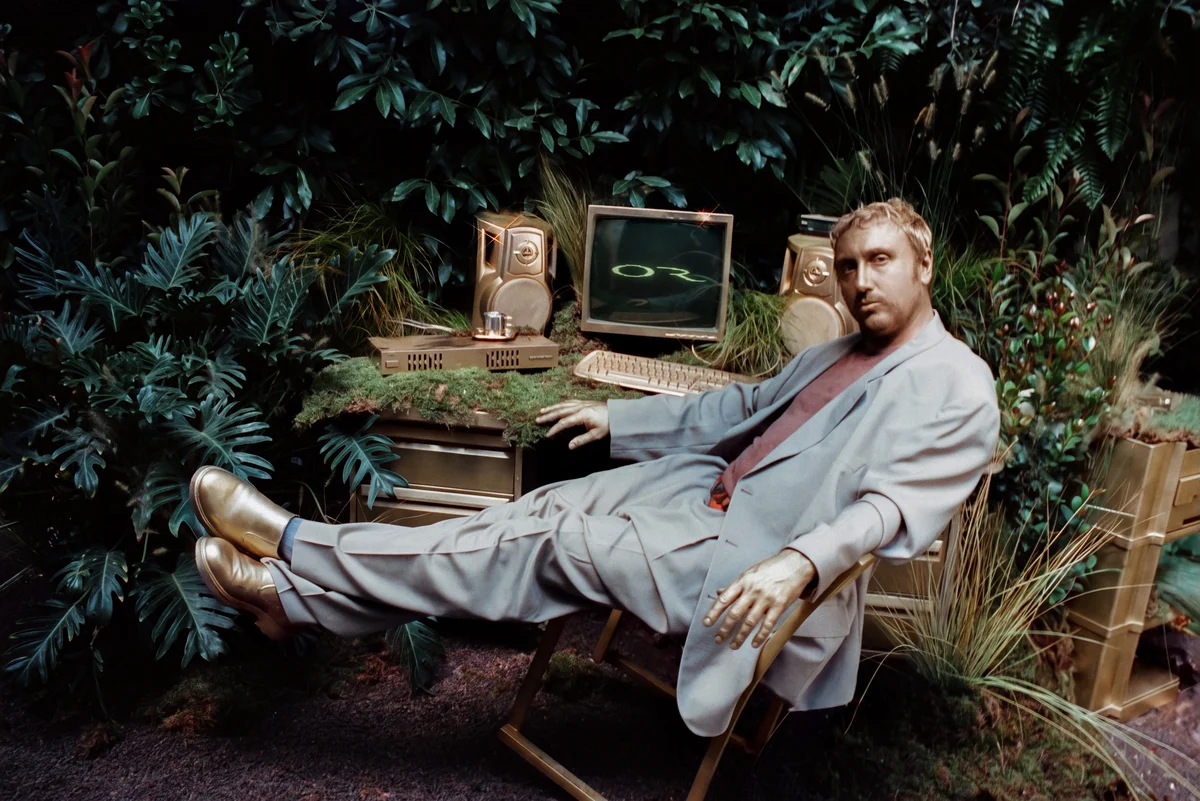

OR found something to hold onto amid the uncertainty
Oriol Riverola, aka John Talabot, tells Fran González how Ursula K. Le Guin and Ravel’s Boléro helped get his pandemic opus Music for Empty Stadiums over the line.
During the first months of the pandemic, Oriol Riverola found himself making music for a world he could barely imagine returning to. The clubs were shut, the journeys and encounters that had sustained his life as a working musician had stopped, and the future of dance music seemed increasingly uncertain.
Sitting at home with an old device, he began building sprawling, erratic, and almost absurdly exuberant compositions, less concerned with the conventions of the dancefloor than with finding somewhere else to go. “I was just experimenting, feeling really disappointed at home, with an old computer and a few sequencers,” he recalls. “I came across something that seemed interesting and started exploring it. It was more about finding an idea and abusing it to forget a little about what was happening around me.”
For someone whose life had revolved around travelling, DJing, and responding to the energy of different places and people, the sudden interruption was particularly difficult to process. “For the first time in our generation, we were told no,” he says. “You couldn’t decide how your life was going to be anymore.” Even seemingly mundane freedoms, such as catching a flight or going for a swim whenever he wanted, had suddenly disappeared. Having spent two decades building a professional life around music, he found the suggestion that artists should simply reinvent themselves rather difficult to swallow. “I’ve spent 20 years doing one thing, and all of a sudden I was supposed to reinvent myself in two months. It’s not that easy. I’ve invested so much time and effort in building something, and suddenly you’re being told you can’t do it because of a virus you can’t even see or understand.”
The experience left him feeling particularly vulnerable, and it is one reason he feels more personally attached to this album than to much of his previous work. The music itself became a way of reclaiming some of the excitement he had lost. Riverola describes the early compositions as “quite histrionic and megalomaniacal”, an attempt to reconnect with the energy of performing on a large stage at a time when even the idea of a functioning club felt almost dystopian. “What is the point of a stadium if you can't fill it with people? What is the point of a club if nobody can go?” he remembers wondering.
He eventually made around seventy projects, often spending hours on the sofa absorbed in their construction. “Sometimes I could spend eight hours working on this and without thinking about anything else.” When Nic Tasker later asked him, as part of an NTS programme, for any music made during lockdown, Riverola sent six finished renders. Tasker was intrigued and suggested turning the material into an album. Returning to those sessions, however, meant revisiting a particularly painful period. “Opening the projects actually hurt a little,” he admits, recalling a breakup, people around him who had died, and friends going through difficult moments of their own. He told Tasker he could only manage one project a week. Some sketches were almost complete; others were barely more than ideas. The album gradually emerged through this process of reconstruction, with Riverola trying to make the different fragments belong to the same world.
Part of that reconstruction involved embracing the unpredictability of the original recordings rather than ironing it out. In “Fractal Love Odyssey”, for instance, polyrhythms and sequences refuse to resolve in quite the same place, making the track particularly difficult to assemble. Riverola had applied randomisable rules within relatively stable musical parameters, allowing certain notes, lengths, and patterns to change from one repetition to the next. “It’s all probabilities,” he explains. “The probability that a certain note plays here but doesn’t play the next time around, or that a parameter becomes shorter or longer, that a sequence runs for eight steps or seventeen.”
Sometimes even he was surprised by the results. “There were projections that I didn’t even understand. I’d press play and think, what is this? How does this work?” Making the pieces coherent required a fair amount of musical sleight of hand. “It’s a bit like David Copperfield,” he laughs. He would join sequences halfway through, combine different recordings of the same melody, and automate the transitions so that the listener wouldn’t notice the cuts. “There’s a little bit of trickery involved.”

That sense of movement also owes something to the orchestral recordings Riverola became obsessed with during lockdown, particularly a performance of Ravel’s Boléro. What fascinated him was the way acoustic instruments could move from barely audible to full-volume through the musicians’ own performance. “I realised that acoustic instruments allow you to play very quietly or very loudly,” he says. Electronic music, meanwhile, often relies on modulation and compression to maintain a consistent presence. Rather than bringing every melody forward in the mix, Riverola began working with volume automation, allowing individual sounds to emerge and recede. “I love that because it’s quite unusual in electronic music. Normally, elements come in, disappear, and come back as loops. Here, they move in and out almost like soloists in an orchestra.” Despite the album’s clinical, almost aseptic sound, he wanted it to retain “a certain sense of organic life.”
Melody became another way of pushing those ideas further. The track “Where’s the Melody?” started with a simple question: “How many melodies can you fit into one song?” One line gives way to another, then another, each finding room where it seemed impossible to fit anything else. Riverola describes the result as something halfway between a soundtrack and an orchestral composition, with individual melodic voices appearing, disappearing, and answering one another. “If there’s space here, I can put another sequence in those notes. I can overwhelm you melodically even more.” The intention was also a reaction to the ambient music he was being asked to play during the pandemic. “I kept thinking, what's the most extreme ambient music we can make? What's the craziest version of it, something that goes completely against creating a state of comfort?”
That impulse reaches an almost comic conclusion in “CROWDPLEASER”, a track that builds into a seemingly endless rush without ever delivering the expected release. “It’s a constant high that never ends, that never gets anywhere, and when it finishes you just say, thank god,” he says. “Every time I played it, I felt like I was about to have a heart attack.” The track titles, he adds, are something of a guide to the album’s intentions. Its compositions are also arranged chronologically, so the listener can follow the growing intensity and confidence with which he approached the melodies and sequences.
That willingness to follow an idea wherever it leads is closely connected to Riverola’s preference for working with limitations. Having used the same production software since its earliest versions, he has watched its possibilities expand over the years, from a handful of plug-ins to an almost overwhelming collection of tools. “There are millions of possibilities now, and sometimes it’s just too much.” He compares the experience to opening Netflix and spending hours deciding what to watch. The same applies to music consumption: “Imagine being 14 and someone comes along and tells you, here’s all the music that has ever existed for $12. I think you’d end up hating music.” For Riverola, the abundance of options can also diminish the value we attach to culture. “Culture was never supposed to be viral. It was supposed to make you think a little.” He worries that the distinction between cultural expression and internet content is becoming increasingly blurred, with everything competing to be immediately understood, consumed, and shared.
His criticism of AI comes from a similar concern about the disappearance of the creative process. Riverola is not against using new technology as a tool, but questions the idea that entering a prompt and receiving an audio file is equivalent to making music. “A creative process has to be full of mistakes and those mistakes have to become your skills. You use those mistakes to create something new, something that wasn’t supposed to exist.” He points to the history of electronic music itself, from acid house to jungle, as evidence of what can happen when musicians discover unexpected uses for existing equipment.

“If you use something as a shortcut, there’s no new or particularly personal element that you’re bringing into it. It’s basically going to replicate something that already exists.” For him, the distinction is fundamental: “Without a creative process, the file isn’t a work of art or music. It’s just a product, something to show or sell.” An artist interested in experimentation, he argues, might use AI as a tool, but not simply to have it hand over a finished piece. “I think it has a very clear intention: to do away with creators, to make you believe that by typing a prompt into an app you’re going to become a producer, an artist, or a writer.”
On that note, the irony of a distribution system mistaking Music for Empty Stadiums for AI-generated music is therefore difficult to ignore. Riverola tells us that its unpredictable melodic patterns and randomised structures probably triggered its alerts. “The machine looked at the notes and the melodic patterns and seemed to think, this is nonsense; no human could have made this because it has no fucking logic,” he laughs. “Yet curiously, and perhaps precisely down to that shambolic feel, this is the most human record I’ve ever made.”
Riverola returns to the idea of intellectual escapism, invoking Ursula K. Le Guin and the refuge that art can offer when reality becomes impossible to make sense of. During those months, music gave him somewhere to go when almost nowhere else was within reach. Music for Empty Stadiums grew out of that solitude, but its restless melodies and unruly surges carry the energy of someone trying to recover a life that, for a moment, seemed to have been taken away.
“There are projects you choose, and there are projects that choose you,” he says. OR was one he needed: something to hold on to when the world he knew had suddenly slipped out of reach.
Sign up to Best Fit's Substack for regular dispatches from the world of pop culture