

Ahead of their performance at The Barbican as part of Rough Trade’s 50th anniversary, Anton Pearson from Squid talks Cal Cashin through the songs that made him.
A decade ago, Squid formed as a haven for Sussex University’s brightest musical outcasts. Cosmic jokers and post-rock urchins on the South Coast.
Barnstorming shows across Brighton - as well as at the Brixton Windmill - in their raucous infancy, alongside a string of punchy singles, meant that by the time 2019’s Town Centre EP dropped on Speedy Wunderground, the group were one of the country’s most-hyped young bands. Since those early days though, the band have consistently defied all expectations and hype.
Squid compromise with each other, but they have never compromised on creating the wacky, fascinating, and experimental music they want to make. Singing drummer Ollie Judge, synth wizard Arthur Leadbetter, and prodigious multi-instrumentalists Louis Borlase, Anton Pearson, and Laurie Nankivell all bring disparate elements and influences together in the band, and the result is something vital, ambitious, and always interesting.
Debut album Bright Green Field – for Warp, in 2021 – was preceded by radio-unfriendly lead single “Narrator”, ten minutes of krautrock mania, shrieking and shredding aplenty, while every subsequent release has seen the band get weirder and weirder still.
Second album O Monolith saw their pastoral free-rock corrupted by a constant haze of synthesisers, while third album Cowards saw the group answer the question: “what if Talk Talk’s Laughing Stock was evil instead of zen?”
Squid are bookending this visionary three-album run with Crowds, their first live album, as they prepare for the next chapter. The stage has always been Squid’s most natural habitat, and Crowds catches the quintet in an absolute flow-state across shows in Southampton, Bristol, and Brighton.
Crowd-pleasers like the funky “G.S.K”, the bleeping punk disruptor “Building 650”, and the insurgent “Swing (Inside A Dream)” go down a storm, but so do weirder moments like the deconstructed rocker “Well Met (Fingers Through the Fence)” and jagged sound collage “The Blades”.
Crowds acts as a greatest hits by proxy for their career so far… but it does posit the question: where are Squid now?
“We’ve got our biggest show of the year coming up at The Barbican soon,” guitarist, bassist, and occasional trumpet player Anton Pearson tells me, “So right now, we’re locked in on rehearsals. We’re writing and meeting every few weeks, but this has been a bit of a slower year for us. Ollie’s been concentrating on being a dad, and we’ve all had all sorts of musical, and non-musical, projects on the go.”
Pearson’s 2026 has been preoccupied by Driving Through Belgium, his solo debut. A pastoral and naturalistic drone record that captured a certain wheeze and lilt, it came out on World of Echo earlier this year to rave reviews.
“It’s a really rewarding process,” he explains, “We're all involved in every aspect of everything that Squid does. There's something nice about just doing something totally in your own life. I did all the recording, all the mixing, all the engineering, and all the writing, obviously.”
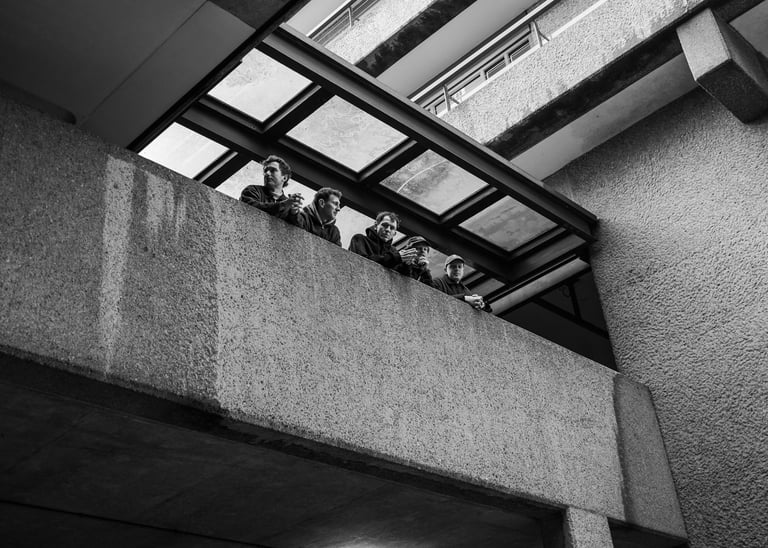
Squid are now all based in different locations across the South of England but are working together better than ever. “We‘ve been playing new songs,” Pearson continues, “which we want to work live in their early stages. They’ve maybe been more energetic, or danceable, than the last album, not to say that’s necessarily the path we’ll take when we come to record them, though.”
Telling the story of his life in music through the Nine Songs that mean the most to him, you get a sense of which elements Pearson brings to Squid’s sound. His fascination with drone, ambient, and neo-classical music is evident, although you could have probably gleaned this from solo material, as is the inventive way he approaches the guitar.
“I knew there was a few ways I could go about this,” he reflects, “and ultimately my selections tell the story of mine and Squid’s musical life, rather than personal life.”
Most of Pearson’s selections are made with the acknowledgement that his own story is forever intertwined with Squid’s, and you can crucially glean the cannon of disparate influences from across the spectrum that has allowed Squid to eventually become one of the decade’s preeminent rock bands.
A shared love of krautrock, festering in their student accommodation, the “best gig” they ever saw, and the soundtrack to a million “rickety” van journeys. It’s all here.
“Fire” by Jimi Hendrix
BEST FIT: Hearing Jimi Hendrix for the first time is a rite of passage, isn’t it? How old were you when you first heard this song?
ANTON PEARSON: Well, I have a really specific memory of hearing this song for the first time with my mum in a car driving me to school. I would have been about 10, and she had this compilation CD of loads of old rock music. It was jumping all over the place in terms of eras and scenes, and a lot of it was crap.
But I remember hearing “Fire” by Jimi Hendrix. I was already playing guitar, but I wasn't really aware of Jimi Hendrix. And I remember just being, "This is amazing," and I'd always get her to skip back on that one. It’s a funny one for a child to be really interested in, I suppose, in retrospect. But it's still great. I think the best thing about that song actually is the drumming from Mitch Mitchell, it’s incredible.
I went through a period from age 11 to 13 where I literally only listened to Jimi Hendrix. When I was a teenager into my 20s, I didn't really listen to any of that stuff very much, so it was fun listening back to it. Actually, I've recently been listening to “Third Stone from the Sun” a lot. It's on the same album, and a much more experimental tune, it’s awesome.
He's still probably the best guitar player of all time, right? Electric guitar player, anyway. He's such an interesting figure to learn from. I grew up in rural Norfolk. Culturally, there weren't any venues near me. I was really lucky. I had a really, really good guitar teacher. He showed me a lot, albeit just through CDs.
“Hallogallo” by NEU!
BEST FIT: NEU! make, to my mind, really simple music. But often, I think the effect it has on people is anything but.
ANTON PEARSON: Right! Something about it is, again, similar to a few songs here in the way it's really simple things done really effectively. This tune was introduced to me properly by Louis in Squid. This is when I was living in Brighton. I live in Brighton now, but I mean when we were all living in Brighton.
I used to live in such a shithole and Louis had quite a nice student house. I used to go around there all the time because it was a much nicer place to hang out. Louis showed me this tune and we all got totally addicted to it. We put it on every time I'd come around, there's something so hypnotic about the repetition in that piece. I remember wanting it on all the time.
I think it’s the best example of how krautrock works and it was always on in the background. It's a long song, and it never feels boring. It just keeps going. The song would finish and we'd put it back to the start again and keep going. I’d have been 19 at this time, I think, and it got me into krautrock in a big way. I knew about Kraftwerk and stuff, but this was something else.
I can hear how krautrock must have been a big early influence on Squid.
Yes, definitely. There's a video of Can playing “Dizzy Dizzy” on YouTube. Have you seen it?
No! I’m a big Can obsessive though, it’s going on the second we say goodbye.
Well, it's a 1977 performance of “Dizzy Dizzy”, and it's an incredible performance. It's super funky, and they're in this theatre-style venue with seats. The audience looks totally bored and uninterested, and Can are all having this really weird time on stage. Everything's quite odd, what I found so inspiring about it is it felt like there were so many different worlds on that stage, all happening at once. The drumming and the bass playing felt like they had two different things going on, and then you've got all this more effect-driven stuff, the tape loops that they're making on stage. It felt like loads of disparate worlds put together in a weird dream.
I think Michael Karoli's guitar playing is really underrated, too. There's a lot of really pounding Can songs where he's playing a really beautiful, delicate melody. And I hear the same coming together of worlds a lot with Squid.
That's definitely what we're trying to do. But I think of it more in terms of that being an inspiring thing and a liberating thing. We all put ourselves together from slightly different musical backgrounds and have quite different approaches to making music, not only can this work, but if anything, it makes it better, it makes it all stronger. Coming at things from different angles, rather than being like, "Yes, we need to make a song like this," makes it more interesting.
This laid the groundwork for us being, “We can do this, even though we're not all on the same page." I think that's what being in a band is all about, navigating differences.
“Small Hours” by John Martyn
BEST FIT: I knew John Martyn - the folk singer - from Solid Air, but this is crazy. It’s from a few years after that, and it sounds like Tortoise or something. Is this the first post-rock song?
ANTON PEARSON: I'll stand behind you on that one, for sure.
Why have you picked this one?
This is the origin story of Squid, if you want to hear it. There's a jazz venue in Brighton called The Verdict, it's actually a really prestigious jazz venue. Around the time that we were there, it was voted the second-best jazz venue in Europe, and it's quite an interesting space.
It's quite traditional, there's canvas paintings on the walls of the jazz greats, and it's really dark and acoustically-treated downstairs. There's about 60 seats or something, and if you're on the jazz circuit that's where you'd go. Especially if you're on the old jazz circuit. I guess it has that sort of reputation of being a little bit elitist in some ways.
The guy that was running it at the time was called John. He was trying to get it away from that a little bit, open it up a little. One day, I happened to walk past with two friends and we were looking for somewhere to go for a drink. John invited us in and was, "Do you guys want to come in here? There's music. You can come down and watch it for free."
I was like, "Yes, great." I can't remember what we watched, it was a saxophonist or something. And at the end of the show, I said, "Oh, thanks so much for letting us in. Can I put our night on here sometime?" And he said, "Yes, absolutely." I booked it for a day three or four months in the future. I was like, "Great, this is all good."
It got closer and closer to the show, and I hadn't booked anyone to play. So that's how we started as a band. We wrote the music to play that night, frantically, and invited all our friends to come. And we called the night “Small Hours”. It ended up being a semi-regular thing. And because we were all listening to that John Martyn album all the time, we thought that was quite a good name for a night. I still think it is a good name for a night. Maybe we’ll resurrect it sometime.
I'm taken back to that time. It's quite a special time, just us starting, it was all so DIY. We were putting on the shows ourselves and writing music specifically to play live. We were phoning every single person up who we thought might come, to make sure they came, and then it was us who was on the door. It was so DIY.
I know exactly what you mean.
That’s how Squid started. We started in a jazz club. We weren’t playing jazz music, we were playing post-rock, I guess. We were very into post-rock at that time. We saw Godspeed You! Black Emperor at Brighton Dome around that sort of time too.
“Horse Sings from Cloud” by Pauline Oliveros
BEST FIT: This is a beautiful piece. Why have you picked this one?
ANTON PEARSON: What's beautiful about the whole album [Accordion and Voice] is its pure simplicity. It’s all done really effectively.
Squid do make really complicated music, but I think what I try and aim for with everything I do in music is to do the really simple things really effectively. That whole album is really beautiful, really interesting, intriguing and weird, without ever being really in your face, and you hear more from it every time you listen to it.
There's something really earthy and honest and personal about it that I think I really like, and it's great to achieve that with a drone record. Although I used very different equipment, I was consciously aware of that album when I was making my own drone record. I wanted to make everything feel very tangible and real, even if it was using more electronic technology than Oliveros did. She’s a big inspiration.
“I Woke Up in a Fucked-Up America” by Lonnie Holley
BEST FIT: I don’t know much about Lonnie Holley. Tell me why you’ve picked one of his songs.
ANTON PEARSON: I think “Seeds” is his best work. It's an incredible, powerful piece. There's so many layers of incredibleness to it, the way he evokes memory and trauma. It's incredibly sad and the music's so powerful. But in terms of songs that tell a story about my life, and Squid's life too, it makes less sense than “I Woke Up in a Fucked-Up America”.
We all really love Lonnie Holley. The reason I wanted to put in one of his tunes here is because if anyone asks me what the best gig I've ever been to in my life is, it was seeing Lonnie Holley. And it was in one of the most unlikely places in the world to see your best gig. South by Southwest.
We went to South by Southwest in 2019. This was quite a long time ago now, and quite early on in our lives as Squid, before our first EP, even. It was a pretty unique time, we'll never experience anything like it again, because there was a lot of buzz around us. We were having all sorts of meetings with record labels.
I'd never been to America before, we'd done maybe one or two shows abroad at this point and then suddenly we were on a plane to Texas. We'd booked this apartment, we're all sharing beds in a little American house, a bungalow, wooden, with a massive driveway. Proper American. We were getting Ubers that were pickup trucks into town.
Have you been to South by Southwest?
No. Should I?
It's just absolute carnage, and I think it probably gets worse every year, it's gigs happening everywhere. You can barely walk down the main strip. We did something like five shows in three days. All of them were super haphazard, 15-minute changeovers with a sound engineer who you've only just met, who's stressed out of their mind.
We had one where the sound engineer was clearly really high, and then disappeared just before we were about to play. The show was obviously absolute dogshit. You feel like everything's really important at the whole festival, but at the same time, the quality of the shows are in the absolute pits.
So that's the scene that we're in. We did get a chance to see one or two things, and one of them was Lonnie Holley. He played at a stage on the Colorado River, on the bridge. He played in the evening time, at dusk. We'd been in this really intense urban environment, and then the sun's coming down, while Lonnie Holley is this incredible performer making this beautiful music.
The bridge that goes over the river in Austin is home to loads and loads of bats, it’s a million bats or something. In the evenings, certainly in the summer, they do this murmuration. But bats rather than birds. And they all came out and flew around while Lonnie Holley was performing.
He's got a really playful and interesting take on blues music, and I love hearing the age in his voice. I think that's really important. There's also definitely a parallel with Robert Wyatt. he’s like an American Robert Wyatt, a Deep South Robert Wyatt. That gig was just an amazing American experience in a beautiful urban American environment.
The tune is absolutely crazy, and it's obviously a protest song, definitely a protest song, really angry and disorientating and confusing, but also good fun at the same time. That was a good description of what it felt like to be at South by Southwest.
“Poor Boy” by John Fahey
BEST FIT: Lots of guitarists cite John Fahey as a favourite. I completely get it. How do you pick just one Fahey tune?
ANTON PEARSON: It was tricky. I love this one, he's got “Poor Boy” and then he's got “I'm a Poor Boy a Long Ways From Home”, and there's all the different versions of this tune. Then there's bits of this tune in other tunes and there's bits of other tunes in this one. And I love that about him, that he doesn't really give a shit, it’s “I'll play a bit of this, play a bit of that, it doesn't really matter.”
I love that attitude towards playing. On the one hand, an incredible, technically gifted guitar player, he doesn't get talked about enough. But on the other hand, he’s got a punk, comedic attitude to the way he approaches his music, and I love that mix. I think that's why everyone finds him so fascinating. Everything that happens around the music is so bizarre.
He always invented new names for himself. He's built his own mythology, but not in a narcissistic or pretentious way, and from the outside, it appears that was the more fun thing to do.
He was doing this at the same time as the folk revival in America. Not that that wasn't great, but there was obviously a certain amount of self-righteousness in that scene. If it wasn't for John Fahey, I wouldn't have considered that. But because of how he is, I thought, "Oh, maybe some of those guys are actually a little bit annoying." I love Pete Seeger and Woody Guthrie, and I love Ramblin' Jack Elliott as well, but I love that Fahey came to this with the same instrument, but completely differently
Whenever I interview someone that loves Fahey, or Bert Jansch, Nick Drake, I can’t help but ask them what their favourite weird guitar tunings are to fuck around with.
Everything I do in Squid is in DADGAD, I'm really used to playing in that. I'm more used to playing in that now than standard tuning. I know less about what I'm doing than in standard tuning, I feel more comfortable in that. One of the new tunes we played at Simple Things was CGDGAD – kind of like DADGAD with two strings gone a further tone down.
I've been learning a Leo Kottke piece. John Fahey released some of his music on his record label Takoma Records. That’s Open A, which has been really fun. And there's also another beautiful one. I don't know if you've ever heard of the tune “Solitudes” by Kinloch Nelson, but that’s in CGDDBD, it’s an open G with the fourth in there rather than the third, and that is so beautiful to play.
“Introduce me to your family” by Otoboke Beaver
BEST FIT: I love Otoboke Beaver. What made you choose this?
ANTON PEARSON: One of the first things we did when we got a publishing deal was to buy our own rickety van. We've still got it.
Around the time of the first album we were playing this multi-city festival, a small independent one in the east of France. It meant going through relatively small towns - Dijon, Mulhouse, and Belfort, and I think one other too. We went as a five, and we drove ourselves in our little van. There was a mad storm happening at the time, and we were getting blown around, but we had such a nice time.
You get so well looked after in France. We realised how much better you get looked after in France compared to the UK. Every venue we went to, we all had a big meal. All the artists together, and all the staff, and it was, of course, delicious. We were like, ‘touring is amazing.” All you have to do is drive for an hour, rock up, have some delicious food, piss about with your mates, play a show, and then you get put up in a hotel.
One of the bands driving around with us was Otoboke Beaver. It was a bit of a weird thing where we’d see them, sometimes they'd be playing on the same bill as us, sometimes they'd be playing at a different venue.
I'd never heard of them before, and I thought they were the most technically gifted musicians I'd ever seen. The way they communicated, how weird they were, and how much fun they seemed to be having was all so inspiring.
We worried we were going to be a bit baffling for a probably slightly more conservative French audience. But with Otoboke Beaver, we felt like Coldplay coming on after them.
That tune is amazing. I love the anger. I love the domestic themes that they're covering with their music. I think that's a really nice marriage of ideas. They’re amazing fun. We saw them at Glastonbury a couple of years ago, and everybody had so much fun watching their shows.
“Nocturn” by Kate Bush
BEST FIT: Kate Bush is probably, push comes to shove, my favourite artist of all time. What specifically do you love about her?
ANTON PEARSON: That's a tough question. What's so great about Kate Bush? Kate Bush hast an appealing intrigue about her. She's really not afraid to make things strange, but it’s generally in a beautifully accessible way. You really get the sense she's in her own world the whole time you're listening to her. She feels so independent in the way that she thinks, and that all comes across through her songwriting. I think she just does things that would be annoying if other people did them.
The reason why I picked it was that Kate Bush is one of the only artists that everybody in Squid loves. We'll all listen to Kate Bush really happily, and we're all really happy to consider her one of our favourite artists.
I think she's made loads of really interesting decisions throughout her career. She builds such an amazing family of sounds and instruments in everything that she does. Everything feels so unique to her. There's something magic in the production quite often. If you had any of these elements individually, you wouldn't think too much about it. But something about the combination is always a bit odd, but in a really magical way. Nobody else is doing things in the same way as her, which is awesome.
And Aerial is one of the albums that we've had on in the van the most. It's an amazing album. The last two tunes on the album - “Nocturn” being one of them - are a super euphoric end to an album when you play them together. It's so fun, and it's kind of funky as well.
Is there a wider Squid connection to her?
Well, the Squid link there is that we recorded our second album at Real World Studios. It was mad. It costs loads of money to be in there, and we couldn't believe we managed to get any time in there. We could only be there, in one room, for two weeks. There were some other big bands in there before us, and they booked the whole complex for a month. We were like, "How are they doing this? Where is all this money coming from?"
At Real World, there's another separate studio on the other side of the car park. This guy called Roger Bolton works there. He was one of the original Fairlight programmers. The Fairlight is an early sampler, basically. It’s all over Kate Bush's early work. So it would have been Roger doing some of the programming for her at that time. All those sounds, all those strings on “Cloudbusting”, that's all Fairlight sounds.
We met him by chance in the shop, he was buying lager in the afternoon. He was a really kind, eccentric guy. He was just, "Come and have a look." You go into his studio, and it's piles and piles of stuff. He had a microwave, and underneath the microwave was the master tape for Hounds of Love. It was amazing, and we owe so much to him because the Fairlight is all over our second album.
He died a couple of months ago and that was a really sad thing to hear. We're so indebted to his kindness. It was a funny little hut in the middle of the Wiltshire countryside, an amazing experience.
“They Being Dead Yet Speaketh” by Jóhann Jóhannsson
BEST FIT: This Jóhann Jóhannsson song is part of the Miners’ Hymn soundtrack. Is that why you’ve picked it?
No, I've never seen the film. It's one of my favourite albums of all time, but I've never seen the film, and I'm never going to. I think it would change how I feel about the music. I'm sure it's a fine film, but I've got so attached to the soundtrack. All of the songs on this album are amazing, and some of them run into each other, it's like a continuous piece of music.
I find this incredibly powerful, incredibly moving, haunting, and rousing. His treatment of horns is halfway between uber-classical - some of them are Wagner-esque - and then a sort of Tim Hecker, modern ambient. He brings those worlds together beautifully.
And as a study of brass, I think it's incredible. There’s some brass in some of the stuff we do. I play a tiny bit of trumpet, really, really badly. I put some on my record, and I wanted to embrace that but I was shit at it. I'm fluffing all the notes the whole way through, and I just layered them up. This album and this piece was the inspiration for that.
Whereas Jóhannsson was doing it totally intentionally, I was using my bad technique as an interesting character, I suppose - I think it's really good to do that sometimes. To be honest, everything that Squid does is really precise. We talk about everything that we do, and it was nice to throw things in that were badly done. It was a different way of thinking, but it was really healthy for me to get into. The trumpet is a fun piece of equipment to make odd sounds with.
BJóhann Jóhannsson’s amazing. This is an amazing piece.
Squid perform at The Barbican Hall on 5 December as part of Rough Trade's 50th anniversary
Sign up to Best Fit's Substack for regular dispatches from the world of pop culture