

As Richard Thompson releases his 20th solo album, the legendary guitarist and songwriter talks Ed Nash through the musical signposts that shaped him as an artist.
In psychology, the Reminiscence Bump is a phenomenon whereby as we get older, formative moments from youth become even more vivid and emotional.
As the theory goes for music, the songs we hear when we’re young imprint themselves on the psyche, define tastes in music and shape our identities. Whether or not you buy into the idea, the music that Richard Thompson heard in his household as a child has not only never left him but played a pivotal role in shaping the force of nature that he is as a guitarist and songwriter.
The same can be said of his first band, Fairport Convention, with whom he broke through in the 1960’s, and left in 1971, but like the music of his youth, they’ve have also been pivotal in his life and stayed with him.
“I played them in August actually. My wife and I played at Cropredy Festival on the Friday and Fairport played on Saturday. We got Fairport up as a rhythm section with us on the Friday, we played some old stuff and some new stuff and that was great fun. We had a wonderful time.”
Thompson was surrounded by music as a child, where the family home was soundtracked by the record collections of his father, a jazz loving Policeman who was also an amateur guitar player, and his sister Perri, who had an indelible influence on his love of Rock and Roll.
Finding his own voice as a musician was both defined by what he didn’t want to be – Thompson describes the blues guitarist scene of the late ‘60s an overcrowded field and jazz felt too niche for him – and embracing music outside of the mainstream. After he left Fairport, he released his first solo album, Henry the Human Fly in 1972, he made a series of records with his then wife Linda, before returning to a solo career in the 1980’s.
Thompson is about to release his 20th solo album, Hippies, Thugs and Heroes, which showcases his talent not only for incredible guitar playing, but his love of writing seemingly disparate character pieces that come together as a distinct story. When I ask how he feels about releasing twenty solo records he laughs and says, “Oh God, that's ridiculous, isn't it? It shouldn’t be allowed.”
He explains that the need to keep writing songs is because songcraft is part of who he has always been. “Well, it's interesting. I kind of call it a job, but it’s been a fascinating thing to do since I was about 14, or earlier, maybe 11, and I can't help it. I just keep writing stuff, and once you've written stuff, you think, ‘Well, what am I going to do with this?’ And it’s, ‘I know. I'll make a record.’”
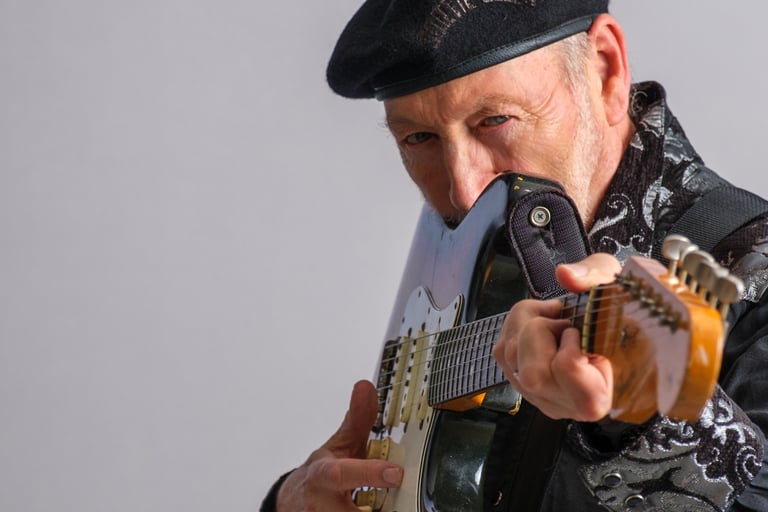
As much as he loves writing and recording, for Thompson playing songs in front of an audience is his favourite thing to do. "It’s all wonderful, really, I'm fond of all the processes. For me, the greatest pleasure is playing in front of an audience, where you get that feeling of communication, something that comes out of you and gets received by other people, heart to heart, or soul to soul, or whatever you want to call it", he explains.
"That's the best thing, and you don't really get that any other way. I love recording and I love writing, but it's the sense that something you've written, something you've performed - is received by other people, and that's the payoff for me.”
Next year is Fairport Convention’s 60th anniversary, of which Thompson says, “goodness, who knows where the time goes?” Before he gets to play with his old bandmates, he’s touring with his band in January and February in the U.S. and in April and May in Europe. “The 60th anniversary will be a big one. We're doing a mini tour as part of Fairport, and then I'll do Cropredy Festival with them. It would have been Sandy Denny’s 80th birthday, so it’s all kinds of stuff for next year. It's going to be busy, but I think it will be wonderful.”
As we finish up, I ask Thompson about the foundational impact that songs can have on us, especially the songs we fall in love with when we were young, and he describes his Nine Songs choices as, “absolutely pivotal, unavoidably so. The stuff you hear when you're young, you can take it or leave it. All the musicals that my mum used to love - everybody's parents had Carousel, South Pacific and Oklahoma - that was another part of the background of growing up in the ‘50s and ‘60s, and you rejected them, although I still learnt a lot about musical structure from those musicals.
“You absorb stuff, even if it's on the back burner, even if you’re not accepting it, you're always learning.”
“La Mer” by Debussy
BEST FIT: This is the first of two songs you’ve chosen that share the same title, “La Mer” - the sea. When did classical music come into your life?
RICHARD THOMPSON: I’d hear bits and pieces on the radio. My parents didn't really have any classical music, but when I heard this the radio, probably on Radio Three, I thought ‘this is really interesting.’
I was probably about 16, and up to then I’d never immersed myself in classical music. I knew about Rock and Roll, I knew a bit about folk music and I knew a bit about jazz, but it seems to me that “La Mer” is a precursor to some of the elements of jazz, in the use of the harmonic landscape of it.
Debussy was my entry into classical music and from that point, which is a kind of impressionism perhaps, it was Debussy, Ravel, Eric Satie. Then I went forwards and backwards. I went forwards into Stravinsky and Schoenberg, and I went backwards into Beethoven, Mozart and Purcell.
What is it that you love about Debussy in particular?
Debussy is certainly one of the watersheds of Western music; harmony becomes more ambiguous, the harmony accompanying a melody uses more of the upper partials of a chord, it also brings in scales from other parts of the world, it brings in a whole timescale.
But it's mostly that the music becomes subtler and more ambiguous. You can tell that Charlie Parker was listening to Debussy, he declared that as much himself. He’s probably still my favourite classical composer, everything he wrote is just wonderful to me.
Did he influence your guitar playing at all?
Absolutely yes. As a guitar player, I didn't want to be a blues player because it was an overcrowded field when I was a teenager. You had Eric and a whole slew of players, Jeff Beck, Peter Green and everybody. I didn’t want to be a jazz player, to me that seemed kind of a cliché and in a sense, somewhat narrow.
So I tried to create my own musical vocabulary. I thought, ‘Well, I want to be a bit different’, so I found some of the harmonic language of Debussy and Ravel useful in extending what I knew about music and what I knew about soloing.
“Caravan” by Les Paul
This was written by Duke Ellington in the 1930s. There's a version of it that Les Paul played with Chet Atkins, where Atkin’s guitars are in the left-hand speaker and Les Paul's are in the right.
Yes, that was the album that they made in about five minutes!
This is the original version from 1950, and it's Les basically inventing overdubbing. He was using the technology of the time, which was a cutting lathe, where you’d cut a seven, eight RPM record. Les would use two cutting lathes, and he'd go from one to the other, overdubbing as he went, building up a number of tracks. I think there's about eight tracks on his version of “Caravan”, it's an extraordinary piece.
When did this come in terms of your musical discovery?
I think there are four selections that I chose from my dad’s record collection, and there's two from my sister's record collection, so talk about formative, this is formative stuff, this is musical signposts, and I must have heard this when I was three years old or something.
That’s young to be listening to pioneering guitar playing!
It got played in the house and I probably became conscious of it when I was about five or six and then I took it very seriously when I was about 14 or 15.
Les Paul, as we know, was an absolute ground breaker. He was a technical genius as well as a guitar genius. He invented multi-tracking, he invented tape echo, he played double speed and you can hear it all on the original recording of “Caravan”, which as you said, is a co-composition between Duke Ellington and Juan Tizol, who played the valve trombone in Ellington's band.
It's just extraordinary and ahead of its time. Les is playing the bass, percussion and probably three guitar parts, there's an accordion on there as well. It’s fascinating stuff, and it sounds so clean. He had all kinds of ways of making a record sound as clean as possible, and his studio in Los Angeles at that time was a mecca for recording engineers and musicians. A lot of people would drop by Les's studio to try and figure out how he got such a great sound.
Did you ever meet him?
Yes, I did. I met him once, and in fact, as I sit here, I'm gazing at the picture of me and Les. He used to play once a week at Fat Tuesdays in New York, and I went down because I wanted to see him live once. It was great to meet him and tell him that my dad was a huge fan. He was an extraordinary human, an absolutely extraordinary human being.
“Runnin’ Wild” by Quintette Du Hot Club De France
I'm guessing this is from your dad's record collection, he went to see Django Reinhardt play before you were born didn't he?
Yes, he saw the Quintet play, I think it was in London after he’d came down from Scotland to join the police, I think it was 1938.
Again, this is something that I grew up with, it wasn't hip or something that I paid attention to, it was in the background, and I'm thinking, ‘That's insane guitar playing, how do you do that?’ But at the same time, I'm thinking, ‘Well, what's important here? The Kinks or The Yardbirds?” That was the important stuff, or listening to Muddy Waters or something.
Like a typical teenager, I was plugged into whatever was new and happening at the time. This stuff was really in the background and I'm thinking, ‘Do I really want to be a jazz musician, with a life of poverty and neglect?’ (laughs)
What changed?
Eventually, I realised the influence of Django on everything. Les Paul and Django Reinhardt are two massive influences on modern guitar players; it all goes back to there. You could expand the number of players to include other people, but I think that they are the key two really. And Django Reinhardt only had two working fingers on his left hand.
He was badly burned in a fire in a caravan and had re-learn to play the guitar.
Yes, his left hand was semi-perished from fire damage, he had two workable, agile fingers and he could clamp the others down for the occasional cord, but he managed to rise above his physical difficulties and could play with extraordinary dexterity.
Again, it’s extremely melodic, extremely creative. Gypsy Jazz is almost like a form of classical music now. It's at the point where it's 90 years old or something, and there are still people trying to play like Django.
I remember hearing him play when I was learning the guitar and I thought, "How on earth is he doing that?"
The track I chose, "Runnin’ Wild”, is fast tempo and at one point he does a massive run at great speed, and I thought, “Well, how do you do that?” I was trying to figure out how to actually play it and it’s extremely difficult to play that run, but he did with one finger!
“Great Balls of Fire” by Jerry Lee Lewis
Rock and Roll was incredibly formative for you when you were growing up, as well as this Jerry Lee Lewis song you’ve also chosen one by Buddy Holly.
I was attracted to the darker side of Rock and Roll. Elvis in Sun Studios was ground-breaking and wonderful, but there was a point where Rock and Roll got darker and Jerry Lee Lewis and Gene Vincent were the voices of the dark side.
Did you discover this through your dad or your sister?
I heard “Great Balls of Fire” through the wall of my sister's bedroom, and there’s something about hearing a song through a wall that's kind of wonderful, where it's all muffled and you can just hear the low end of the bass drum.
But as I became more familiar with it, I just loved it. It's the language of the post-war Boomer generation, this expression of energy, and to some extent violence. I still wave my head around to it. It just does something to me. All you can really hear is the drums, it’s him on an upright piano and they’re hitting the drums as hard as possible. Its animal, it’s what we craved as post-war teenagers.
I read an interview with him about it, he was asked if the song was risqué, and said, "What are you talking about? All I hear is the beat, the rhythm, and the words.”
There you go, risqué. Rock and roll, which is derived from the blues, was always risqué, and so was jazz in the 20’s, 30’s and 40’s, it was all about sex.
So Rock and Roll is all about sex essentially?
Yes! In the whole of black music in the 20th century, there’s a strong sexual element, full stop.
“The Threepenny Opera” by Brecht/Weill
So the next one is technically not a song…
Yes, it’s technically not a song, but you could pick a song, “Pirate Jenny” or something.
I got acquainted with Brecht and Weill in 1967, in the psychedelic days when they would have a light show at a Pink Floyd concert and they'd sometimes show old films behind the band or in the interval. It was a psychedelic rave up where they'd show old films, probably because they were free, but you could see silent films, and it was all part of the multimedia experience.
At one of these events, where Fairport were playing, they showed The Threepenny Opera, the original film from 1931, and I thought, “This is great stuff, this is really interesting, because it's not quite Schoenberg, but again, harmonically it's much more advanced than what you'd normally get to hear in a musical.”
That encouraged me to seek out more of Brecht and Weill, so I started absorbing the whole oeuvre, and I found it fascinating. It also gave me some ideas about songwriting, and about where you could go as a songwriter. You could cover darker subjects, and you could be more abstract musically. You didn't have to be all three chords. And from there I got interested in other 20th century operas, one of which I’ll mention later on.
There are so many characters in The Threepenny Opera, as there are on Hippies, Thugs and Heroes, do you think there’s a link with this what you're doing on your new record?
I suppose so. I like any musical or lyrical play; there are threads that run through them. The Beggar’s Opera from the 17th Century was written by John Gay, there was Dryden, Pope and all the satirists, and The Beggar’s Opera is a very satirical thing. It’s that type of deep political satire that makes fun of Walpole and his very corrupt government.
If you make an album, it's much more disconnected. There are characters in one song that are nothing to do with those in another song. So yes, you're writing stories, but they're not all connected; they're ‘I feel like this’ - and that's a song. If I'm going to tell a story, that's another kind of song.
What was your approach for this album?
In the case of this album, it's much more individual stories, but there was a commonality. If you write a lot of things in a short space of time there tends to be a commonality between the songs, between the lyrics and between the harmonic structure.
“Peggy Sue” by Buddy Holly
Hearing Buddy Holly made you want to play the guitar. When and how did you discover him, was it through your sisters' record collection again?
My sister was a huge Buddy Holly fan, and her boyfriend was as well. This is 1958, when I was a kid, I'm like 10 years old or something, and a lot of the music I heard was Buddy Holly, who is the master of simplicity.
Simplicity in song is so underrated, it’s almost an anathema to very accomplished musicians.
It's one of the hardest things to do, to create simple songs that have individuality, creativity and novelty. With Buddy Holly, no one had quite done what he was doing before and there were a lot of derived styles from Buddy Holly. The Beatles were huge Buddy Holly fans.
What was it about his simplicity and playing that made you want to pick up a guitar?
I’ve chosen “Peggy Sue”, and as a fledgling guitar player, playing something like “Peggy Sue” was okay, it was playing A, D and E. But one of the wonderful things about “Peggy Sue” is the fourth chord, which my friend and I were bloody baffled by. It just makes the whole thing really individual and special.
And there’s his wonderful band, The Crickets as well.
The drums on the record are kind of a rolling, halting counter, they're very unique, and the whole thing sounds fantastic. So from Lubbock, Texas you've got this influence from across the channel that’s affecting things like The Beatles, and it certainly affected me.
“Honky Tonk Train Blues” by Meade Lux Lewis
Where did you discover “Honky Tonk Train Blues”?
This is another one from my dad's record collection.
There’s a great story to this song. When he first recorded it, it didn't sell and he went to work in a car wash. Ten years later the record producer John Hammond heard it, paid for him to re-record it and it became a huge hit.
That sounds about right, and sad but true. It was probably recorded in the late 30’s, early 40’s. Meade Lux Lewis was a boogie-woogie pianist, and there was a fashion for boogie piano.
I think it started out that they used to play it for the railway construction workers as they’d move up the line, they'd be in the mobile camp that was building the railway lines across America. It became a popular style there, and it spread of course, and it became a thing in the 30’s and 40’s.
“Honky Tonk Train Blues” had a big influence on what would become your beloved Rock and Roll. What do you like about this song in particular?
What fascinated me about it as a record was the fact that pianists could do different rhythms with different hands, and that's very hard to do on the guitar. But I managed to figure out a reduced version of doing that on the guitar, where with the right hand I could actually play separate rhythms between the flat pick and my fingers, and that was kind of personal to me, as a way to break down rhythm when I'm playing guitar.
What do you think learning the way pianists play meant for you as a guitar player?
It gave me another dimension, and it's really helped me as part of my learning process on the guitar to be able to play a more orchestral accompaniment to a song, to just make it sound bigger, basically, and a lot more complex.
“La Mer” by Charles Trenet
Another song called “La Mer”, which is incredibly lovely.
That’s another one from the family record collection. My dad was in this strange organisation during the war. Before the war he was in the police, then he came home on D-Day, and at a certain point he was in the special investigation branch of the military police. If you've ever seen Carol Reed’s film The Third Man, which is set Vienna, my dad was doing similar stuff, but he didn't get demobilised until 1947.
Did you ever find out what his job was about?
It was to do with smuggling, murder, the Nazis, all the post-war stuff that went on. But when my father finally came home, he brought a pile of 78” French and Belgian records, and this was one of them, “La Mer” by Charles Trenet.
Again, it’s something I've had since childhood, and all through my childhood I listened to this this record. At some point I translated the lyrics, and lyrics are quite extraordinary for a popular song that was number one in the charts in France in 1940. It has really beautiful, poetic lyrics. There's a line - "Bergère d’azur infinie” - which translates as describing the sea as the shepherdess of the infinite blue.
That's very poetic.
It’s the sea as the shepherdess of the sky, really. But it's just a beautiful song, it absolutely kills me. I still love to play it, and I love to hear it, it's a great recording, and it’s one of those things that’s been a presence in my whole life. My dad also had Jean Sablon records, Édith Piaf records and stuff like that. This was another influence on me - apart from traditional music, apart from rock and roll – the French music of the 1940s.
I was amazed to read that there are 4,000 different recordings of this song.
Wow! Holy mackerel! Well, despite not having heard all of them, I think the original is still the best!
“Lulu” by Alban Berg
We finish with an opera, and the story is crazy. Lulu had three husbands, the first died of a stroke when he saw her having sex with someone else, the second died by suicide, she killed the third and is eventually killed herself by Jack the Ripper. How did you discover it?
I think it was from when I was around 18, probably from when I was looking into Brecht and Weil. I came across Lulu and his other great opera Wozzeck and it became a fascination. There's a film of Lulu as well, which is just extraordinary.
It's almost a summation of the 20th century in some ways, certainly the moral corruption of the 20th century, it has all kinds of evil and corruption.
What did you like about Berg’s music?
Alban Berg was a student of Schoenberg, and certainly Schoenberg’s Twelve-tone technique. It’s much more… I can’t say melodic, but it’s more accessible perhaps and more emotional. The opera version is very brass and woodwind heavy and it does extraordinary things that are almost too far towards dissonance.
But I find that mixture from around the turn of the earlier part of the 20th century - where there’s a dissonance and melodicism, with major thirds and fifth intervals from time to time - sort of unavoidable.
There are always things where as much as you try to rewrite music and rewrite history, you still land on the things that are in common with Mozart or something.
Sign up to Best Fit's Substack for regular dispatches from the world of pop culture