

With PISS on their way to becoming the century’s most consequential and peerless force in art music, vocalist/creative lead Taylor Zantingh talks through the songs that bolted together her value system and her artistic practice.
“We have to find some way to keep the rapists off the street.”
“Law is only one way of doing it. I myself favour violence – deeply, I favour it. The reason that I favour it is that the law isn’t working. As long as the law isn’t working, women who have been attacked, or who are being attacked, need to be able to understand that they have a right to defend themselves…”
Taylor Zantingh’s voice isn’t the only one on PISS’s debut album, you made me / skin on linen. The previous quote comes from the venerable academic and self-described feminist militant Andrea Dworkin, interviewed back in 2002, a few years before her death, two decades before Sarah Everard was raped and strangled by Met Police officer Wayne Couzens – an event horrifically emblematic of “the law isn’t working.” Dworkin stars posthumously in both “andrea I” and “andrea II” from the album.
There’s also French philosopher Manon Garcia, who addresses the sickening case of Gisèle Pelicot, and the “resistance is possible” call to action of Rote Zora – the West German “terrorist” group. Zantingh borrows quotes from an interview two members gave in 1984. After all, the PISS vocalist never intended to be an in-the-spotlight messiah or soap-boxer. She doesn’t claim to have all the answers. Since forming the emotional-noise-art project barely two years ago, she has approached PISS like an unlocked rage room – working through her own trauma without being prescriptive, and sharing it without caveat or expectation.
“I wanted the samples to provide a wide range of perspectives on the issue of violence. Only because I don’t have the answer. Nobody, I think, has every single piece, because the problem affects every individual person,” Zantingh tells me, calling from her Vancouver apartment first thing in the morning. “To get to the answer – that starts in an ability to tolerate discomfort, of listening to different perspectives and taking what you can from something, and then understanding when you can leave it.”
This is why some of the samples posit conflicting views. She describes the album as a reading list – providing several introduction-to texts that listeners may follow further if they wish. Her Nine Songs selections, similarly, double as a primer on the past 50 years of music that pushed boundaries and had important things to say.
But before we get into her picks, back to “we have to find some way to keep the rapists off the street.” As Zantingh puts it, “I think way, way, way more men are doing this, and many of them are not psychopaths. So what does that mean about culture? Having [Dworkin’s] voice articulate that so clearly – I’m really grateful for the challenges that led to her being on the record.”
When it came time to set in stone the audio snippets that thread through PISS’s live show, tough decisions had to be made. “When Howard Stern’s lawyer sends you an email, you’re like, oh, we’ve got to think about this,” she says, explaining that some of the speakers they approached didn’t want to be involved. Those “were at the more, I would say, nonviolent or gentle side of the spectrum, and they elected not to be a part of it because they didn’t want to sit alongside some of the more militant voices on the record, which was a shame, because when you take those voices out, then the record does skew much more militant.”
For Zantingh’s part, she has several modes, vacillating between blood-run-cold shrieks and matter-of-fact spoken-word. Or breathlessly repeating the line “howcanyouactoppositetothisemotion?” again and again, exhausted and falling over herself. Lyrically, there are strident, graphic slingshots such as “there is a stickiness on my tongue that never washes out” from the more classically riot grrrl “time loop at hot slit”. “blocking a scene you can’t remember”, the album’s thematic centrepoint and the most unforgettable piece of their live show, is more abstract and cinematic. “Interior, a girl’s bedroom, nighttime,” Zantingh says, continuously interrupting herself as she rehearses a confrontation. “I still feel the weight of all that skin – cut, again,” she pants, exacerbated.
“Everybody who has ever known me, and everybody who never will know me, will know this music,” Zantingh says. But PISS’s debut album was tracked by nobodies. They’d played their first gig barely six months earlier. Shows beyond Canada’s rainy left coast weren’t in the calendar.
Ever since they entered the studio in the first few days of 2025, though, the quartet has become anything but anonymous: talk of the town for experimental-noise philomaths, check. A giggling point for men nursing flat ales in festival fields, that’s a check too. But – above all – a companion for anyone whose life has been singed or scorched by abuse, as well as providing a way into the conversation for sympathetic or complicit outsiders. And all of this happened with only three demos released – barely five minutes of music.
“It’s a lot to get so much attention so quickly for something that is also very sensitive and personal. So on top of everything, I have to learn these skills of compartmentalisation, where I can separate artistic criticism of the record from these feelings that get pulled up of people criticising my story. There are a lot of parallels between my experience of telling my story in the past in a non-artistic way and having it questioned, criticised, picked apart, and learning to separate those two things.”
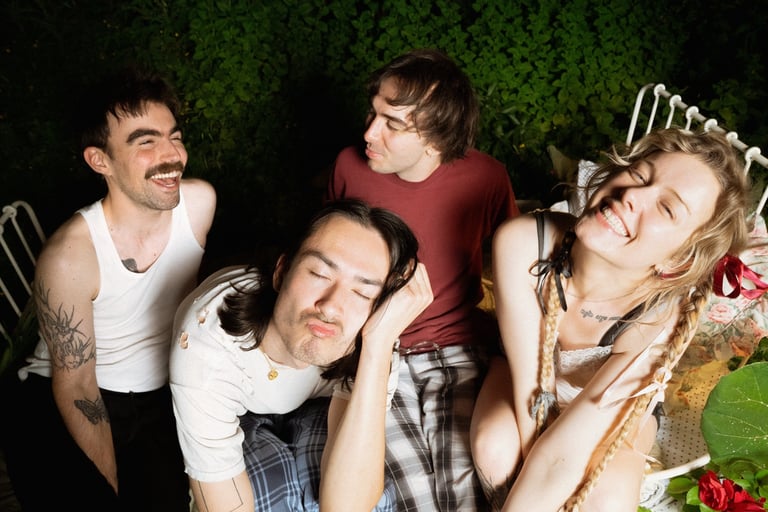
Navigating such hordes of new participants in the real and online worlds – and so quickly – would be challenging enough for a “normal” band. But PISS is not a normal band; indeed, their framing as a “punk band” or “hardcore band” falls short of what they do.
They are performance artists, activists, experimentalists, something we haven’t quite been able to categorise accurately. What other distressing, exhausting, but ultimately cathartic live show opens with a trigger warning and closes with an ending the artist keeps trying to change?
“The biggest question was this constant dilemma of how you write an ending to this that feels sincere in some way, because there isn’t an ending for trauma – it just keeps evolving,” she says of wrapping up the album. “Sometimes there’s hope, but pretty often you have this understanding that it’s something you will live with for the rest of your life in some way. I didn’t want to give this sense of despair because I don’t feel despair. Even just me being in this project is evidence of how far I’ve come.”
On “i keep trying to change the ending”, the album’s finale, clanging metal, chainsawed cello, and thunderous drums eventually, reluctantly give way to a reflective afterglow where Zantingh sings – or perhaps it’s more like an absentminded hum – “I won’t bleed forever.” It’s a powerful mantra, and the instruments know it; each time the singsonged words poke through this atonal war in the track’s first half, the rest of the band responds more angrily than before. But Zantingh drags them kicking and screaming into something close to peace. They fall in line. The album is over.
“The only way to end the arc where the album leaves off was to make sure there was a sort of ambiguity where it was sad and hopeful. You only get there after you listen to this big chunk of noise that makes no sense and is just annoying to listen to. Then you can have a moment of peace. It’s not definitive, but I do want people to feel hopeful because change is possible. You can’t go back, but you can get better.”
“Sometimes I’ll tell a story to my bandmates, just casually relaying it to them, and the look of horror on their face will bring me back and make me think, holy shit, I have really crawled my way, on hands and knees, out of this hole.”
Here are the Nine Songs that accompanied Taylor Zantingh out of the hole.
“Not Ready To Make Nice” by The Chicks
BEST FIT: First up is The Chicks, which I feel is quite an accessible introduction to the concept of a protest song. Is there something to that for you?
TAYLOR ZANTINGH: That’s exactly it. I heard it on the radio before I knew anything about politics or even really thought critically about music. I was in grade five or six. I remember my mum – who’s not a very political person – trying to explain to me what the song was about, and just loving the song but not really understanding why.
The idea that a person could be censored or isolated from the industry for voicing a political opinion just really shook my worldview at that young age, because that’s the kind of stuff you only see in movies and you don’t really think it applies to you or whatever. I remember this song as being this huge moment of, oh, this is something that music can do.
All the songs on my playlist are moments that aligned with where music met me at a time in my life, personally, that helped me elevate my idea of the power of music and drove me forward personally, while also pushing my practice further as an artist. It’s a very early example. I’d be like 10, I think, or 11.
I suppose that would be when I was having a similar experience with “American Idiot” or something. Did this instigate a Chicks phase for you, or was it more that the type of song led you down a different route – into protest music more deeply?
I grew up in rural Ontario, so my family was super into country music, and at this stage in my life I didn’t have a lot of agency over what I was listening to. I was just listening to what came to me. I did love country music as a kid, for sure, so I was already listening to The Chicks as a kid.
“Landslide” by Fleetwood Mac
BEST FIT: I like how this song starts from a place of doubt; she’s asking, “Can the child within my heart rise above?” – those kinds of questions – and then by the end, there’s no doubt, and she’s extricated herself from that person. It’s a really impactful narrative.
TAYLOR ZANTINGH: Yeah! This song has been with me for a really long time. It was on a karaoke singing game that I had as a kid, and right before my parents told us that they were divorcing, my sister and I were singing this song.
I didn’t have any personal connection to it. It was just one of the available songs. When we were finished, we turned around, and in the doorway, my dad was watching us, and he was crying.
I just remember being so confused about why he would be crying. I was in grade six maybe, so 12 or 13 years old, and I remember being so curious about the song and not understanding how a song could evoke so much emotion, because that’s the first time I saw my dad cry.
Then, getting older and starting to really identify with this song – it’s just stuck with me as this moment of appreciating the emotional impact that music can have, and the ability to bring emotions out in people that are deeply repressed.
That’s such a formative moment when you first see, particularly your dad, cry. It makes you feel so unrooted. Like, what the hell? I didn’t know he could do that.
Yeah! Especially because I remember not understanding why. It was probably before they had told me that they were separating. That time in my life, I learned a lot about my dad, and my dad has been through some of the worst stuff you can imagine. It kind of marked a turn in my life from childhood into seeing reality in a much colder light.
And the song has stuck with you since?
I heard the song when I was in my early twenties again. It came on the radio, and I was just like ooof. Because I didn’t understand it at the time. I remember reading the lyrics and being like, what is it about this song?
I had my little desktop family computer in the living room, like the big brick, looking it up. I always had a lot of curiosity about lyrics. I think this was an early example of me trying to understand “why?”, and I didn’t really at the time, because then shortly after this, I was into emo music and My Chemical Romance and stuff.
“Illustrated Bible Stories For Children” by The Weakerthans
BEST FIT: That leads well into The Weakerthans. Historically, this is my favourite band so I was pleasantly surprised to see this on here. With what you’re saying about lyrics, for me, I could tell the lyrics were special when I first found this band, at 15 or 16, but didn’t understand a lot of them. My relationship with them in the 15 years since has just continued deepening. But tell me about this song. Was it the lyrics that attracted you?
TAYLOR ZANTINGH: Definitely. This song is like a poem. That’s the foundation of it. It’s a poem in the way that, instead of telling you how it feels, it literally uses images and just images. Instead of saying, “I don’t understand my emotions and I’m feeling so much, I don’t know how to process it,” it says, “Blinded by heart, I cut my hair short.” Me in grade nine, I was like, what?
It’s the very early moments of me becoming more autonomous with my music discovery and not just listening to things that were popular at the time or that my parents listened to. I wrote the lyrics to this song in every notebook. I was just fascinated by them, and by how much power you could evoke and how much you could say without saying.
It coincides with – at the same time I discovered this poem in my ninth-grade English class by E. E. Cummings called “l(a”. His poem is almost a puzzle, and it totally changed the way that I think about language. I remember just looking at it and trying to decipher it like a puzzle.
It’s a simple enough poem that a child in grade nine can understand once you decipher it, but there are enough layers – I felt like a little genius when I discovered it. I was like, oh my god! Now I look back and I’m like, okay, girl. But these two things at the same time… after that, I was just obsessive about poetry and language, and it became a direction that I started heading in.
Right! Because John K. Samson also does the reading list thing that you were saying about with the PISS album. I remember going through the liner notes on the record, and it has quotes from Karl Marx and loads of others, and I was 15, like, who’s that guy? I’ll look into what that’s all about. But this one’s got the line, “I’d like to pull just this one building down.”
Ugh! It’s so good!
What’s your interpretation of that? I’ve always thought of it as focusing on your sphere of influence rather than trying to change the entire world. That idea tracked with PISS for me.
When I was young, I perceived that as this feeling of wholehearted obsession over one problem, and not so much that I don’t want to change anything else, but a humility in it, because the lyrics are almost like he’s begging God. There’s so much humility there, and it’s like, okay, I know I can’t do everything, but please give me the strength to just do this one thing.
It stuck with me because it was a time of great expansion in my life. My parents divorced, we moved into my aunt’s basement apartment, and I discovered the CD, which was my cousin’s, and I listened to it, and I was like, what is this?
It was a time of a lot of change, and I was feeling infinite, but also so small. I think it’s that sense of having such huge aspirations and huge feelings, but understanding that I have to just focus on this one thing.
“In Accordance to Natural Law” by Bikini Kill
BEST FIT: I had this in my 2025 Inauguration Survival Playlist because I always loved how bright the distortion is and how angry it is. I hadn’t paid necessarily that close attention to the lyrics. I just always loved how “get up and go” it is. But lyrically, well, you start.
TAYLOR ZANTINGH: I could have chosen any Bikini Kill song. I found riot grrrl at this very dark, horrible time in my life where I felt totally powerless.
This song is the one I chose because I remember being fixated on the lyrics, and also with this general ethos of riot grrrl to reject mainstream media so that they could have complete agency over how their story was told.
I really resonated with it at that time because I was the centre of a pretty gossiped-about assault in my hometown, and I felt very powerless to other people’s interpretations of me. I almost felt as though all these stories and rumours and ideas that other people had were influencing the way that I thought about myself and changing my own idea of my personal narrative. It made it really hard for me to understand what was real.
Being able to see this model of the rejection of other people’s stories about you, and also to understand that putting this practice in context with my childhood growing up in a Y2K culture that infamously loved to absolutely tear apart women celebrities for every little thing – loved to watch a woman fall – it was really important for me to see that you could tell your own story. It gave me permission to just block everybody out and write my own songs.
It wasn’t until riot grrrl that I started writing songs, and I wrote them horribly – very, very horribly. But it was important for me to try to find some sort of value in some part of my body, self, voice, whatever.
I like how, with each of these, you’re very much looking at the stuff around it. I think when I came to each of these bands, I was approaching it from a place of just enjoying the sound or something really simplistic. But you’re using music to contextualise your life and more in a really nuanced way that I should have done.
That’s something I noticed too. Maybe if I hadn’t had nine songs to define my whole life, I probably would have had lots of things that were maybe less [consequential] – but I have always had a journaling practice, for example, and I remember in my early journals having this sort of manifesto for myself: half of my life should be dedicated to experiencing and not thinking, and then half my life should be dedicated to reflecting on what I’ve learned from those experiences, and I shouldn’t worry too much about this when I’m doing that.
When I think about Kathleen Hanna or Ian MacKaye, I remember being so obsessed with the whole lifestyle surrounding the art they created and how their value systems were inextricable from their art. That might be why it took me so long to actually make good art, because I was much more focused on the ethos of something than the actual textural quality.
That’s so important. That’s how things get taken to the next level, and you don’t just end up with a bunch of bands trying to sound like other bands, but bands like PISS that make everyone go, there is no other band like this.
I guess I feel like I struggle with the influences question a lot for that reason, because sometimes I just feel like I’ve consumed so much in my life. There’s like a compost in my brain. I definitely have been influenced by so much, but I don’t think about it consciously.
“Argument” by Fugazi
BEST FIT: Ian MacKaye called this their anti-war manifesto. Is this another genre of protest song that you came to, and also how old were you around this time?
TAYLOR ZANTINGH: This would have been grade 10, so like 15-ish. This would mark my transition from that three-chord thing. If we’re talking about who radicalised me initially, that would be Leftöver Crack or something like that, something that’s super surface level but just blowing my grade nine brain.
But when we’re talking about things that withstood the test of time and really challenged me to take something that was an interest that maybe helped me connect to my peers and further it into a deep intellectual interest, Fugazi was a band that represented a perfect convergence of all the things that I was deeply interested in at the time, and the ability to write political songs that weren’t corny or derivative or surface level – to write about them in a way that really reflected the way it feels emotionally to be living in a system where you’re like, I cannot believe that we even have to ask that you don’t do this. That, paired with the musicianship, really elevated my idea of what music could do.
I listened to this whole album, The Argument, which was not a popular choice amongst my friends. But this would mark a time when I started to like a lot of things that my friends didn’t really like that much or my friends thought was less cool or something.
But I liked this record because of how political it was, and earlier songs of theirs like “Suggestion” – I liked that song at the time, but it always felt like it could have gone deeper. With The Argument, I just loved it so much. Even still to this day, I listen to it all the time and think about it and discover new things about it.
This was their last album, wasn’t it? I think it splits the room a bit. Some people say it’s the best one. With this song, I like how he really softly sings that line, “Here comes the argument.” It’s a striking juxtaposition between the words and the delivery.
Totally.
I guess it’s impossible to overstate how influential they were on having an ethical framework to your band. Do you think political art would look the same without them?
Oh, definitely not. The fact that they filtered everything they did with their project through this – there was no debate. It was just always, what they’re doing is for the audience. I’ve always struggled with this balance of: the best art is made for yourself, but once you decide to share it, you have to think of it almost as a service or a gift that you’re giving. I felt with Fugazi that they created art that was like, well, this is what we want to make, so we’re making it, and we’re passionate about it. That’s why there’s so much fire. That’s why they have that magic quality in the songs.
But then in the delivery, they thought about it in terms of, okay, what’s the kind of world that we want to make, and how can our art further those goals? That structural framework is exactly how I proceeded with PISS, and how I keep trying to return to that. Because the bigger you get, the more industry comes in, and it’s so challenging to make those decisions.
I’m the type of person who can make an argument for myself for almost anything to make it make sense. So I really have to sit in that place of feeling, where my intuition will just know something. With Fugazi, they always oriented themselves in a direction of the political focus of their movement. I think that’s why they’ve withstood the test of time so much.
“Heroin” by The Velvet Underground
BEST FIT: This is also quite a significant song for me. I remember coming downstairs one morning as a kid and my dad was listening to it, and I was like, what the hell is this? It completely blew my mind.
TAYLOR ZANTINGH: Yeah, because it’s quite an operatic song, and it’s like a whole emotional journey that’s so different. The choices that are made are very poetic: the drum sounding like a heartbeat.
For me, this song changed the way I think about songwriting for sure. It changed what I thought was possible with sonics in songwriting, and it coincided with a period of my life that was characterised by significant stagnation, severe depression, a lot of self-abuse and reckless decision-making, and just generally disregarding my wellbeing. For years.
When I was making this list, I came to realise that [at this time] my life was exploding with books I was reading, music I was listening to, so much possibility. And then events happened, and then there were just years afterwards where I was like, what was I really doing in this time, other than sitting in a basement that was mouldy, playing video games for 12 hours a day, eating cold canned beans straight out of the can with old dirty chopsticks, and telling myself this is life?
I almost felt comforted by this song because I just felt completely alone, and I was. I had lost a lot of friends. The song almost helped me – romanticise is not a good word, but helped me feel like I wasn’t existing in this place alone.
It doesn’t have an answer or a kind of thesis, because he keeps coming back to that “I guess I just don’t know” line, which can be weirdly comforting to hear someone say – especially if they’re, like, Lou Reed.
No, totally. That feeling of the cycle – it’s so hard to describe, but there’s almost, when you’re in that pit, like, I’m never getting out of this, I can’t get myself out of this, I really did feel for so long that this is just who I am. This is just what life’s going to be. Having somebody else give voice to that feeling of the cycle – I don’t even want to say helpful; it just meant a lot to me.
Thank you for sharing that. I think the music captures that so well as well. It’s so mangled and disgusting, but also just kind of lovely and hopeful.
It makes sense why a person would choose their own self-harm or degradation over and over and over again. It’s like a piece of magic to me.
“Dancing In the Dark” by Bruce Springsteen
TAYLOR ZANTINGH: I had heard this in passing because it’s on the radio and stuff. For about five years, during this depressive episode, I worked at Home Depot. I was driving to my six a.m. shift, and this song came on. For some reason, I was paying special attention to it, and the lyrics just shook me awake. I was in the parking lot of my job – it’s still dark outside – just crying. It was like a visit moment. Something about this song just woke me up, and it’s still my karaoke song to this day.
BEST FIT: I love a moment like that, a story like that – I can totally visualise it. Obviously, you said it was about the lyrics – but was any of this epiphany because the music was a contrast with what you were listening to, and it woke you up because it is so fist-in-the-air musically?
It would be a contrast to what I was listening to because during that period of my life I didn’t really do anything for myself. I got seven years of nothing. I was like, what the hell? It was a lot of me listening to whatever music the guy I was dating at the time was listening to, me just putting on a playlist on shuffle and letting life happen to me, in a way that so contrasted what I had been like as a child.
In this case, it feels like one of those songs that’s a bit more about feel-good escapism rather than one where it’s giving you a new framework for understanding things or jumping-off points. It’s just “this feels good” a little bit more. Is that right?
I guess so. I can’t really describe it. There was so much misery in my life at the time, and the song was so happy sonically, but then the lyrics being so depressing… A lot of times I feel like music that has affected me has almost given me permission to think in a certain way, or shown me a path, because I’ve always kind of felt in my life that I’ve been hacking through a bush, where I’m like, none of these paths make any fucking sense to me at all, so I’m just going to go through here.
You’re met with constant resistance, and you’re trying to get through and find something that makes sense to you. Art for me was always a beacon where I was like, okay, I’m going in this direction at least.
Do you mind me asking, timeline-wise, how old you are now, and how long ago this era was?
I’m 31, and the Springsteen era would be like 2016. I literally found this song. I quit my job. I moved to Europe for a summer, and then I went to university when I got home. It was so crazy because I had wanted to study – I loved school when I was a kid, and I had wanted to go to university. I was like, I’m going to get a PhD. I had so much excitement about the future.
And then I just never did anything, because when things happen to you that make you feel like you have no control or no power or autonomy, you don’t think about how that ripples out and affects your entire self-image, but it does. And it wasn’t conscious. It wasn’t like I was sitting there like, I have no power, therefore I can’t go to university.
It was this subconscious belief that’s like, oh, I thought I was in the driver’s seat of my life, but turns out anyone can just hop in there and do whatever they want with it. It took me a really long time, but I got there.
“Sad Pony Guerrilla Girl” by Xiu Xiu
TAYLOR ZANTINGH: The last two songs I wanted to do more recent influences, so this would be an influence that I could point to in terms of vocal delivery and storytelling for the record.
BEST FIT: I hear that for sure.
This song and the experimental ways that they work with sound in this song – it was completely earth-shattering for me to hear this, because there’s a little play that takes place in a weird noise [section]. I remember hearing this song and just being like, oh, you can do that with music.
It coincided with a time in my life where I was leaving a situation. I was leaving a relationship where I felt as though I was choosing situations that were harmful for me. When you zoom out and you look at the situation, you’re like, okay, that’s a harmful situation, but I was choosing to be there.
This is another perfect example of discovering a song at a time where what I was experiencing really mirrored what was going on in the song, and then at the same time, my artistic practice growing as a result of that. Because a lot of times my practice involves feeling deeply moved by something, and then analysing the fuck out of it to find out how they did that. How did you make me feel that way? And then trying to find how that makes sense in my own voice. So this was a huge influence on vocal delivery, specifically, on the record.
“Little Flame” by Carsie Blanton
BEST FIT: This one feels like a nice sister song to the Springsteen one: keeping that little flame alive / can’t start a fire without spark. I read the tiny-shreds-of-hope-that-you-hang-onto thing in “I won’t bleed forever” from the final song on your album. The repetition that you do.
TAYLOR ZANTINGH: I appreciate that. I think this song has very recently influenced me. It only came out last year, and it’s really pushed me in a direction of what I want to do with my time, because I never set out to be a musician. I never have had this career goal. I really like to orient myself in a direction, and then go, and then let the world – the mystery – tell me what it’s needed for me, if I’m being sincere and being true. This song came to me at a time when I was trying to do that.
I co-founded an organisation in my city called Fervorists, which is a group that organises shows in the city. They’re always fundraiser shows for local or international organisations. Let’s say local, because there’s legislation passing in Canada right now that’s making it harder for Canadian groups to support overseas initiatives.
We try to connect our local community, our scene, with social and political organisations, because I noticed at the merch table and at our shows that there were a lot of people who were engaged in radical politics of some sort. They were interested in it, but there were a lot of young people who felt super intimidated. They’re hearing buzzwords like “organisation, organise!” on Instagram, but having no idea how to actually do that. I have been there before.
My life completely changed when I stopped thinking about myself so much. There’s a trend in the world right now where you’re really encouraged to think about yourself, your mental health, your problems, your whatever, your image, as much as possible.
For me, when I started volunteering, when I started being politically active, a lot of these problems just went away. A lot of these problems are rooted in ego. I’m not thinking about myself any more because I’m just being, and I’m not thinking about who I am because I’m thinking about what I’m doing.
[I’ve had] a whole lifetime of being interested in politics but being intimidated to get truly involved, and it actually wasn’t hard at all. We host shows to fundraise for a local organisation, and then we invite other related organisations to ‘table’ so that people can come to the show and meet people who are looking for volunteers.
It’s literally like a job fair but for social organisations, like the Vancouver Tenants Union and whatever. It just feels right. I don’t worry about it too much or think about it too much because it’s just like, okay, this is obviously what I’m supposed to be doing.
Finding this song at the same time as we were getting started with this organisation, I just heard it and burst into tears because it does go back to that: I can’t believe that we have to be doing this work, but we do.
There probably will never be this huge revolution where everything’s perfect, but we still have to try. We cannot stop. Even if we’re trying a little bit, at least we’re trying. Seeing all these references to people who have done that – we have made progress.
To me, it does tie in with the end of the record too, because you keep working, you keep trying, and some things will get better. You have to find some sort of peace and satisfaction in the work because the work will never stop.
It’s not a happy ending, but it’s enough for now.
It’s a sense of purpose. A lot of people are looking for a sense of purpose. What they think they’re looking for is a happy ending. But when you commit yourself to working on something that matters to you, the ending doesn’t matter as much.
you made me / skin on linen is released 30 October 2026 via Sub Pop
Sign up to Best Fit's Substack for regular dispatches from the world of pop culture