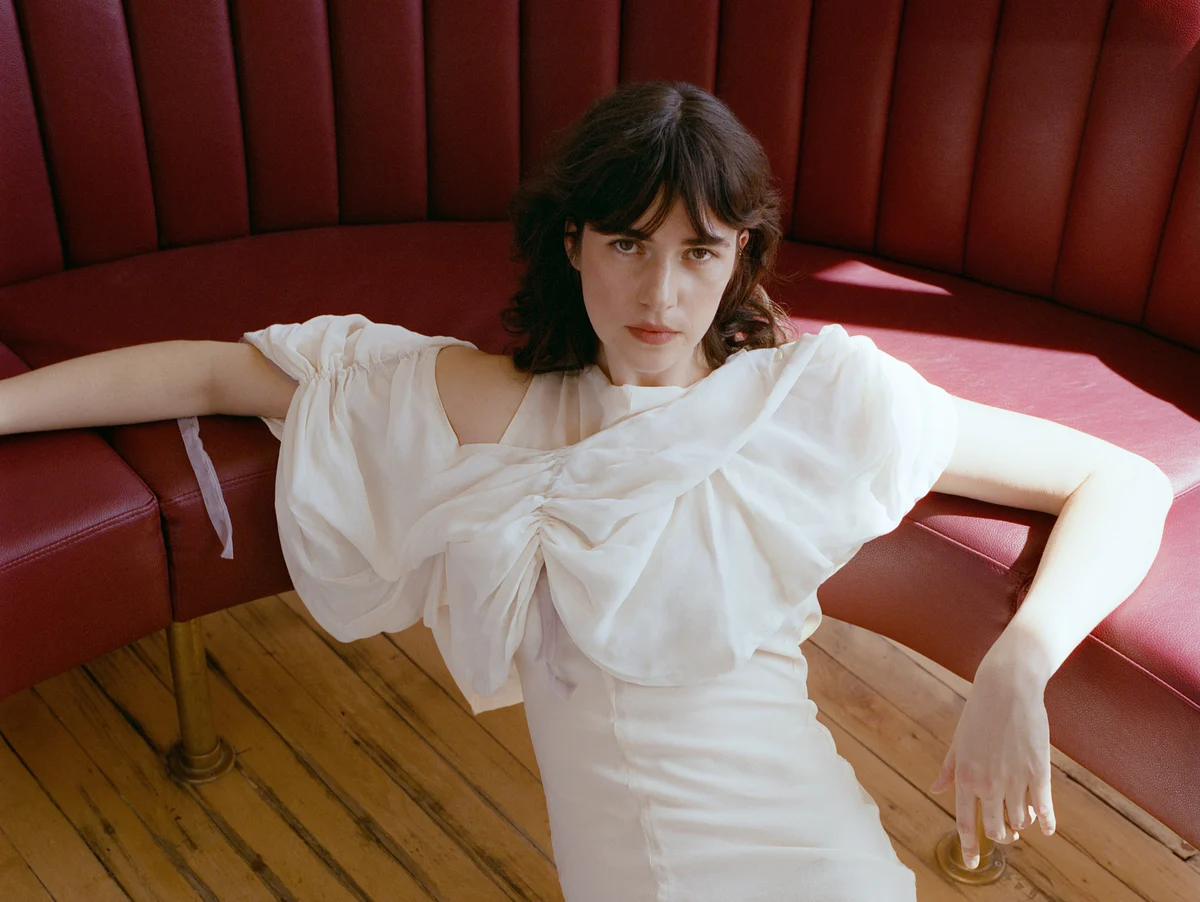
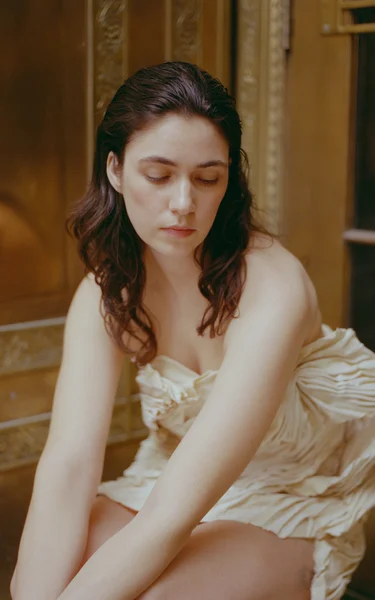
Le Ren’s songs love her back
Montreal-based singer-songwriter Le Ren tells Kate Ratner about the power of writing a song for someone else – a consistent source of magic whatever stage of love one finds themselves in.
Lauren Spear has a knack for magic.
Not the rabbit-out-of-a-hat, abracadabra kind of magic – the magic of made-up worlds, 90s children’s films, and swimming in the rain. Spear was raised on Bowen Island, a dreamscape located just a 20-minute ferry ride from Vancouver. The island taught her about magic – about curiosity, creativity, and imagination. On 28 August, Spear, better known as Le Ren, will become the teacher with the release of her sophomore record Don’t Be Funny Without Me (DBFWM).
I saw Spear perform for the first time at Le Festival d'été de Québec last month. The singer-songwriter played an intimate evening set that left my heart swelling. It was Spear’s first time playing songs from her new record, but nobody in the crowd could tell. My best friend and I sat on the steps of the Place D’Youville, with bottles of blue Gatorade and tears streaming down our cheeks.
The night before our call, Spear went to a Big Thief show in Montreal, where she has lived since uni. She was joined by her boyfriend, two friends who had separated years ago, and a friend and their partner who are on the verge of ending things. “Everyone’s in different stages of love, but [were] all really feeling these songs,” she says.
Adrianne Lenker is one of Spear’s songwriting idols, alongside Julia Jacklin and Audrey Hobert. “It’s so cool to see a room full of people watching this woman who is talking about getting older and gender and sexuality in these nuanced ways. And everyone is hanging on her every word – you can hear a pin drop,” she tells me. “I’m so relieved and excited to see that people are showing up for this kind of writing.”
Spear has been writing music since she was a kid. She learned from her father, Ted Spear, who released his first record this year with her help. He writes songs to commemorate major life moments: birthdays, weddings, anniversaries, funerals. “In the process of making his record, I was like, oh, you’re the reason I write this way,” Spear says. “The best thing I can do for somebody is write them a song. I think it was something that I didn’t realise was so rare and special until I became an adult.”
Spear comes from a family of creatives. Her mother fell in love with bluegrass music in her fifties, and has taught herself to play several instruments since. Her two older sisters are filmmakers whose works have heavily influenced Spear’s music. Growing up, the Spears didn’t have to stray far from Bowen for creative inspiration. “We were allowed to have such an expansive imagination, because you kind of had to,” Spear says. “We didn't have any stimulus other than our own minds. I was just able to run around and be really free and be by the water and be in the woods.”
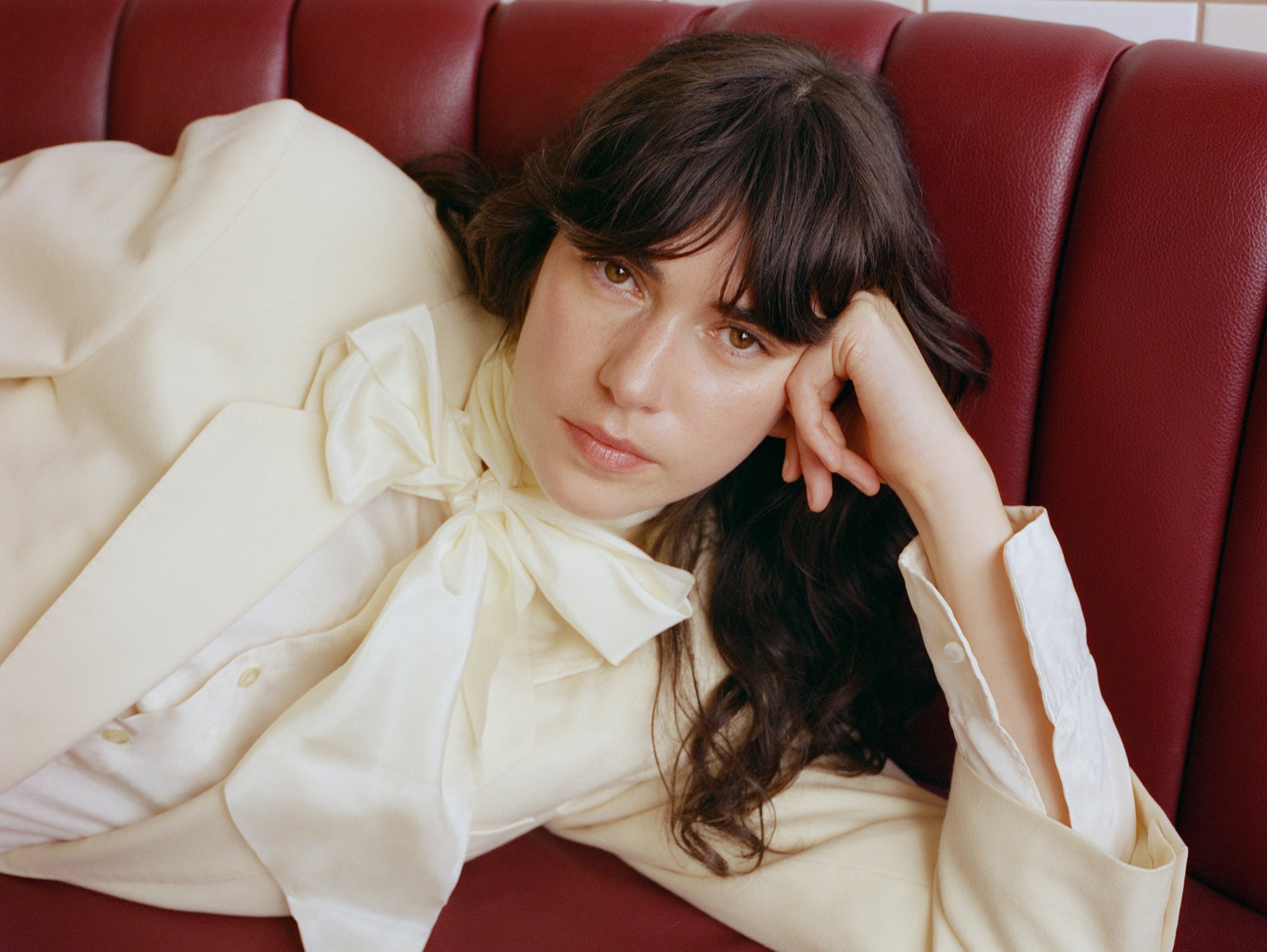
After secondary school, Spear moved to Montreal to study art history. “[Montreal] was this entry point into this world of music and people and culture that I had been looking for on Bowen,” she says. We discuss Chandler Levack’s 2025 film Mile End Kicks, a coming-of-age story set in Montreal’s early-2010s indie music scene. “It was so weird watching that movie because that's around the time that I had moved to the city, and it was just so electric,” she says. Spear was living the Canadian dream – a stone’s throw from Grimes and Mac DeMarco in their early years.
Spear released her debut record Leftovers in 2021, a “very stripped-down” Covid-era project. She worked with producer Chris Cohen (Weyes Blood, Cass McCombs), layering in tracks her band members sent from home. “I really wanted this record to be like a bunch of my friends in the same room,” she says of DBFWM.
And so, Spear spent two weeks at Port William Sound in Mountain Grove, Ontario, with a pack of her most musical friends. DBFWM is co-produced by Spear, Jonas Bonetta (Evening Hymns), and bandmate Fez Gielen (Farser). “I didn’t work out any of the parts before, so we really came in and workshopped every song together,” she says, allowing her to experiment with instrumentation. “I was like, the more the merrier!” she says. “We had drums, we had electric guitar, we had fiddle.”
DBFWM is a “portrait” of Spear’s 20s, being released at a wiser 33. “There are many different romantic relationships with separate people in the record. There are relationships with my friends,” she says. “I think it's just a lot of chaos and stumbling through this time period, making a lot of mistakes, and ultimately, the focal point being music and having this craft that I discovered that became a primary relationship for me.”
Much like Spear’s favourite childhood films The Secret Garden and The Little Princess, this record is warm, expansive, and transcendent. DBFWM is bookended by “A Song Can Love You Back” and “Epilogue”, two piano-forward halves of a whole. “The prologue is falling in love with somebody through music, and then at the end, being like, I can have that for myself. It doesn’t have to be attached to someone,” Spear says. “My songs will love me back,” she realises in the final track.
Spear wrote lead single “Free Wheelin’” in 2019, a nostalgic tale of ephemeral romance. At the time, she was obsessed with The Chicks’ 1999 record Fly. “I really love country pop music. And for a while, I was ashamed of my music taste,” she says. “I was just listening to that album on repeat, and I was like, I’m so happy when I hear this, and I really want to write a song that makes me happy.” “We’ll part ways on the interstate / With no words to say, just a feeling that it’s time,” Spear sings over bouncy fiddle. “Country music has this wonderful way of writing about really crushing things, like letting go of somebody going through a breakup, but having this spin on it that’s very bright,” she says.

“Otherwise, I’m Fine” is an ode to Spear’s first time touring in the UK and EU. “I took one of my best friends, and she was the tour manager slash driver because I didn't have my license at the time,” she says. “I had no idea what I was doing, and neither did she.” Spear’s vocal is delicate and smooth, akin to her folk godmothers Gillian Welch and Laura Marling: “You could carry it all / And I could carry a tune,” she sings.
Spear writes about her best friend Ali Vanderkruyk often. “I’m a Cancer and [Vanderkryk’s] a Capricorn,” she says. “We're opposites, but the way my friend explained it to me was like: you’re sitting on opposite sides of the table, looking at each other. So, you see each other, even though you couldn’t be more different.” Spear claims that she isn’t big into astrology but entertains an annual birthday reading.
Reminiscent of Big Thief’s “Certainty”, fourth track “Gold in California” feels like rolling hills. It’s earthy, whimsical, and perfectly imperfect - much like its accompanying music video. Directed by Talvi Faustmann, the video features Spear and Gielen as “Cheerful Girl” and “Boy Who Needs Cheering Up.” The pair spend a sunny day climbing trees, exploring a mall fantasy fair, and slow-dancing in a picturesque mansion. “[Faustmann] has this friend who has this insane house in Toronto who let us shoot there for free,” she says. “He’s this eccentric man who has this crazy collection of art. There’s no way you could have made a set look like this because it’s just so personal to him.”
If she could, Lauren Spear would put out a record every year. “I write in a way that’s kind of continuous,” she says. “I feel like I always have a backlog of songs because I like to write as if I’m journaling.” DBFWM plays like a journal, with confessional songwriting following Spear through her most transformative years. She’s excitedly anticipating the day she can share her songs with the world, but plans to avoid streaming statistics at all costs. “My astrologist friend said, ‘Do not look during release week!’” she says. “So I will be putting my phone away and cracking the champagne!”
Sign up to Best Fit's Substack for regular dispatches from the world of pop culture