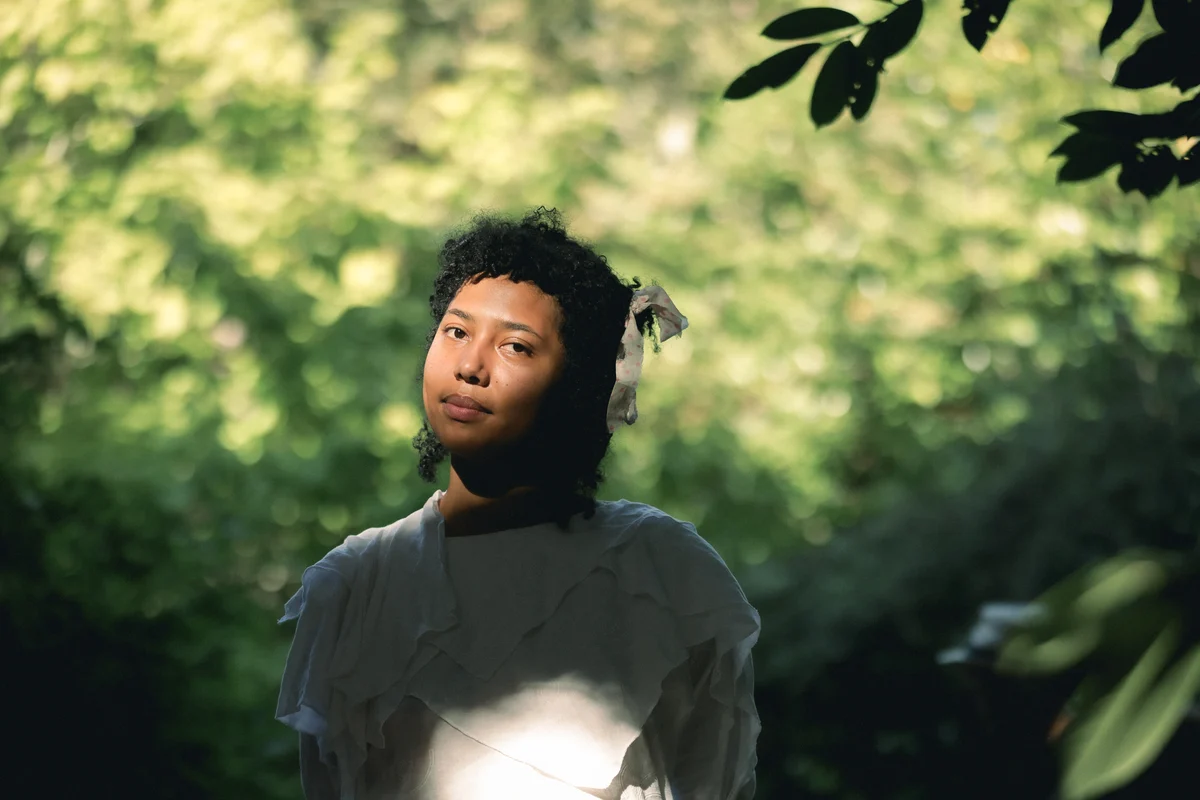

June McDoom is writing her own history
June McDoom’s new album is cut straight out of her, she tells Josephine Illingworth as they discuss existing outside of boxes and leaving sonic fingerprints.
June McDoom is not a folk artist.
She sits across from me in the noisy pub garden, a couple of hours before her London headline at The Old Church. “I feel like I’ve been forced to be like, ‘I’m a folk singer,’ which I’m cool to say because I love folk. But anyone who is really knowledgeable about folk is going to be like, no. So I feel weird saying it.”
I’ve been listening to her album for the last few days. It’s a thing with many heads, moving in unexpected patterns, delicate and vivid and often both, laced with seams and wings like folded cloth. We are discussing genre as an instrument of power in the music industry. “Everything I read about you online is about genre,” I say, “about you mixing this and that.” She laughs. “It’s so hard because anytime anyone asks me about genre, I just feel like I have to give a weird answer, I just have to force something out. Sometimes people are like, ‘What do you make?’ and I’m just like… ‘I sing and play guitar.’”
I wonder if genre is a boxing in, a hat forced upon the head of female, guitar-wielding artists, with a set of instructions written alongside it. Once the hat is on, everyone can look away. June McDoom’s music is not folk, and there are no hats or instructions to be seen. Instead, it is a sound informed by her own history and her own self, it is full of her presence. “Honestly, if you listen to it, you just hear whatever it is.”
We move onto her process, how her own selfhood became embedded in the album. “I write on a nylon string – the foundation of the song, like guitar and voice, and I don’t really think about any of the other instruments at that stage. We’ll start by thinking about the way we want the song to sound.” “What do you mean by sound?” I ask. She pauses. “I think when most people listen to the song, they’re listening to songwriting and harmony and the rhythm. I don’t think people ever intentionally listen and think, ‘Oh, this sounds dry or this sounds close to my ear.’ But I think it’s a really essential part of a song that people don’t realise they’re experiencing. It’s kind of like an instrument in the song, the way the recording sounds.” It’s one thing that defines Follow The Light: this meticulous attention to recording process, which conjures structures and spaces you wouldn’t find in folk.
“Then we multitrack each part. I’m a super big part person. I love when we’ll come up with a part and it becomes the song’s identity. When we’re figuring them out, I’ll sing the parts, which is why people say that my music is very melody-heavy… because that’s how we make all the parts of the track, they’re all vocal melodies.” Amongst the album’s mellifluousness, it makes total sense that the songs are all made of voice. They have the accidental, incidental sense of movement that only a sung melody could conjure, and it spreads her presence through all the track’s elements, even to the bass.

McDoom’s voice is distinct in itself. “I have a strange voice to capture because there’s a lot of air in it. When I hear myself singing I’m hearing a lot of textures that I want captured. Different mics capture my voice differently, and they’re not capturing the whole thing I want.” To combat this, McDoom approaches recording like a puzzle, mixing multiple microphones, and slowly fitting parts and strange sounds into the right place, rendering her songs tactile and unexpected. She works with longtime collaborator Evan Wright in a kind of symbiosis; “Evan’s a piano player, so I’ll sing the top line of what I like the part to be, and then he fills out the rest. We both listen to the exact same music, so he understands the context of where I want a part to be when I sing the melody.”
Another collaborator on the album is her grandpa, a distinguished Mento man, who appears on one track via a voice note, sent to McDoom by her dad in Florida. Even in the iPhone microphone, his voice is startlingly deep, almost uncanny, sitting far below hers in the track. “You would expect that we played together at the same time, but we didn’t,” says McDoom, which to me feels exactly as it should be. Nothing in this album is obvious or easy. The process, often roundabout and rehashed, conjures a music that feels beautiful in its strangeness, and it is these traces of her musical upbringing, scattered through the songs, that preserve her voice. “It’s cool to give people context, to do something weird and a little different. In this album I want to introduce people to the music that I’m really nerdy about. A lot of people don’t really listen to a lot of genres of Jamaican music. So if I can just add little elements, that would be cool. The music industry is so uninspiring; artists are having a hard time. I’m going to do anything I can to make it worthwhile, just by trying something differently.”
Recently, McDoom signed to indie heavyweight Jagjaguwar, a label home which has been supportive. “But once you start growing as an artist it’s weird. You have to become a brand that advertises yourself. You can’t not do it, and you just end up overthinking. I don’t even want to be thinking about posting. I’d rather be doing something healthy for my body.” This fate of the musician, endlessly defining yourself in public, becoming something akin to a brand, is one McDoom does not sit comfortably with. “There’s so much that we’re consuming constantly, so I want to make sure that everything I make is something that is really intentional and thought out. If I have to contribute something I want to be like, at least I thought about it for a while.”
She shows me the poster she has made for her tour, printed with ribbon bought in a shop in Manhattan and overlaid with coloured feathers. Her face is half-silhouetted in the centre, looking away from the camera. “I have a hard time showing people the music I make. All my friends are like, ‘can we hear your music?’ and I’m like no. You can listen to it when it comes out. I’ve worked on it for so long, and I want people to experience it in the right way.”

The art of taking time and space for her project is one that seems rare for a woman in this industry. “I had so many experiences with people being like, ‘you don’t know anything.’ It’s really hard because it’s such a male-dominated space. I’m kind of proud of the fact that I can’t help speaking my opinion, because I care about the music so much. It’s my own music.” She laughs. “If you’re in the studio and you aren’t super clear about a song then the project is going to sound like the engineer’s project.”
You can hear this doggedness from top to bottom in the album, in its deliberateness, in her choice of samples, and in the visual world around it. “I feel like I’ve always grown up not being in spaces where I necessarily fit in. So I want to encourage people to make things that they think are weird. If you’re really into something that maybe your friends aren’t, you should still make it, because maybe you can convince your friend to like it. You want to convince the people you love to be into the things you love.”
So here we are. June McDoom is still not a folk artist. Follow The Light is an understanding of all that makes up herself. Cut straight out of her, her family, her childhood, her friends, her influences, her relentless commitment to artistry in production and recording. The genre is herself, itself, and defined only by a fluidity. “My parents don’t like folk music but they like the record, because they like reggae music, so they’re like, ‘Wow that’s really cool.’” She pauses. “But they’re also my parents.”
Sign up to Best Fit's Substack for regular dispatches from the world of pop culture