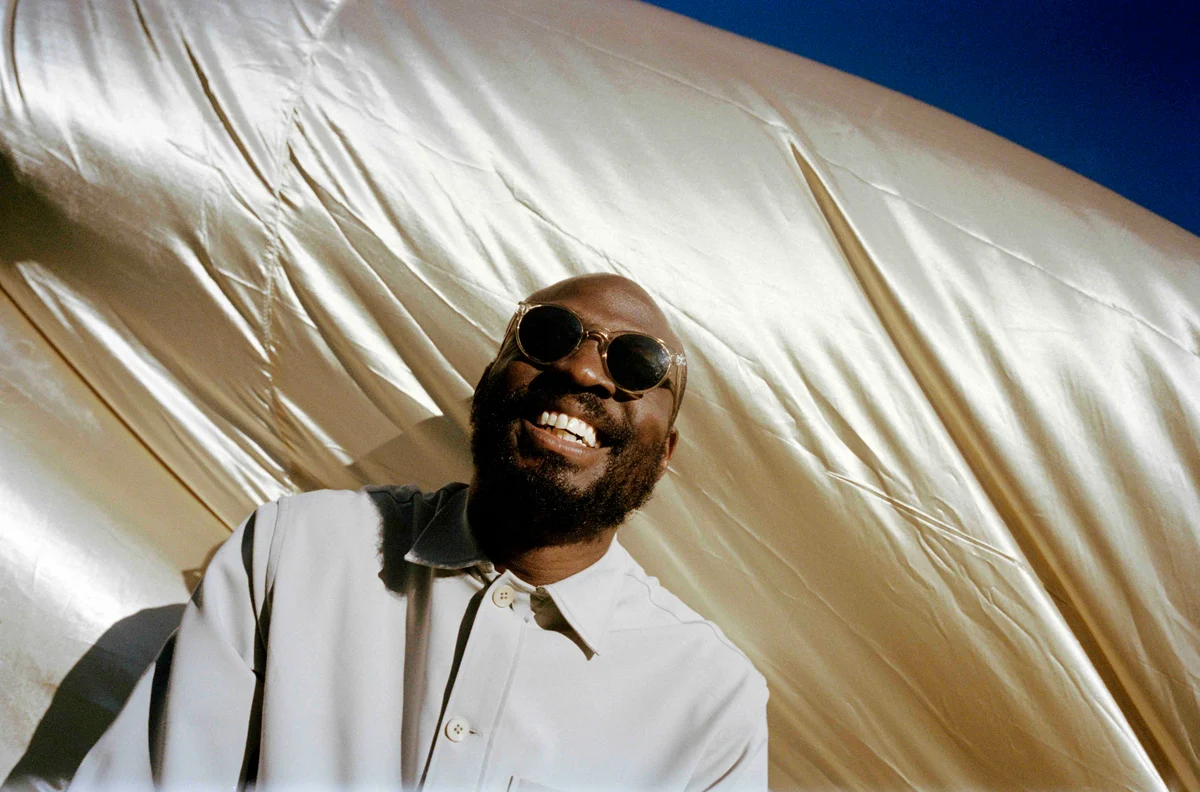

The extraordinary philosophy of Joshua Idehen
Thorough a summer of playing festivals across Europe, Joshua Idehen has learned to reshape his work around every audience and help poetry find a new place on the international stage, writes Emmeline Armitage.
Remarkably, it’s been over 10 years since an inspired Joshua Idehen took to Twitter to air out his latest pithy, poetic remark: "Matriarchy: your mum does the washing. You do the washing. You are really happy pilling [sic] your weight in the house."
Moments later, he would add to the chain: “Mansplaining – your mum does the washing. You pay her a dollar. You get her to do your mates washing. Your mate pays you £50.” And so the thread continued…
If those words seem familiar to you, it’s probably because that exact chain of tweets has turned slowly but surely into Idehen’s musical life-force, in the form of the tense, experimental electronica that in many ways has changed his artistic practice forever.
"Time equals value," Idehen tells me. “As a poet what I try and do with my work, what I hope to achieve in my work is being able to shine a light on that. I think in the past I thought that meant writing the most detailed, most intricate lines, but now it’s saying it as simple as I can.”
When the London-born and Sweden-based spoken word artist – inspired by the likes of Scroobius Pip and Dizzee Rascal – began experimenting with music, it came most excitedly in the form of collaboration between himself and Swedish producer Ludwig Parment. And when it came to making an album together, Idehen knew straightaway that he wanted a centrepiece, something to hit an audience’s gut with truth, something as powerful as that series of tweets-turned-performance poetry.
“Because the poem [Mum Does the Washing] had predated the band, we didn’t really feel like there was a strong opportunity to convert it into a song – it was also quite long,” he explains. "And then in 2024, I remember hearing something particularly bad on the news about what was going on in Palestine and I went to add a section to the poem, which is when I reached out to Ludwig for some music.
“Initially, he couldn’t think of a way to make it work and I was insistent it needed to be dance-y house. We let it sit for a while and then eventually he sent me a beat saying ‘I’m not sure you’ll like this but this is what I’ve come up with,’ and the moment I heard it I knew I had to finish writing it, to finish fitting it with the music that night.”

Those potent and politically astute observations have had manifold creative iterations, but are now one of Idehen’s most recognisable raptures; it’s the tune that instantly rouses and rallies an audience when performed on stage, or the song that people show their grandchildren, their students, the stranger they get to talking to on public transport.
“When we started playing it initially there was a decent response, especially in London, but we were cautious. We thought nothing is ever just the big arrow, the hot knife to cut through butter. But then one day our book agent in Sweden told us 'I’ve just heard “Mum Does the Washing”, it’s going to change your life.' And I’m still cautious, but let’s just say the butterflies are blossoming.”
The song is a perfect example of what Idehen does best: turning the language of the everyday into something extraordinary. His album I know you’re hurting, everyone is hurting, everyone is trying, you have got to try. was released early this year by legendary indie label Heavenly and is a mirror to that philosophy, featuring songs that are as much found poetry as musical observation.
For example, the opening track “You Wanna Dance Or What?” references the time when Idehen was sat collecting himself on the club steps when a stranger called out to him, “Come on man, don’t be sad. There’s no darkness here.” Or there’s the effervescent bop “It Always Was” that sees our MC “beaming” in the “backseat of Benji’s Mazda” – an ode to Idehen’s youth spent in busted cars, “trying to get into clubs while Black and male in the noughties,” and savouring the phrases of friends who settled on “What’s for me will find me anyway."
I ask Idehen what particular use of language or shape of sound attracts him to a phrase, and makes him want to include it in a song: "First off, it’s a clever use of words. I love when a turn of phrase has been twisted just a little bit – that’s my catnip. For example, I have an old friend Katrina, and we hadn’t seen each other in years, since Iceland Airwaves festival. And I asked her how she’d been doing and she said, ‘Yeah, you know, just ticking along, really struggling with this joy as a kind of resistance thing.’ And that was just like. ‘Ohhh, shit man.’ It’s terminology I use and believe in, that I think about a lot, but also have been dealing with the thought of how can you dance at a time like this, knowing fully well that I live in a very complicated, compromised society?"
He continues: “I also love turns of phrases where it's anything that has a tiny little bit of truth at its centre. Someone will say ‘curiosity is a cat’ and I’ll think how can I make this mine? Curiosity is a cat killer.”
This summer, Idehen and Parment have taken the album live to many corners of Europe with the aid of the European Talent Exchange (ETE). Part of the boundary pushing Eurosonic Noorderslag Foundation’s attempts to put European music on the international stage, the pair have been playing a myriad of festivals and curated events to new and growing audiences.
"It’s been a dream to play live, there’s no other way to put it. We’ve had an incredible summer. I’ve been given the opportunity to travel pretty much every corner of Europe – from Poland to Switzerland and right down to Hungary. It’s been hugely beneficial to getting word out to our fanbase. I don’t think we would have sold as many tickets for tour if we hadn’t done local festivals in different regions. When do you get the chance as an artist to perform music in places that are just so far out of your sphere, where you’ve never been?"
I ask if there’s been any surprises along the way: "A good example is we did this festival in Switzerland. It was a free festival and I was pretty certain that no one would turn up, or that people would have something better to do than listen to spoken word. But the place was rammed. It’s an amazing feeling and it’s been a blessing of an opportunity."

It’s almost as if Idehen, a Forward Prize shortlisted and much beloved poet, was bound to create something musical, despite what he admits to as having little in the way of formal musical education and training. His discernment therefore lies in the language, and the unique ability to structure that language around the emotional anchor of a bassline, or a synth stroke. In playing the songs live this summer, he’s been able to realise the final element of this project: “As a spoken word artist writing is one half of the art. Yes, when it’s written and recorded that’s one aspect of it, but its full form is when it exists on stage, when there’s a dialogue with an audience. It always feeds off the energy of the audience.”
There seems to be a very direct relationship between Idehen and his audience, and the way the songs come to life: "If the audience is dancing that’s gonna make me dance. Sometimes when I perform in places where English is a second language people might latch onto the emotive nature of the work or they might be dancing to the music and I’ll follow suit.
“We’ve got this song called ‘Brother’, which is an interesting one cause I get people to hum in the starting key of the song. It’s an intense performance, about one man telling another to fix up, and sometimes I perform it to silence, but other times with the hum the whole audience joins in and keeps it going completely unprompted. My work is designed to change, to react to how people receive it.”

Just last month Idehen released a new single, a collaboration again with Parment but also with Hot Chip’s Joe Goddard – a strong stamp of approval from the EDM community. In it, he declares “I got McKellen, you got Spacey / I got Macklemore, you got Spacey / I got P Square, you got P Diddy.”
The lyrics are brazenly prescient, and speak boldly and clearly to a music industry in crisis, once again displaying his seemingly natural ability to render the sometimes unspeakable as immediately perceptible.
“I always thought that I needed to write about big things,” he explains, “…the big end of the world, but really you don’t talk about the war, you talk about burnt socks. You don’t talk about the fact that Palestine is terrifying, you talk about the fact that on TV you saw two kids break dancing in a crater. I try to say things in a way that are true to me, as honest to me as possible. There is always extraordinary in the ordinary when you look at it more.”
He pauses, and then continues: “Everything is extraordinary if you look at it hard enough. Everything has depth if you give it enough time.”
I know you’re hurting, everyone is hurting, everyone is trying, you have got to try. is out now via Heavenly. Who will be the next act with such a success story at ESNS 2027? Check the full lineup.
Sign up to Best Fit's Substack for regular dispatches from the world of pop culture