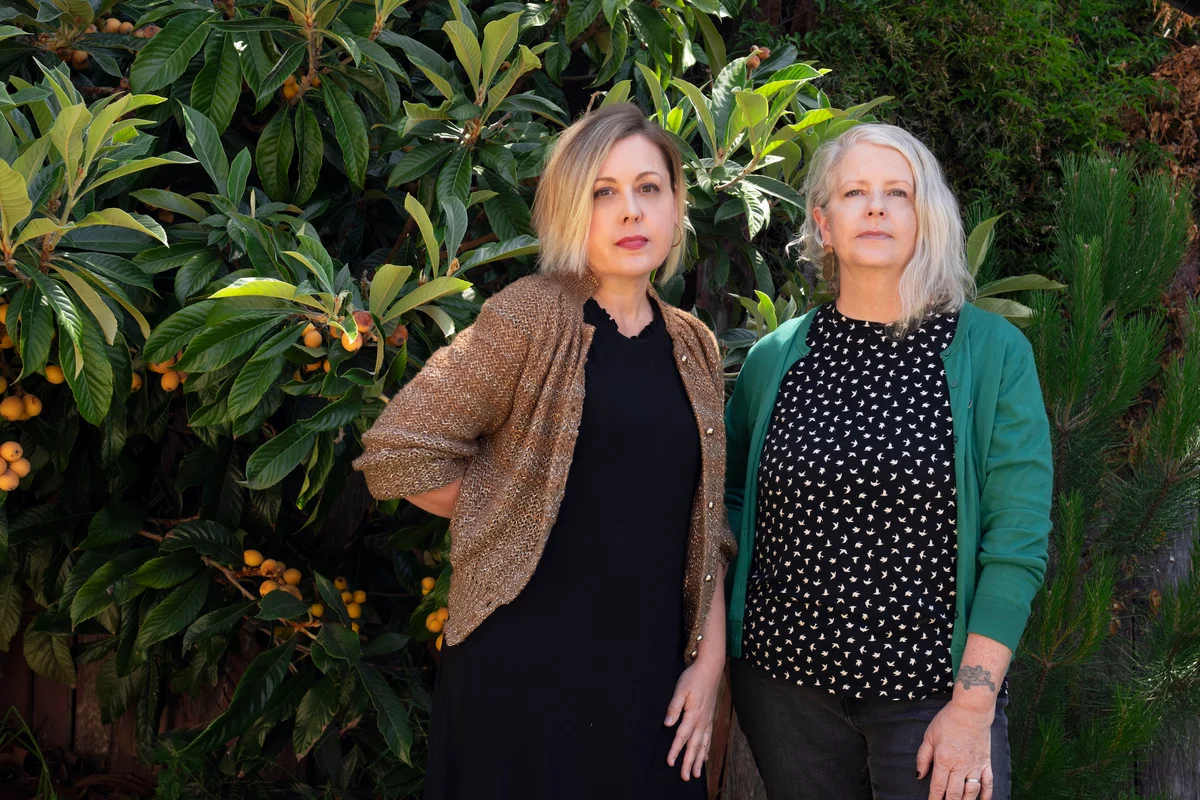

heavens to betsy on their reunion grown-up style
The last of Olympia’s three original riot grrrl bands tell Vida Hasson why now was the right time for the world to revisit heavens to betsy.
If writing about music is like dancing about architecture, then writing about music written thirty-five years ago must be like singing about psychoanalysis – but not for heavens to betsy, who find more recognition today than when they first set out for revolution girl-style three decades ago.
heavens to betsy formed as the last of the three original riot grrrl bands out of Olympia, Washington, in the early 1990s. The duo’s music perforated the masculinist punk scene with hair-raising screams and pointed frowns with visceral lyrics typical of the riot grrrl milieu on subjects like sexual abuse and harassment. For the first time since 1994, the band will reunite in celebration of their new LP, Baby’s Gone, featuring never before heard songs and demos recorded by Molly Neuman of Bratmobile.
Several years ago, heavens to betsy’s riot grrrl sisters, Bikini Kill and Bratmobile, began performing again to thrilled multi-generational crowds. Their Queercore cousins Team Dresch began kicking it with Third Sex in Portland, but where was heavens to betsy?
Sleater-Kinney veteran Corin Tucker (guitar, vocals) always kept a reunion in her back pocket: “I have lived with feeling a little bit regretful of not giving the band its full due.”
A heavens to betsy tour tickled DIY lifer and drummer Tracey Sawyer as much as donating a kidney might: “I thought, yeah, right, I’m not doing that. It was a lifetime ago.”
The band’s decision to return came down to timing. The question why now? deeply mattered to Sawyer and Tucker’s decision to reform the band they started in their teens. There is something about being in your fifties, they explained to me, that smells a lot like being in your twenties. The I-don’t-give-a-flyin’-fart attitude, especially amongst politically minded punk rockers, comes back 30 years later as a more honed version: “When you’re in your fifties you don’t really give a fuck,” Sawyer explained. “You learn what needs your attention and what doesn’t.”
Tucker agreed: “How great to be able to come back to the teenage version of yourself which has that [attitude] and be able to perform again.”
Earlier this summer the duo played a secret show in Portland as a trial run for their reunion. Before the gig, Tucker considered how she would approach the voice of her teenaged self in her fifties: “My instincts were to not soften anything about these songs or the voice I used in performing and to let it be as raw as possible.”

Several songs on the album come from their previous EP release These Monsters are Real (1993) and the 7’’ Direction (1994). In the recordings you can hear Tucker finding her voice for what may be the first time: “I included some songs that I needed some coaxing to include on the compilation,” Tucker said. My favourite song on Baby’s Gone is “Firefly”, and not because Tucker shouts, “A bug! Kill it! A bug! Get it!” – my new soundtrack for the silverfish living behind my radiator.
“Firefly” starts out with some pleasant chords and a jangly drum. The firefly represents Tucker’s voice. We all know she has gone on to become one of the most respected musicians, at least in the feminist sense, of all time. In “Firefly” her voice emerges, a little shyly, for the first time: “Sometimes I look for a safe place to free my little bug / sometimes it flutters around trapped and I feel so sad / but I know what would happen if i ever let go of it / i think that this cruel world would surely kill it.”
I want to say no, little lady, the world will not kill it. In fact, the world fucking loves it thirty-five years later.
“You only get one chance to write songs like that,” Tucker said about Baby’s Gone. “I love being able to return to that place.”
Baby’s Gone strikes a chord so deep with a voice so open, it sounds like listening to your diary’s diary – if your diary is well versed in feminist theory. Riot grrrl gobbled up academic feminism in college like it was hearty chicken noodle soup. (Kathy Acker was the soda on the side.) The first song on Baby’s Gone, “good food”, which works well in conversation with Bikini Kill’s “Feels Blind”, refuses to accept misogynist social learning: “This bitter pill / this is society’s poison / that makes me say I can’t.” In an echo of Pink Floyd’s “Another Brick In The Wall (Part 2)” heavens to betsy offers “factory”. A slow rumbling of bass and vocals turns those wordy Marxists and Frankfurt schoolboys into a one-and-a-half minute scourge of capitalism.
Ad nauseum riot grrrl histories cite location (Olympia), scene (punk), and time (early 1990s) as the critical forces behind the movement. The overemphasis on time and place neglect the intellectual work these young women put in their music, lyrics, and culture. While at Evergreen State College, Tucker read Unpacking the Invisible Knapsack, an essay published in 1989 by academic writer and speaker Peggy McIntosh. As the only riot grrrl band who lyrically navigated their own position in the “punk white privilege scene” (“Axemen” from Calculated, 1994), this inspiration is plain as pudding. The essay elucidated, from white woman to white woman, white privilege in America as it operates on a daily basis.

heavens to betsy put their name in lowercase letters (even if many publications do not follow suit) in reference to, or at least inspired by, the feminist writer and theorist bell hooks. “I had been in this very thought provoking environment,” Tucker said about her time at Evergreen. “But the voice I was using was very personal. That was inspired by listening to Bikini Kill and Bratmobile.”
Riot grrrl stays relevant because (enduring misogyny) they prove the entry point to performance, art, writing, and punk in particular is a borrowed drum kit and something to say. Their music pulls the listener into what feels like the most Joan Jett girl-in-school’s bedroom – where you get to see her posters, her favourite records, and how she thinks. She might even tell you what pisses her off and how she plans to kick her dad’s ass!
By the time heavens to betsy recorded Baby’s Gone, Tucker and Sawyer had already acquired a drum kit in bits and pieces on a trip to Atlanta to study its music scene. (Back when they called themselves This, That, and The Other.) From there they switched the name, borrowed ideas from academic feminism and the voice of their riot grrrl predecessors, and combined it with wisdom earned from their own lives. This perfect tonic still inspires riot grrrls around the world.
heavens to betsy wish they could tour Baby’s Gone like Bob Dylan or Iggy Pop might play a newly discovered demo tape, as a fun jaunt to a bygone era, but riot grrrls don’t have the luxury. “I would much rather talk about Baby’s Gone in a historical context, like, ‘Oh this was back when things were so much worse.’ Instead of what we are dealing with today: The rollback of women’s rights,” Tucker says in a dead pan.
The heavens to betsy resurgence reminds us of riot grrrl’s intentions when they started in 1990: to show women and girls they can do this too. “I’m impressed that we were able to record knowing that it wasn’t polished and that we weren’t the best musicians in the world while feeling like we wanted to get our music out there. It was coming from a place of frustration, but also love,” Sawyer tells me.
riot grrrl alone would never be enough to bring about universal human rights, though they made massive waves, or several dozen ripples, or at least some punk rock plip plops. Maybe – I don’t know, you can go see heavens to betsy on tour this fall and borrow their courage to start something too.
Sign up to Best Fit's Substack for regular dispatches from the world of pop culture