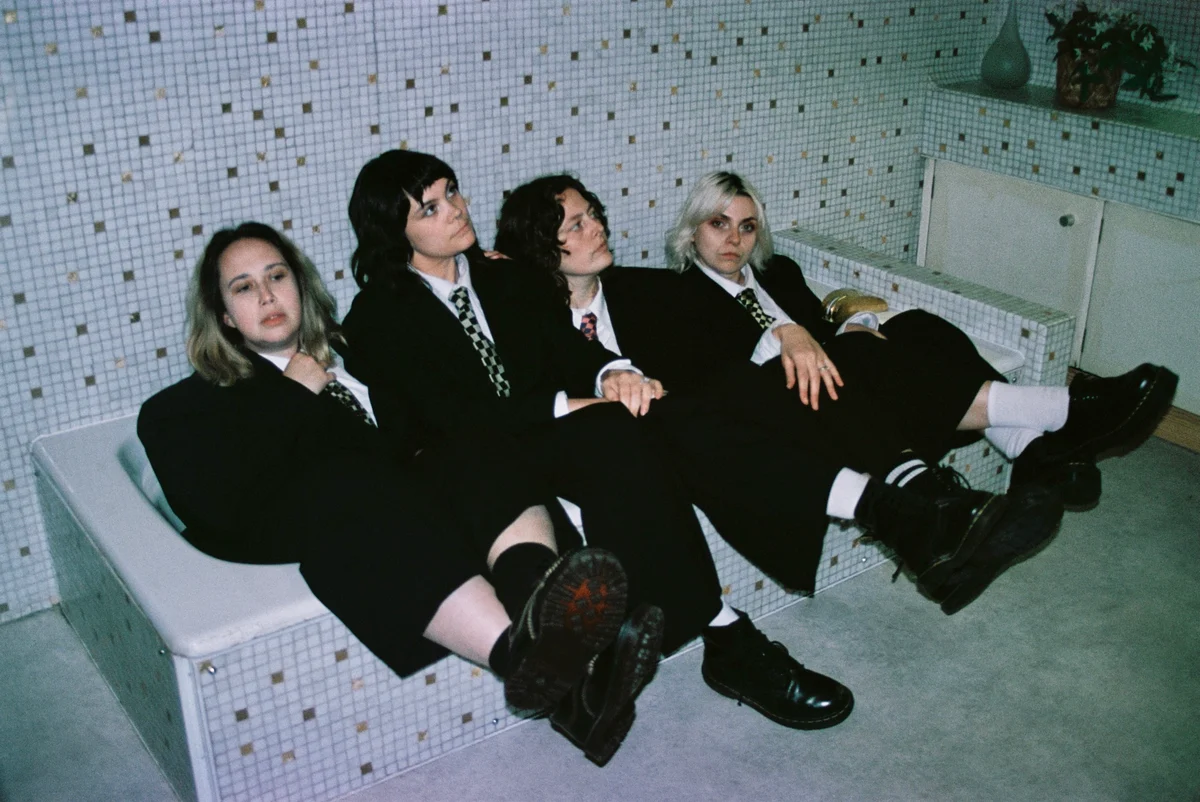

Grandmas House are working from home
Battling chronic illness and a demanding industry, Grandmas House became a home away from home for four friends bonded by a figure-it-out-together approach to energetic, wonky guitar music.
There are friendships that exist around music, and then there are friendships that teach you how to make it.
Fleeing the nest for university is often seen as the beginning of figuring out what you want to do with your life. Three years of sticky dancefloors, fluorescent seminars, and increasingly frantic library runs, all preparing you for the adult world waiting on the other side. For Yasmin Berndt, Poppy Dodgson, and Zoe Zinsmeister, university was a pivot into a life in music, something they hadn’t planned on. Grandmas House, a band named after a friend’s tattoo, became an unexpected home away from home.
Meeting during their first year at university in London, the three were united by their love for the left-field guitar tumbling out of the capital at the time, despite none of them arriving with musical backgrounds or studying music; Dodgson and Zinsmeister were doing fine art, while Berndt studied film. They spent their final year dipping in and out of local gigs, becoming obsessed with Goat Girl, Shame, and SOFT PLAY, before seeing The Big Moon at Kingston’s Banquet Records made something hit home. “It was seeing other women in bands. That was our oh-my-god moment – we can do this,” Dodgson says. “That’s when we decided. And then I was like, well, I guess I should learn how to play drums.”
So she did. While Berndt dug out her old childhood guitar and began to relearn old tricks, Dodgson stacked cardboard boxes into her university room, clutched pencils for drumsticks and tested her coordination. Eventually, the boxes gave way to a cheap drum kit from Gumtree, and Dodgson thought, “Oh, I think maybe I do have some sense of rhythm. Kind of,” she laughs.
“No, of course you do!” Berndt says, squeezing her shoulder.
After hanging up their hats and gowns, they moved to Bristol, around the time IDLES, just down the road, were being catapulted to main stages. They started gigging around local bars, eventually expanding to a four-piece. When their former bassist couldn’t make their Dot to Dot slot, their largest booking at the time, Berndt asked Zinsmeister: Do you think you could learn bass in a month? Zinsmeister did. Second guitarist Polly Jessett, meanwhile, was playing in another band and caught Grandmas House from upstairs at the same venue. “As soon as our set finished, theirs started, so I ran upstairs to watch. I’d heard their name around before.”
It would be easy to frame this as the charmingly scrappy prehistory of a band who have since graduated to international shows, a catalogue of outclassing EPs, and now their debut album, Baby You’re A Winner. But the DIY beginnings charged by close friendship represent the bones of the band rather than just an origin story. Grandmas House learnt their instruments together, their homemade sound forged by collaboration and improvisation. “We’re all self taught. Music theory was not even in our orbit,” Dodgson says. There was no rulebook to rebel against because they had never been given one in the first place. Instead, they learnt by listening to one another.

“We all learnt just from playing with each other and going off of each other’s energy. It sounds cliché, but our sound came from just exploring our instruments together, sat in a room together,” Zinsmeister says.
“Playing live together too,” Jessett adds. Their first gig, a 15-minute set of five songs played through shaky hands and a sweltering dose of imposter syndrome, was thrust upon them by the manager of Bristol’s squat Thunderbolt after they merely mentioned that they had started songwriting. “We were so nervous, but you just have to play live and see how it feels. That helped so much with learning. The nerves make us better players anyway.”
Nearly a decade later, the room has simply grown bigger. Now it is a stage in Athens, opening for IDLES, or the SXSW Music Opening Party. In the studio, though, the principle remains much the same: four friends in a room, listening to one another and working out what happens next.
Produced by Ali Chant (PJ Harvey, Mark Ronson, Perfume Genius), Baby You’re A Winner is a cultivation of two weeks of early mornings and late nights, with the band sometimes turning out a song a day. The demos were already burning holes in their pockets, but the recording process gave them room to pull them apart and see what else they could become, oftentimes revisiting old recordings and wondering why they’d scrapped them. The result is a record that sounds recognisably Grandmas House – scraping guitars buckling and blooming around tumbling drums, Berndt’s voice shifting between serrated shouts and curling croons – only now sharpened by Chant’s “insane attention to detail.”
The album has a lack of straight lines. “DOG” bites in second, all teeth and stomping propulsion, its guitars snarling underneath Berndt as she spits, “Got you growling through gritted teeth / The doctor always said this pill is all you’ll ever need.” Elsewhere, the band lets the noise fall away. “Spring” closes the record with beautiful harmonies purring against a murmuring, velvety riff, leaving behind the energetic abrasion that came before it with “I think that in another life you’re still standing by the door / I’m still not sleeping.” Across the tracks between those bookends, Baby You’re A Winner keeps changing its footing, distortion giving way to harmony, momentum giving way to space, and songs are allowed to breathe before the band inevitably kicks the door back open.
Dodgson spent three years seriously ill with Topical Steroid Withdrawal – a skin reaction with no cure – at one point becoming bedbound for eight months, while also losing two members of her family. The pace of an industry built around constant output became particularly unforgiving when her body couldn’t keep up with her completely physical instrument. “I was in a mentally tough place; it was a crazy time. I couldn’t drum and I knew that I couldn’t not keep doing the band because we’d worked so hard. It feels like if you pause then everyone is going to forget. We even lost a few people on our team because we weren’t releasing anything, but we physically couldn’t,” she says, “It heavily influenced the direction of the album.”

The record doesn’t need to be reduced to that period, though, and if anything, its most striking quality is how much life it contains beyond the circumstances that flavoured it. Love, grief, loss, infatuation, frustration, and friendship all find their way into the tracks, sometimes loudly and sometimes in the negative space between them. “If you sit and listen to the album from the start, you can hear us progressing,” Dodgson says.
“We’re still very much connected to our earlier music, but this album feels the most like us. It’s how we want to sound. This is Grandmas House,” Berndt nods. “It’s quite rare for a band to have a time capsule like that in terms of how our EPs have sounded next to each other. It shows how far we’ve come and how much we’ve learnt how to make the exact sound we want to make.”
The same hunger for experimentation that saw Dodgson drumming on cardboard boxes and Berndt relearning guitar still charges the record’s restless arrangements: try something, listen to the person beside you, follow it somewhere else. And nearly a decade on, they are still figuring it out together. “We put everything there,” Dodgson says. “It’s really what we were feeling as we wrote it with all the different subjects of what we were going through. We’re so proud of it. It feels really surreal that it’s here.”
I tell them it’s important to keep giving themselves pats on the back. They all smile. “Yeah,” Berndt adds. “And each other’s.”
Sign up to Best Fit's Substack for regular dispatches from the world of pop culture