
On the Rise
Good Health Good Wealth
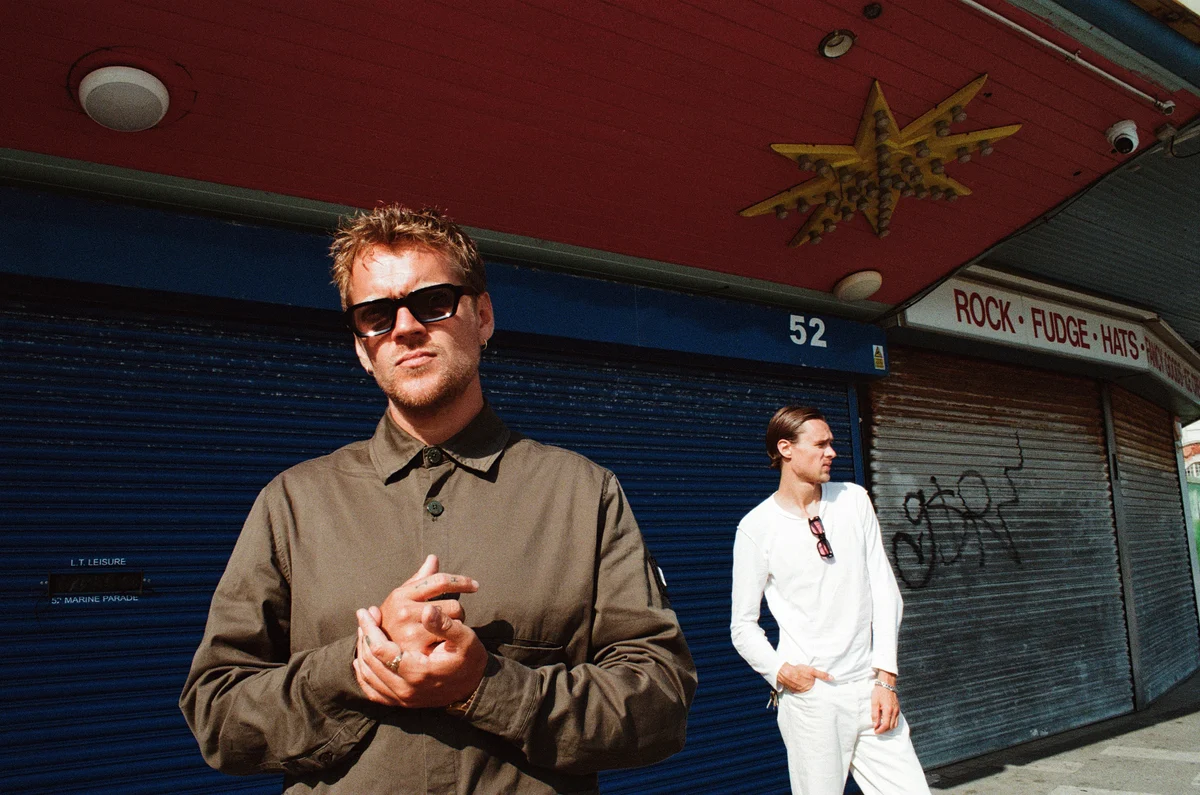
Good Health Good Wealth’s hip-hop-goes-indie-rock genre collages are familiar enough to light up nostalgia circuits in your brain, but new enough to surprise you with double takes as they foreground a universal truth: life goes on.
Years ago, Bruce Breakey and Simon Kuzmickas were at a flat in Dalston, unseriously playing around with the music production software FrootyLoops.
“We made this tune, it’s never come out, but it’s called ‘Local Legend’. It’s about this girl I used to know from back in the day who became a porn star. It was a funny, Ian Drury, Madness type of thing – a house-y beat,” Breakey says. They were just having a laugh with it, but when they listened back, they realised “there’s quite a lot to this. We started making a few more of those things that were a lot more of that spoken-word storytelling. That came to the forefront of everything and we were like, this feels cool. This feels different.”
Today, as Good Health Good Wealth, Breakey and Kuzmickas incorporate indie rock, hip hop, and dance music into their songs, but back then they were two members of a punk trio, which had met and formed in a Wetherspoons pub. “We met through our mate,” Breakey says. “He was intro-ing us. It was a bit like a blind date, like, ‘I know this guy who plays guitar.’”
Breakey – an East London native – and Kuzmickas – who grew up in Lithuania – might sound like an unlikely pairing on paper, but all the same they threw themselves into playing punk shows which, according to Breakey, were as DIY as possible.
“You’re just having so much fun at that time, at 23 or something, just absolutely sending it – music-wise, pub-wise, party-wise,” he says. “You’re going full throttle with everything, and you’ve kind of got to do it, if you’re going to do it.”
They eventually discovered a close affinity for music production, after the pandemic sent them indoors. It was a retread of old territory for Breakey, who had produced for artists he was friends with as a teenager, before letting that interest fall by the wayside. Good Health Good Wealth emerged from that small change in direction.
It’s not easy to define a Good Health Good Wealth track, because they tend to be genre collages: familiar enough to light up nostalgia circuits in your brain, but new enough to surprise you with a double-take-inducing production choice, or lyric. There’s something of The Streets in it, but with more of a rock sensibility, and something of Sleaford Mods, but with more of the joy often found in classic British dance music.
But in short, the band’s evident attention to detail is often what links the songs together. Kuzmickas, who handles most of the production, might add an off-kilter guitar part over a garage or jungle beat, while Breakey’s spoken-word delivery might tilt into rap, or melody. His lyrics usually hone in on the everyday, and describe life experiences which may have happened to him before or after Good Health Good Wealth got started.

That highly specific – and sometimes humorous – way of focusing on everyday people and places characterised the very first Good Health Good Wealth record: 2025’s This Time Next Year We’ll Be Millionaires. It was a concept piece that Breakey thinks of as representing a week in his life.
“I’ll reference the most niche person,” he says. “Like the Victor Moses line in ‘You Don’t Know Me’: ‘the only Moses that I know goes by the name of Victor.’ It’s such a niche reference. He’s a great footballer but he’s not David Beckham. But people who get it really get it, and come up to me after the show like, ‘I love that Victor Moses line.’” He credits that specificity to his enduring love of hip-hop. I ask about his go-to rap artists for funny and visually tactile lyrics.
“Early Eminem is massive for that sort of thing. It’s a lot of wordplay, but so visual. MF Doom is one hundred percent massive for it; the comic book references...” he adds, “…and Big Boi from Outkast is a bit like that: ‘cooler than a polar bear’s toenails’ – it’s so visual, you can’t help but see that exact thing when he says it. I think that, as a lyricist, coming at indie music from a hip hop/rap perspective is what I hope gives us our slightly more unique assessment.”
Millionaires is only eight songs long. As such, Breakey and Kuzmickas describe their upcoming 12 song record, The Disco Never Ends, as their debut album, which scales up their production style and lyrical subject matter. Both projects were mostly demoed together, but the sound of Disco was unlocked when they finished the title track alongside producer Joseph Wander.
“The original demo I had was a lot more garage-y. It was almost like Jessie Ware,” Breakey says – “a very electronically minimal production which I’d done. When we finished that session, it was much more epic, and leaning towards the indie guitar sound.”
The title track, with quietly optimistic lyrics delivered solemnly by Breakey over maximalist instrumentation, became a good opener for what the pair wanted to be their boldest project yet. “We wanted it to be a step up,” says Breakey. “This was the first thing we’ve done properly in the studio, so we wanted to go for it and make it as big and epic as possible. And we made it so quickly. It was over the course of two weeks’ worth of sessions.”
They certainly achieved something close to that aim – evidenced by Disco’s sprawling tracklist, which takes you on a journey through distinctly varied songs. The album did however emerge from a humble context: an Acton industrial estate, where Wander’s studio is tucked away. The process was close-knit, between three guys who have known each other for a long time, and for Breakey all of those factors were important to how Disco sounds.
“Next door is a tattoo artist. There’s someone who blows glass – like a pottery person. Someone who does picture frames. But we worked with Joe on and off for a few years, and he just seemed like the guy,” he says. “Also, we’re mates – I’ve been to his wedding – and for this, it’s another very personal record, so I wanted to be with someone I was comfortable with.”

In simple terms, each song on Disco sounds different from the one before, a music journalism cliché, but borne out by evidence – from the sprechgesang punk of “Susanna”, to the moody breakbeat of “Who, What, Where, Why”, and the four-on-the-floor indie rock of “I Can’t Tell Ya”.
“Because this album’s called The Disco Never Ends it’s metaphorically about life, right? And life is not one dimensional, so we didn’t want to box ourselves into one sound,” Breakey says. “Some songs are punkier, and I’ve got full whack AutoTune on one of them – going full Bon Iver. And it’s like, why can’t this be on the record?”
Meanwhile, the lyrical content tackles a few different subjects – love, friendship, communication, and going out with friends on a Friday, on the album’s joyful, to-the-point closer: “Call My Mates Up”. But there is a simple sentiment running through each song: that we should all make the most of life. The passing of a close family member reminded Breakey of that idea.
“Every day, as cheesy as it is, is somewhat of a blessing, and I think that’s part of this album,” he says, adding, “I was reflecting a lot on my auntie – we’ve dedicated this album to her. The song ‘Leftovers’ is about her. And it’s important to enjoy the moment because you don’t know what’s going to happen.”
A band flying the flag for a “lack of cynicism” is a bit striking, considering how on a daily basis our digitally interconnected world tends to feed us the most saddening information possible. I ask Breakey if he intentionally conveys that quality in his writing. He’s unsure, and says that he finds it hard to write a “purely happy tune,” but with this new album his intention was certainly to start and end with songs which, lyrically, find a “light in the darkness.”
“Hopefully, the point of The Disco Never Ends is: life keeps going on, the wheels keep turning, and it might be that you’re going to work every day, but remember you’ve got that thing on Friday night with your mates coming up,” Breakey says. “Always got to find those positives.”
Sign up to Best Fit's Substack for regular dispatches from the world of pop culture