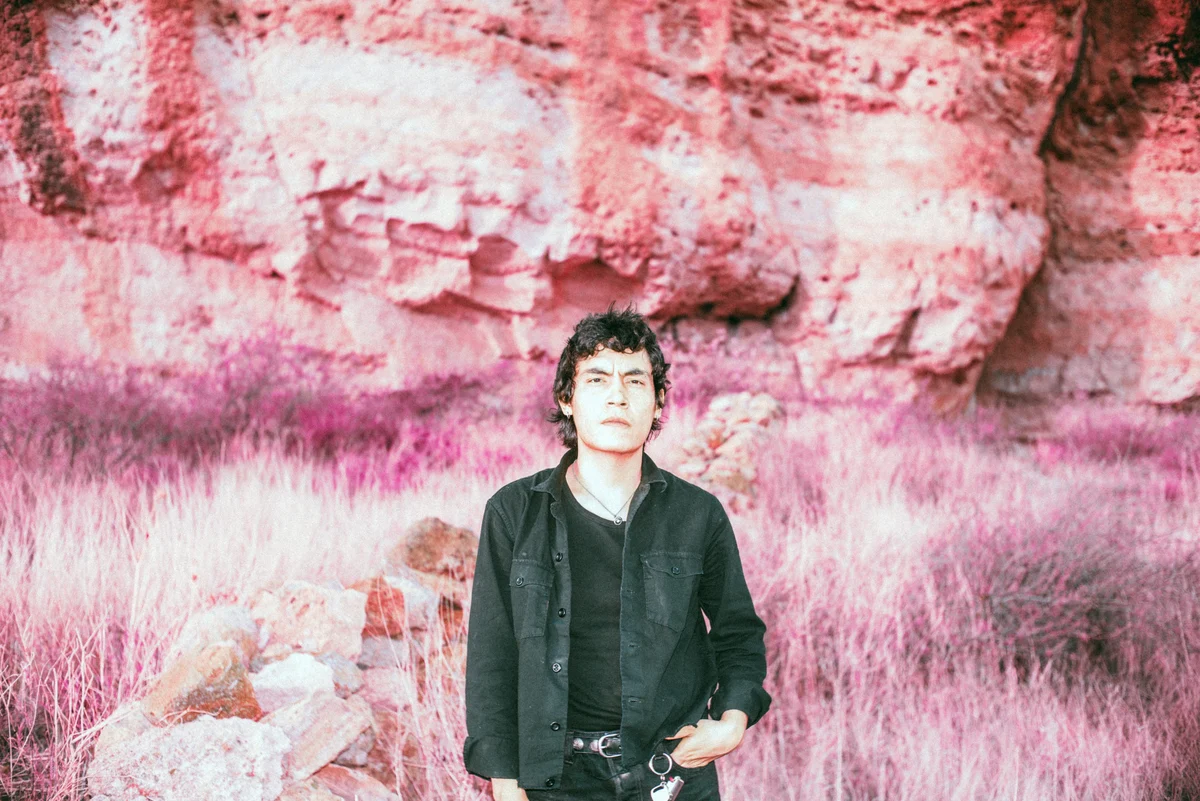

How Ed Maverick found freedom through songwriting
Fame made breakout Mexican singer/songwriter Ed Maverick guarded, and it's taken a long stretch of solitary studio time to loosen that grip, he tells Max Gayler.
“Now things are changing, but I think for the better,” says Ed Maverick, pondering the passage of time and the painful nostalgia that comes with a catalog of music.
For all the care Ed Maverick takes over what makes it onto a record, there’s a point at which his control ends. He can spend months shaping a song, deciding how it should sound and whether its words are the right amount of self-aware. But once it’s released, that distance between the private act of writing and the public life of a song is one of the stranger consequences of becoming a successful songwriter so young.
“It's very curious that the music I like least in my catalogue is the most popular,” he tells me from his home studio in Delicias, Mexico. “But in the end, I think all the songs have their merit, and they have their place in people's lives.”
Maverick’s music is a dreamscape in the truest sense. Echoed confessions of desire melt together with washed out production to create a sound that hypnotised millions and led to him selling out the iconic Teatro Metropólitan in Mexico City faster than anyone had before at just 18 years old. Throughout his first four records he explored this sonic world as deeply as he could.
He’s matter-of-fact about the shift in ownership. “When I’m working on songs, that’s when I’m enjoying them the most, when I’m working on them internally and they haven’t come out yet. But when they come out, the songs become the property of the people. So at that point, it doesn’t matter so much whether I like them or not, because they’re not mine anymore.”
His self-appointed responsibility, then, is to give the people what they want. On his current tour, older songs are rearranged to sit alongside the new material, their familiar shapes given a different instrumental life. It’s a way of acknowledging what those songs mean to listeners without being permanently bound to the versions he made as a teenager.

That balance runs through Maverick's double album Sin Agua Es Ruta Yerma itself. The two volumes were not conceived as a grand statement about duality. The distinction emerged as the songs accumulated, with the first turning towards existential and spiritual questions, and the second towards a more conscious understanding of love. For Maverick, the division gave each set of songs room to breathe, and would give listeners a way into a body of work that might otherwise feel overwhelming.
“At first, I just thought, okay, I want to make an album,” he explains. “But so many songs came out, and when I saw the full separation between them, I thought, ‘Ah, of course. I can make two albums out of this without any problem.’ Also, I don't like long albums. I really like ten-song albums. For me, they're perfect.”
At 16, Ed Maverick was already turning the awkwardness and intensity of first love into songs that didn’t mean much to anyone yet. His 2018 debut, Pa’ Llorar en tu Cuarto, made him one of Mexico’s most recognisable young songwriters. “Fuentes de Ortiz” has since amassed more than 800 million streams on Spotify.
Now 25, Maverick revisits that emotional territory wielding a few more years of loving, writing and hard-earned lessons. His fifth record is a sprawling, 20-track double album, shaped by psychedelic production, orchestral arrangements and a more expansive sonic palette.
Mostly, he made the record alone, developing arrangements from the first kicks and snares to the final lyrics. He’s less interested in chasing the sound that first made his name than in making something he can live with. “I like making music that I want to listen to myself,” he says, “and that I feel will continue to sound good over time.”
Maverick’s music has always invited listeners into an intensely personal space, but the experience of having that invitation accepted by hundreds of millions of people is rather different from offering it to a handful of friends. The intimacy that made his early songs so affecting also became something he had to protect. As his profile grew, he found himself more reserved, more conscious of the dynamics between himself and the people around him.
“I didn’t know about fame or all those phenomena that later made me limit myself socially,” he says. “Back then I was very free, so it wasn’t a problem if this guy was there while I was writing a love song.”
That same tension has followed Maverick into the studio. Though he's collaborated with friends on his latest record, Maverick largely prefers to write and record alone, building songs on his computer without having to explain an idea to somebody else: “It's less tiring. I just think about it and do it, and that's it. For example, the three collaborative songs on these two albums are “Me Inundo”, “Sahuaro” and “Haciendo Tanto”. Niño Viejo, Santi from Little Jesus, actually everyone in Little Jesus, and Seb Rodríguez are all people I've been friends with for a long time.” It’s a practical preference, but there’s an emotional dimension to it, too. Working alone means he can follow a feeling before worrying about how it might be received.
“It’s a question of freedom,” he explains. “Of taking away the fear that nobody is going to judge you for what you’re saying in the song… But lately, when I meet other people who write music and I don't know them very well, it's also a good lesson in finding that freedom. You realise, okay, this is a game. It can be as fun as I want it to be or as difficult as I want it to be. That's the only thing you can control, and that's also good.”

The change is audible on Sin Agua Es Ruta Yerma, but Maverick is careful not to confuse emotional maturity with leaving his younger self behind. The intimacy that defined his early work remains important to him. What has changed is his ability to find different ways of expressing it. “Now, the way I compose, I have more resources to talk about something,” he says. “So inevitably, there’s an evolution there that you can hear. And the way I understand relationships is also very different from when I was 16.”
Writing about love, however, continues to be a balancing game. There’s a fine line between sincerity and sentimentality, and Maverick knows when a song is threatening to cross it. When I ask him how he decides whether a lyric feels too cheesy or exposes too much, he returns to the importance of being genuine.
“The love songs that stayed on the album came from a genuine place, where I’m not forcing it,” he says. “The songs that didn’t make it were a bit over-elaborate or very forced. They came close to being cringey, and that’s why they didn’t stay in the end.”
He applies the same pressure test even after a song is finished. “When I get to the point where I’ve finished the song and it doesn’t convince me, because it has things that are too cheesy, and I feel it’s a bit performative too, I’d rather take it out.” There will, he trusts, be something else that feels right.
Maverick’s turn towards psychedelia began long before Sin Agua Es Ruta Yerma. At 16, he was already dreaming of making this kind of music, drawn to groups like Tame Impala and the layered angular sounds that can emulate some kind of friendly high. During the pandemic, he returned to those early influences with a different intention. Smoking plenty of marijuana at the time, he began to understand bands like The Beatles differently. He also found himself sucked into the addictive realms of cult film and the world creation that’s on display in films like René Laloux’s absurd Fantastic Planet or Richard Linklater’s surreal 2001 animated film, Waking Life.
“I feel privileged to be able to appreciate art without necessarily understanding it. I'm always open-minded about any kind of art, so that's not really a problem. I think films are what move me the most when it comes to composing. During the pandemic, I watched a lot of Gaspar Noé films and that whole world of cult, psychedelic films. That was a big thing for me. There are lots of films I really like that have this quality of feeling like a dream.”

His relationship with that art has not always been straightforward. Recalling his teenage years, Maverick describes taking benzodiazepines with friends at school while listening to Tame Impala. He’s clear about the consequences: “I don’t recommend it. I went through some really horrible things because of benzos.” His later experimentation with marijuana, LSD and mushrooms is also something he cautions against. “I also wouldn’t recommend that to anyone under the age of 25.” These experiences form part of the history behind his interest in psychedelic music, but they are not a prescription for making it.
That curiosity became increasingly technical. Maverick was drawn to the dry, tightly defined drums of Motown and older recordings, where a relatively simple microphone setup could give a performance its own character. On the new records, those textures sit alongside more expansive, dreamlike arrangements, especially on songs like “Esqueleto” where the mix allows you to hear the finer details: the sharp decay in the room, the soft attack of a towel on a snare drum, or the conscious panning of the toms.
He cites other key references, including Mac DeMarco, Connan Mockasin and Lou Reed as well as contemporary artists such as Steve Lacy and the wider psychedelic sounds emerging around modern independent labels and producers. He’s interested in understanding the lineage of the music as much as its current possibilities, looking back to the 1970s to understand where those sounds came from.
Maverick knows moving towards an unfamiliar sound carries a risk, particularly for listeners who first connected with his quieter, more intimate songs but his new album is something of a counterbalance to 2024’s acoustic La Nube en el Jardín. One project offered listeners a contemplative space they already understood, while the other allows him to explore the music he’d wanted to make for years.
As our conversation comes to a close, the thing that becomes most endearing about Maverick is his acceptance that he can’t control what people hear in his songs, or how those songs might come to define a period of their lives: “Although my taste has changed in some ways, there are many things I've always preferred since I started making music,” he clarifies, taking a sharp inhale of his last cigarette. “Intimate moods. That feeling that something is very close, very warm. That's the thing that’s remained after all these years.”
On Sin Agua Es Ruta Yerma, that means holding on to the all-consuming intimacy that first connected him with listeners while allowing himself the freedom to really change. The heartbreak and longing are still there but Maverick just isn't interested in making the same sound forever.
Sign up to Best Fit's Substack for regular dispatches from the world of pop culture