
Dummy’s inconvenient truths
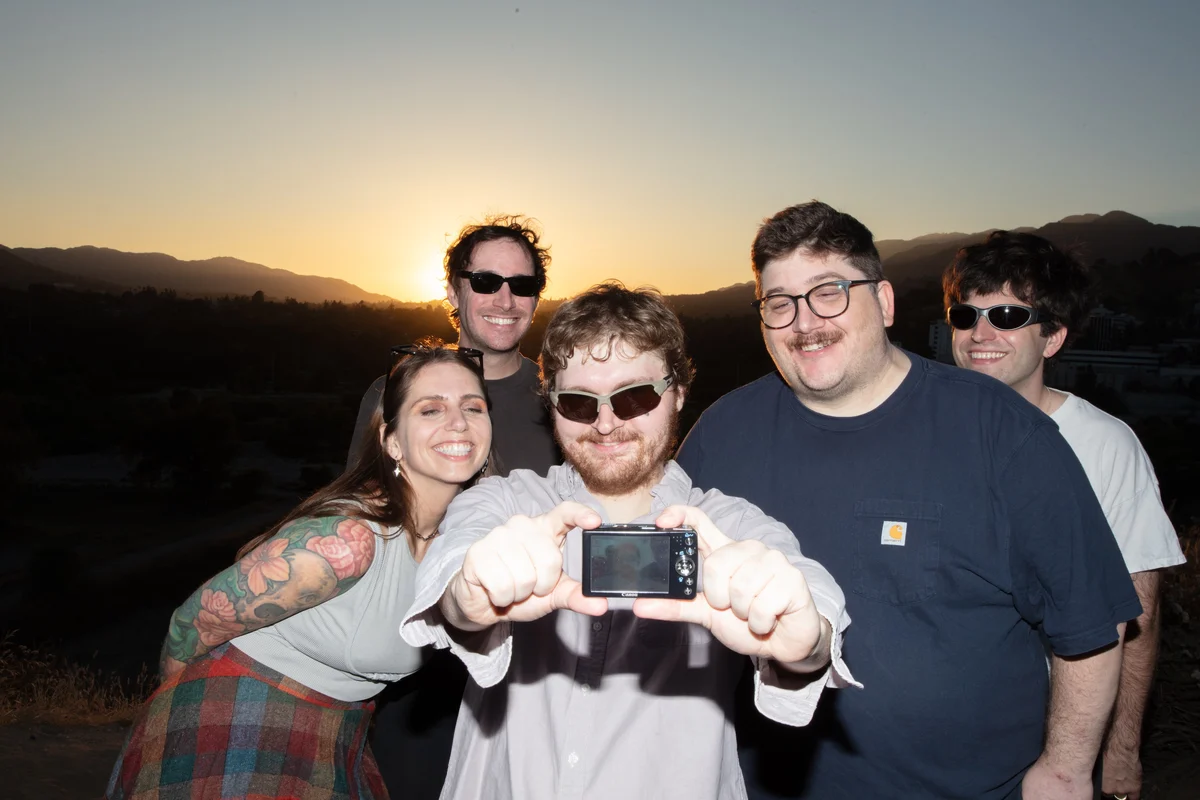
Los Angeles experimentalists Dummy abide by an ethical framework that can be inconvenient and requires tweaking on each album – but as they tell Dylan McNally, figuring it out is sort of the point.
When I speak to Dummy, it’s the morning after a rigorous rehearsal session and a feast supplied by Taco Bell gift cards; such is the glamorous rock ’n’ roll lifestyle in the year 2026.
“We’re in a band; we sleep in!” jokes guitarist Joe Trainor, but he hits on the fact that this sort of everyday politics informs Dummy’s latest release, do you love the color of the sky?.
Take opener “April Limousine”, for instance. In one breath, keyboardist and vocalist Emma Maatman sings of evil thriving on fatigue and our collective complicity in the climate crisis. In the next, she names plants and insects as she homes in on the beautiful mundanity of nature. It is this tension between the macro and micro, between capital-P politics and our everyday realities, that drives the band’s third album.
“When I was writing the lyrics, I was in my political echo chamber,” Maatman explains. “I couldn’t stop thinking about this stuff. I really think it’s important to make art of the moment, especially in important cultural times like this. American politics is completely unhinged – all of this crazy shit is happening all at once – so I was just writing about all of it. It’s all in there a little bit.”
It would be wrong, however, to say that this is Dummy’s political record. Politics is at its heart but to hear Trainor tell it, that’s nothing new. “Maybe in the past people didn’t catch on, but a lot of our stuff is very political.” And besides, being the sort of “pandering political band that is very obvious,” as Ewell puts it, is not Dummy’s thing.
What is different with do you love the color of the sky?, though, is the space given to vocals and its set of crystalline melodies. This is still an album of soundscapes and lush noise pop, but as Trainor explains, “this record was made in a way so that the instrumentals have a lot more room for the vocals to be the centrepiece of the songs, and that allowed Emma and Nathan [O’Dell, co-vocalist] to express what they're feeling more outwardly.”
It means that the record is Dummy couching those personal politics in a world of breakbeats, unshakeable grooves, and effortless melodies – enveloping you in their sonic world before you realise the new vision being presented to you in the real one. “It was always the point in the previous records to slip in the subversive to where you didn’t almost notice it. Now I think you notice it a little bit, but you can also dance to it,” Maatman tells me. Or, as Ewell puts it, “our original inspiration for the band was beautiful music with really devastating lyrics.”
And whilst they may have come good on that initial inspiration, a few years down the line from their formation there’s also a greater sense of intention to how Dummy do things, and a real sense of effort to make this album its own separate entity. “This was the first time we ever had songs cut that we recorded at the studio,” Trainor tells me, “so that was when we started really assessing the cohesion of all the tracks together.” But that time spent carefully constructing the album has made it the culmination of everything the band have learned across their previous releases. “It’s being able to achieve the things we were hearing in our heads all along. Now it feels like we’ve created this aesthetic that’s more distinctive and less referential than our previous records,” Ewell explains.

The problem, then, is recreating all of this in the live setting. Dummy have toured relentlessly, and their passion for the live form is clear. While supporting 2024’s Free Energy, a record that was much more dance-focused than its successor, Dummy brought the necessary instruments on stage – a move that might sound obvious, but in a world of increasing touring costs and the ease of a laptop, isn’t necessarily the one most bands would take. This record has made them rethink that live approach.
“The easiest solution, by far, would be to have a laptop and play tracks from Ableton,” says Ewell, “but that felt almost too easy, and also too on-the-rails. We want to be able to expand things and deconstruct the songs live,” As with the record itself, the band have turned that intention to their performances. “Playing live should be visceral and physical, and the recording, of course, is those things too, but they’re two different experiences,” Trainor explains. “We want it to happen like us! We want to figure out how to do it in a way that you’re seeing the sound you’re hearing and you’re seeing what we’re playing. If we were to use a computer on stage it would be a really old desktop,” he jokes.
What the band seem to relish when discussing their live antics is the danger. It’s the sort of rhetoric that would be more at home in a punk band; pop experimentalists aren’t exactly known for their hedonism. But it does point to the DIY ethos that the band have built up over years and continue to protect, something that often more mainstream acts seem to forget. “I think a lot of bands, their whole set is on the rails, it’s on backing tracks, so there’s never any variation, which I feel would drive me crazy,” Ewell says. “That’s something I love about art,” he continues, “that moment on stage where I try something different. There’s a kind of unexplainable clarity and connection with the audience when that happens. Failure can be charming!”
With a US tour set for this month, the tracks on color of the sky have, at the time of writing, yet to stretch their legs. But the effects of touring can still be felt across the record. “We were writing it in-between tours,” Ewell tells me, “so there was this constant element of we know we’re going to be playing it live, so how is this going to feel on stage? It was exciting, as a premise, to be going into somewhat unknown territory.”
Some of that unknown territory is yet to be charted, whilst some has already been conquered, but for Dummy this is all about the process. It’s a testament to putting in the work, pulling it all off, and then continuing in the face of a fucked-up world. This is nothing new for Dummy. And yet there’s something about this record and its intertwining of politics and the personal – the passion behind them both and above all else a commitment to their music on their terms – that feels incredibly vital.
Sign up to Best Fit's Substack for regular dispatches from the world of pop culture