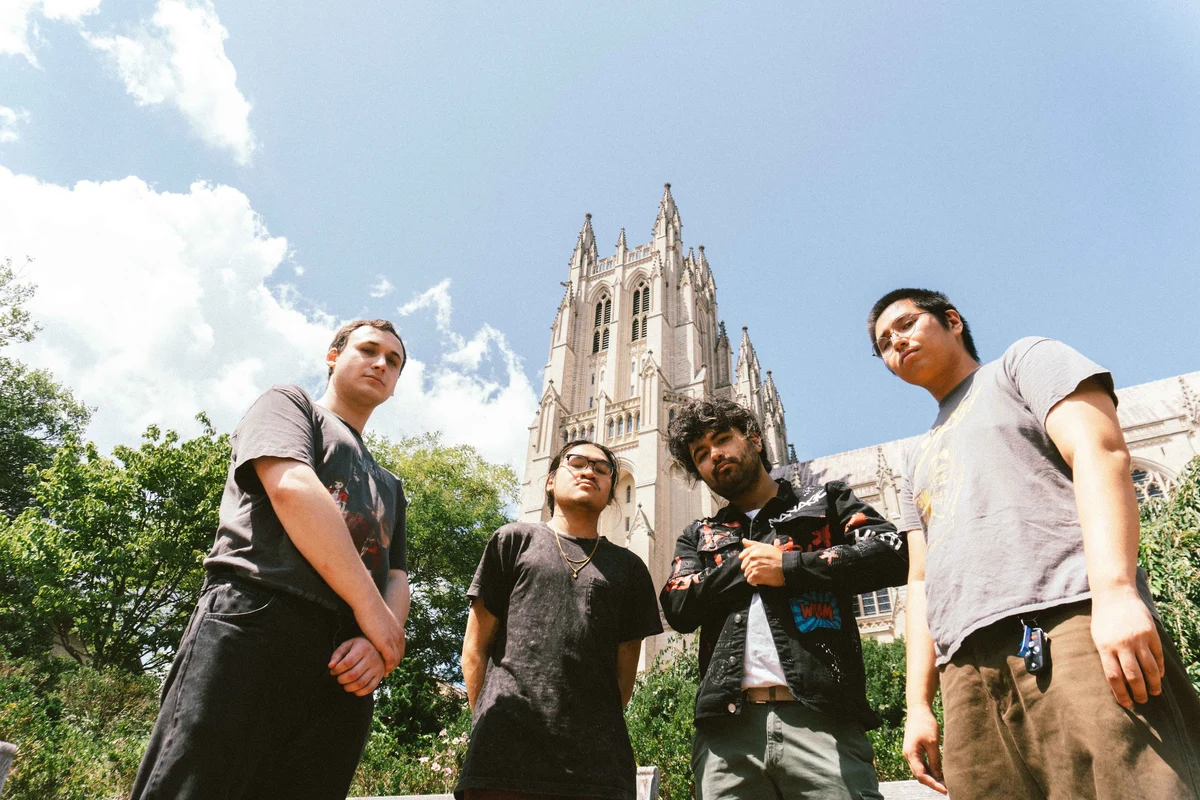

Cuni’s emo apocalypse
With the release of the Washington, DC emo band’s new EP Harbinger, Cuni singer/guitarist Jared Cunanan spoke to Taylor Ruckle about tapping his church upbringing for their most polished work of prophecy.
“When the Lamb opened the seventh seal, there was silence in heaven for about half an hour.” —Revelation 8:1, New Revised Standard Version
There are worse places to face the end of the world as we know it than Malcolm X Park in Washington, DC But if the Lion of the tribe of Judah has opened every seal on the scroll described in the last book of the Christian bible – unleashing final divine judgement – you can’t tell from here. The sound of the bus stop filters through the trees. The sea might have turned to blood for all we know, but the fountain goes on bubbling clear blue. Living creatures of the earth (dogs) trundle by on their leashes; agents of Satan (the US National Guard) tromp past on their perpetual rounds. No trumpets blow, but someone in the distance drums a low beat. If there’s silence in heaven, it can’t be heard here below.
When he lived on 16th street, Jared Cunanan of DC emo band Cuni used to come here after work and see the daily dog meetup. Though he now lives with his parents in Maryland – better for his commute to Bethesda – he’s returned for an evening in September to share the good news of Cuni’s new EP, Harbinger. A four-song concept record based on the biblical four horsemen of the apocalypse – “Conquest”, “War”, “Famine”, an interlude called “Rapture”, and “Death” – Harbinger heralds the coming of a heavier, more polished, and more mature band. In Cunanan’s telling, it’s a testament to the influences beyond the band’s post-hardcore essence and a grappling with the world outside its interpersonal sphere.
“Each song is its own different vibe,” Cunanan tells me. “We got to focus the magnifying glass towards four different aspects of a sound we can achieve…lyrically, each song – with the exception of ‘Death’, which is a bit more introspective – is a critique of the problems the world has.”
First, the introductory rites. Cuni started as Cunanan’s solo project while he was a student at the University of Maryland. In 2020, he released his debut EP, Saturn – a bedroom record that coincided with the rise of the sonically expansive and terminally-online fifth wave of emo. After graduation and the peak of the pandemic, Cunanan expanded Cuni into a full band, retaining the Covet-inspired guitar tapping of Saturn, but raising his voice from a whisper to a scream on Cuni’s first full-length album, 2024’s Prescribed Burn. Cunanan joked at the time that the band wanted to be the “Gen Z Rites of Spring.” But before all that, he grew up a Catholic altar boy with a curiosity about the last book of the bible, full as it is with mysterious symbols, many-eyed and -winged heavenly creatures, and even a dragon.
“It’s like this medieval fantasy kind of thing,” says Cunanan. “The four horsemen of the apocalypse have been mythologised into these really interesting images. It’s like, sometimes people will draw them as a silly guy with a hat, or like a Dark Souls character. I think I want to be in the between of that for the vibe of the EP.”

You could imagine another, perpendicular axis to map how closely a pop cultural work tries to adapt the original text; Harbinger sits on the looser, more cryptic visual end, a la Neon Genesis Evangelion, as opposed to critical and interpretive takes (Good Omens or, oof, Left Behind). In the run up to the release, Cuni has taken to soundtracking their Instagram stories with churchy choral music, and at time of writing, their neocities website has an embedded YouTube link to “12 hours of Exorcist-Approved Gregorian Chants.” On his feelings about religion as an adult, Cunanan asks to get back to me. He later clarifies over DMs:
“My relationship with faith is still a bit weird but incorporating the religious imagery into the ep materials has been really fun. i get to look at it from a creative pov rather than a scared or extremely strict pov…long story short, i’m not a perfect altar boy and it frustrates me trying to be one but im glad i got to flex my sunday school knowledge for a cool aesthetic.”
Harbinger does echo some of Revelation’s key substance. In his book Reading Revelation Responsibly, New Testament scholar Michael J. Gorman demystifies the oft-misunderstood scripture from a Christian perspective. Though it’s been popularly misused as a forecast of future events, Revelation actually comes from an ancient (originally Jewish) literary form called apocalypse (from the Greek apokálupsis, meaning…revelation). Gorman says the function of the form was to comfort oppressed people, critique their oppressors, and call readers to defiance through symbolism and spiritual insight. Take Revelation, with its metaphorical story of a war waged against the nations by a slain lamb. Written in the first century CE and addressed to seven churches in Anatolia, it promised God’s eventual (nonviolent) triumph over evil, but also warned against assimilation with the Roman imperial cult, which worshipped the state as divine, and so blessed its violent conquests. Gorman draws convincing parallels between that culture and the Christian nationalism of the contemporary US.
He also calls apocalypse “the language and literature of resistance,” which Cuni’s apocalypse reflects. The EP’s first song “Conquest”, in drums like thunder and riffs like lightning, rails against the violent powers of history and the present. Cunanan’s lyrics draw on his experience as a Filipino-American and the Phillipines’ history of subjugation at the hands of the Spanish, Japanese, and American empires, each one a beast on par with those of Revelation.
“You strain my blood / to match with yours and / make me forget / the things I fought for / My mother tongue reeling in fear / forced to replace the words / Behind the gun yelling,” Cunanan screams in a fevered 7/4 chant. He embodies apocalyptic resistance in the song’s final words: “I will not fall in line.”
“So much of Filipino culture is not remembering what we were like before colonialism,” he explains, citing the Spanish influence on Filipino music and cuisine. “Filipinos are known to be a very happy people, and I feel strange because I’m not a happy person…Can’t we be a little mad? Can’t we feel just a little aggressive about it?”
The song’s jolted rhythm comes from a Filipino folk dance called singkil – drummer Jian Soriano starts the rhythm on his own before Cunanan, guitarist Aaron Millison, and bassist Danny Parada join in. Compared to the shaggier, live-recorded feeling of Prescribed Burn, the crisp intro immediately hits different. To make the EP as polished as possible, Cuni turned to Ryland Heagy of Origami Angel, a spiritual leader in DC emo for his own band and for his work recording others like Knope and Commander Salamander. For Cunanan, Origami Angel’s 2019 album Somewhere City was a gateway to the scene. Over Zoom, Heagy tells me that he became a mutual follower of Cuni in the run-up to Prescribed Burn, at the recommendation of Claudio Benedi from DC power pop band Abacot.
“It was really interesting for me to see because I feel like there wasn’t that much new emo coming out from this scene for a long time,” says Heagy. “It was like, ‘Oh, this is a domino effect. This is the next band up that was interested in our bands and interested in this genre of music.”

He compares the current scene to the latter days of Dischord Records, which grew from its roots in hardcore to release the likes of dance punks Q and Not U in the new millennium. Even more than the quantity of new releases, Heagy says he’s excited by the variety of sound in the scene.
“I think for a long time it was, you got to either be really really cool or really really tough…I think there’s so much love in between that that we’re showing right now to a lot of these bands, whether it’s Combat, or Cuni, or Torrents, their sister band [featuring Parada on guitar and Millison on bass]. It’s like, ‘Yeah, we love to rock, we love that more than anything in the world, but we also love songs.’ There’s so many more influences being worn on sleeves right now.”
Cuni tracked Harbinger in the attic of Heagy’s Cape Cod-style house in Hyattsville. Through stop-and-start stretches from January through March, they built the songs from the ground up, not just recording the drums separate from the other instruments, but recording the drum shells on different takes from the cymbals. Cunanan (or Josh Bell from Combat, who helped out on some takes) held a foam pad to compensate for Soriano’s muscle memory and give him something to hit when the cymbals weren’t there.
“He totally blasted my finger by accident, but it was fun,” Cunanan says, back at Malcolm X Park.
You can hear the thorough recording process in the precision of the finished tracks; like Revelation, Harbinger is full of clear references for those with the knowledge to decode them. On “War”, which decries the Palestinian genocide, Cuni taps their metal influences, with blast beats and gallop picking they learned from Deafheaven. Cunanan also calls one section a “rip off” of “This Is How I Disappear” by the band’s patron saints, My Chemical Romance. The most tongue-in-cheek reference came from Soriano; the drum fill that opens “Famine” is just a faster version of the intro to “Rock With You” by Michael Jackson.

Prescribed Burn was an intensely introspective album fueled by self-hatred, even to the point of suicidality (“Not trying to avoid you, I just forget / You keep untying nooses around my neck,” Cunanan sang on “Didymus”). “Famine” channels the same feeling into the voice of an Earth suffering from climate change and asking to be put out of its misery.
But as Harbinger arrives at the end, Cunanan shows a new outlook. On “Death”, he narrates the perspective of a dying person coming to terms with their unavoidable fate: “the ending’s unwanted / but I couldn’t stop it.” Cunanan calls it “the shoegaze one,” and sure enough, the track builds to a cathartic wall of guitars and harmony vocals, a tearful goodbye even after the horrors of “Conquest”, “War”, and “Famine”. “To leave is bittersweet,” Cunanan sings at last. “But I let it come for me.”
“I think I’m in a better place than when I wrote [Prescribed Burn],” he explains. “It used to be like, ‘I don’t want to be here, and there are a lot of things inherently that make me not want to be here.’ This one is like, ‘Okay, I accept that I’m going.’ And I think that it’s scarier, but also a more weighty feeling, to wait to go. That’s kind of how I feel about it – do I want to go right now? Not really. Could things be better? Yeah, but I think that a life worth living exists.”
Then he laughs.
“I hate how much My Chemical Romance is here. It’s The Patient in The Black Parade. As they kind of march into it, it’s like this solemn acceptance that it’s going to happen.”
As in Ingmar Bergman’s The Seventh Seal, death itself is the only certainty; whatever comes next is left open-ended, as the song’s long tail fades into silence. Cuni, at least, has something to look forward to after “Death”. The day after the 23 October EP release, they’ll play their first ever set at the Fest in Gainesville, Florida, on a bill stacked with emo peers like Dikembe, Dear Maryanne, and Kerosene Heights, plus genre patriarchs Texas Is the Reason. That said, it comes at what Heagy calls a “really strange” time for emo, as consensus around the sound and its future seems to have broken down.
“It does feel like when we say the word emo, or fifth wave, or whatever emo is right now, everybody’s talking about something different,” says Heagy. “Where my band sits in it, I’m not even sure…it’s almost like the universe; there’s all this dark energy pushing everything further and further away. At a certain point, we were all very close together, and now you’re four-and-a-half-million light years away from me. I’m ever confused by the world of music, but I just feel lucky to still be a part of it and work with great artists like Cuni.”
Cunanan also says that emo doesn’t feel as vital as it did around the release of Prescribed Burn (“Our age of open tunings and capos is falling,” he jokes). At age 27, he feels existential dread as a new generation starts to show up at local venues like Rhizome and Patchwork (“big jeans” are in style, not the skinny cut of his youth). On the other hand, at least in DC, there’s no “arms race” forcing bands into one competitive lane. At Malcolm X Park, as the sun goes down and the lampstands go on, the stars seem not to have fallen to the earth, and the sky seems not to have vanished like a scroll being rolled up. But then again, given the light pollution, we might not know if they had. If the earth is yet to be remade – if conquest, war, famine, and death still ride – at least Harbinger prophesies that the age of emo hasn’t ended. Amen and hallelujah to that.
Sign up to Best Fit's Substack for regular dispatches from the world of pop culture