

Chloe Qisha and the hard graft behind big pop
Recording across three countries for her new mixtape Fantasize, Chloe Qisha came away with a new respect for how much labour sits behind a hook, she tells Laura David.
It’s sort of sickening having a crush, isn’t it? It’s all you can think about. It eats at you when you’re sleeping, working, out at the club. Maybe especially when you’re out at the club. There’s almost nothing worse than having a crush. But there’s also nothing better. Thus, it makes for the stuff of perfect pop music. At least for Chloe Qisha.
When we connect, the London-based, Malaysian-born artist is sitting on her couch nestled between her two cats after a long day of promo. She’s waiting for her ex – with whom she co-parents the pets – to come pick them up. It’s the perfect representation of who Qisha is as a pop star — the kind of auteur who can speak to the highs and lows of modern dating, in an era where meet cutes happen on hinge and building a family often starts with animals rather than kids or homes. It’s a time in human history when we’re all changing jobs, changing friends, changing interests at a rapid pace, indulging in the fun of desire with the recognition that the world is kind of crumbling around us, anyway. Qisha understands this, and she’s writing pop that meets the moment. Enter Fantasize, the lush, 80s-inspired oeuvre that is Qisha’s debut mixtape and the most definitive mission statement yet from this pop girl on the rise.
Take, for example, “YDH,” one of the project’s earliest singles and its opening track. On it, Qisha asks: “Can’t a girl be / Young, dumb, and horny? / God I’m acting like a fool.” The visuals follow suit with this brazenness, laced with fantastic models in boxers and briefs, harnesses, and slicked-back hair. The key allusion is to a world where desire is normal, where fantasies are entertained — and okay. From Troye to Chappell to Sabrina to Tate, desire has been having perhaps as big a moment as pop as it ever has in the post-Madonna era. Qisha, she tells me, relates.
“I definitely think that in just the past couple years, the pop girlies being more open and playful about talking about sex and sexuality has subconsciously trickled in my brain and normalised it a lot more,” Qisha tells me. But while she’s flattered to be tagged as part of a movement, she’s careful to dismiss any idea that her subject matter of choice is in any way pandering or reactionary. For Qisha, the performance of big, bold, throw-it-all-on-the-table pop music is simply a realsation of the artistic dreams she’s always held. There’s simply no other kind of pop star she’d aspire to be. “I almost have to remind myself just how explicit some of the songs are in that way, and just how visceral some of the songs are in the way that I've written them… it just doesn't even phase me.”

Qisha represents, in many ways, both a commitment to the pop of yore — big looks, huge hooks, concept visuals — and a bold new frontier for the niche popstars of the Internet. She plays perfectly to the crowd of popheads obsessed with the perfect hook and a tight song structure, but she’s not the kind of digital native who’s going straight from a stadium show to livestreaming the postgame snack in bed on Instagram after. Rather, she’s still committed to the performance art of pop, one that’s aspirational, and one where access perhaps impedes the mission of the music rather than aids it. “I love the mystery. I love back when pop was more mysterious and you wouldn’t know what the inside of Beyoncé’s bedroom looked like,” she says and laughs.
As a kid in Malaysia, the pop Qisha grew up on was that Beyoncé-style superstardom. She idolized ABBA, Katy Perry, and Ariana Grande, unashamed and unbothered by any indie kids who might have tried to claim her music taste was lesser-than for it. It was the pure confidence of their projects, the largeness and theatricality that thrilled her. “That was the beginning of my journey into becoming like a listener,” she tells me. “Does that make sense? And I do feel like those like early artists in my view as pop artists is kind of how I've maintained the perception of what it means to be a pop artist, which is quite a dated view of how pop artists are, you know?,” she explains.
From her debut EP to now, Qisha has wanted her world to harken back to the days of MTV pop, something stylised to a tee, the kind of pop artist project where you’d wait up until midnight just to watch the new video drop. “There's a beauty in it, how pop artists are so accessible now… but equally, as we've seen from the Chappell Roans of the world, there is no boundary now,” she says.
“[I came] in with that energy of: I know what I want and I know where I stand, and these are the values that we hold,” she explains. “And that slightly more elevated, stylised work. Visuals come hand in hand with the music. I think that's what I've taken from that era of pop stars.”
Qisha also acknowledges the uniqueness of her position. For someone these days so frequently asked about and cited for her Malaysian upbringing, she often finds herself reminding people that her cultural taste palette was still incredibly Western. She was raised in the British international school system and, by her own telling, lived a childhood that moved between home, her car, her school, and the mall (of course). She then moved to England at sixteen to finish her education, staying on to obtain two university degrees in psychology and, later, communications. The idea of Western pop was, really, her main and only idea of the genre. Moving to the U.K. wasn’t so much a culture shock as it was her stepping into something she’d always known. Only now, years later, is the wonder of what she may have missed back home creeping in. “I think I need to make more of an active effort. Really, I think that can be my sort of New Year's resolution to reconnect with pop culture [scene] in Malaysia, because I'm sure that there is a very bustling and thriving one,” she says.
Arriving in England though, the goal wasn’t music. That possibility only arrived with an unsolicited — though, evidently, entirely welcome — direct message from an A&R arrived in her inbox after she started posting covers online. “I had literally no context for what the industry was like, and like I didn't even know, really, what the term A&R meant,” she tells me. “I wasn't phased by it.”
A friend convinced her to take the meeting. Looking back, that early ambivalence probably served her well, allowing her to finish school, floating along a “slow matriculation” into the music industry whereby she could attend studio sessions and attend class at the same time. “I could sort of see the light at the end of the tunnel for both scenarios,” she explains. “Whichever I decided to fully commit to and pursue – whether that was not music or music.”

Despite being grateful for the path she’s chosen, Qisha also doesn’t pretend it was necessarily the easier one. Over the course of our conversation, she speaks at length about the challenges of still “developing,” as an artist, particularly at a moment in industry history where it seems like nobody has a clue or a playbook. She broke out early with her self-titled debut, earning the “it-girl” crown. The follow up records, for her, have been a lot about figuring out how to now wield it. The best answer she’s come up with, she says, is going deeper into her vision every time. In any moment of creative or career uncertainty, Qisha is convinced that the only way she will win long term is by digging into the art itself, not chasing trends. She’s been proven right every time.
A perpetually shy kid, Qisha also credits her long incubation period with giving her the time to emotionally prepare for the demands of having that kind of self-knowing. After all, to perform for a living, and to be one’s own creative champion, is surely not for the meek. “It took a long time, but I just grew a lot more self-assured and confident in myself,” she tells me. “I think by the time I got to my mid-20s, I felt like I had fully come in to myself, and that's why that's why I think music had to happen at that point in time, and not any time sooner..” In some ways, being the outspoken popstar she is has provided a veil for that shyness, an alter ego she can use to let it all out. In her private life, she says, the introversion still remains.
You’d be forgiven, though, for not thinking Fantasize was the work of an introvert. The first thing you’ll likely notice about the record is that it’s bold, fronted by shoots of people making out, with Qisha in assless chaps, with incredibly fit backup dancers feeding the stuff of her dreams. In a way, the project is a bit of a concept record — though Qisha is careful to clarify that it’s technically a mixtape — started while she was still finishing off 2025’s Modern Romance EP. It came after one of those terrible, all-consuming crushes, one that came after a big breakup and an epic realisation that she, for better or worse, was back on the field. On Fantasize, she decided to surrender to that desire and write about it.
“It was just such a weird scenario to be in. I think because I feel like I hadn't had the feeling of a crush in so long, and I think until you then feel that feeling, you realize how long it had been, which is crazy. I forgot how addictive the feeling was, and how exciting the feeling was, and just how joyous, but then also like sad, weirdly, and lonely the feeling is because oftentimes,” she explains. Fantasize taps into all of that, circling the highs of romantic elation (particularly on “YDH” and “Question of The Day”) to the lows of self-doubt and incompatibility. “I love that it sort of sparked from that very innocent feeling, very guttural innocent feeling.”
"I love a pop song that sits above everything...that punches you in the throat!"
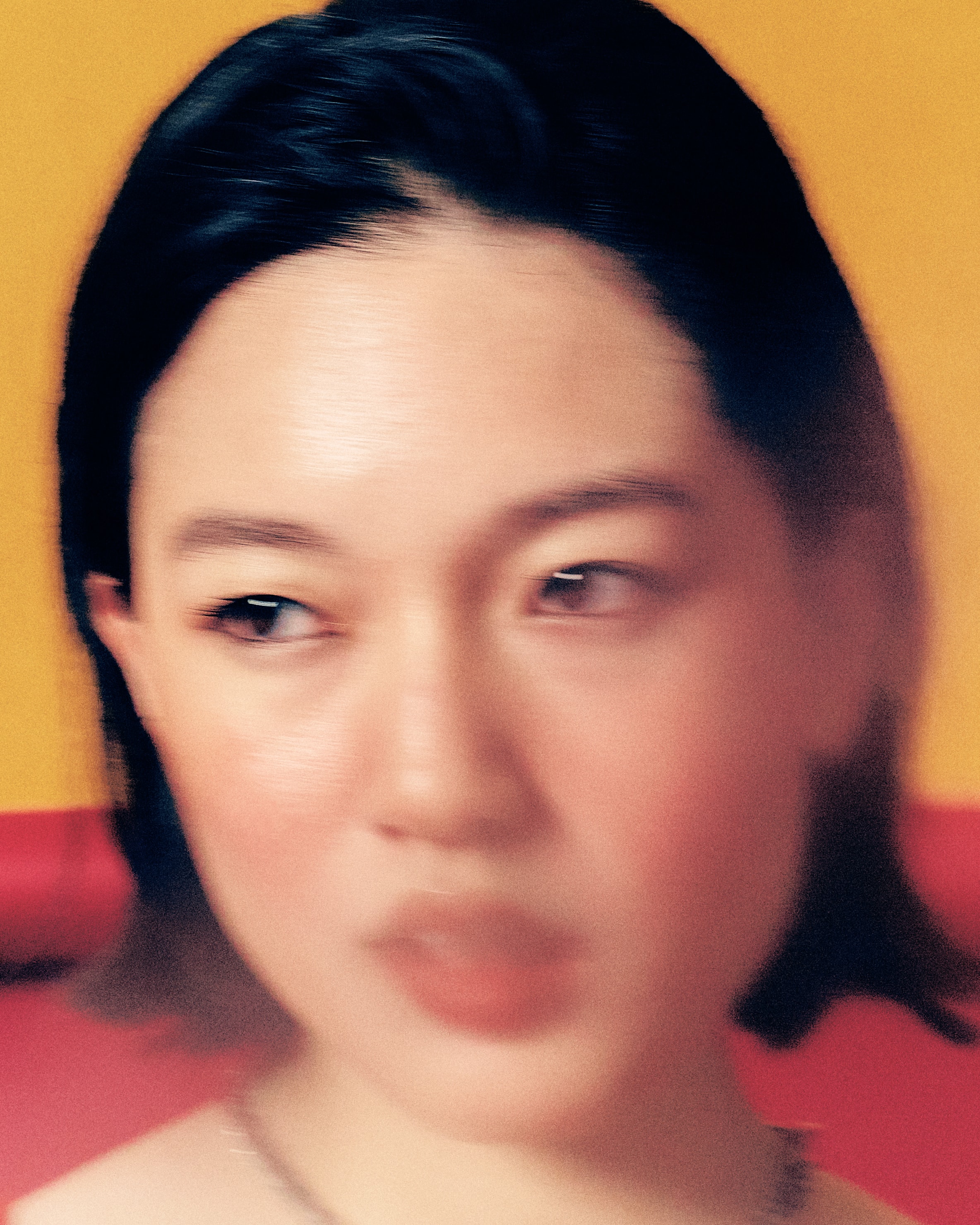
Perhaps its apex on the record is “He Likes Boys,” a soapy, synth-forward ballad about wanting a guy who could never like her back because he was gay. The song is as freeing as any, writing honestly about an incompatibility so often considered taboo. That song Qisha says, was one she struggled with for months about putting out. Her intention was not to trivialise or over sexualise queer men, but rather to name the lonely pain of not being chosen for reasons simply beyond your control. That kind of loneliness is so often present in queer stories, with many queer kids growing up in love with best friends or with others who they know they can’t have, forcing them to hide. Hearing the dynamic from the heteronormative perspective is rarely discussed, but it’s real. For someone with deep ties to the queer community — both through fans and collaborators — and someone finding her own place in it herself — as explored on “Baby Girl” — speaking on that subversive experience came from a place of wanting to remove that “othering” feeling from wanting someone who’s simply just sexually incompatible with you. After a lot of handwringing — and consultation with friends — the song made it on the record. Now, she says, it’s probably the mixtape’s mission statement, challenging listeners to explore love and desire beyond preexisting binaries.
“I think ‘He Likes Boys’ rings true for not just that crush, which was I guess the inception of all the crushes, but I just realised — and this is just purely from you know coincidence and proximity — that a lot of the dancers that I work with, a lot of the creators that I work with are queer, and I think I just ended up crushing on a lot of of gay men at the course of this last year. I really did,” she exclaims. “Like I could name you like five or six dancers that I absolutely love and have my major crushes on, who are my friends now, and you know, I have the pleasure of working with because they're so unbelievably talented.”
Fantasize embraces that kind of messiness, recognising that young adulthood is that time in your life where you try everything on just to see what fits. And through all of it, Qisha sees pop music as the perfect conduit for that experience. Fantasize is, sonically, her most ambitious project to date. Still featuring slick basslines and that occasional speak-sing drawl she’s become known for, Fantasize steps up the theatrics. The arrangements are larger, featuring deeper, more textured layers of synths and strings. “He Likes Boys” and “YDH” harken back, for example, to lush ABBA classics like “One Of Us” or “Voulez-Vous”. Qisha herself admits that here, her palette had widened, and her goal was to make a project that felt both more mature and more ambitious.


“Rob [Milton] and I have this ongoing joke that all roads lead to Phantom of the Opera,” Qisha jokes, citing the iconic West End musical she loved as a kid and brought back as a stylistic reference on her mixtape. “When I listen to musical theatre songs and the way things are delivered, all the feelings are very heightened, all the emotions, the delivery, especially is so key. It's like acting in singing,” she explains. “You're really trying to find the right delivery for that particular line or that particular song, and I feel like I do that a lot when I'm cutting vocals. I really learnt that from Rob. He really loves to go in, and we will spend like days cutting vocals for a song.”
As Qisha’s longtime production partner, Rob Milton was a large factor in the new terrain for her work on Fantasize. Their working relationship isn’t too dissimilar from the Dan Nigro-Olivia Rodrigo/Chappell Roan alliance, or the tight-knit partnership between Phoebe Bridgers and Tony Berg. “We have a very sibling-type relationship. It's very… We've had our like ups and downs,” she says. “I think we've learned a lot from each other in this last year and a half of writing and collaborating, and I'm just really grateful for him. I certainly wouldn't be here without him and his team and his patience in helping me develop as an act.
“I think as well, there's there's something about being you like you know you're a really strong collaborator when not only do you have the patience to obviously develop acts, but you then instill the confidence in them to be able to have a strong enough writing skill set to then be able to [tell them] to try something with this other person and have the confidence to be like they'll always come home. It’s knowing that your person can go away and make incredible music in other rooms as well and then come back and consolidate with you. That's I think when you've hit peak, like masterful collaborator status for me. And we’re definitely at that stage now.”

Recorded in studios across L.A. and London and Sweden, the process of making Fantasize was perhaps Qisha’s most drawn out and intensive. Though she took her first writing trips to California for this mixtape, she was working so much she says she mainly remembers the drive from the airport and the pink walls of the studio. In Sweden, she found herself at the mecca of pop, recording in the MXM Studios (Max Martin’s recording company) HQ with Ilya Salmanzadeh and Oscar Görres, doubling down on the craft of pop itself. Qisha’s home base — as always — was 70s and 80s. She remained true to her ABBA, Troye Sivan-loving instincts. She listened to “Rasputin” by Boney M on repeat for months during the recording process.
She solidified those influences as the sonic home for Fantasize. But working with the MXM crowd and Milton also allowed her to expand on them, too. “I think it's such a brilliant craft,” Qisha reflects. And, she’s right. The freedom afforded to a sprawling, six-minute guitar ballad isn’t there in a pop song, where the goal is to use a tight for minutes to hook in and thrill an audience member. While some critics dismiss the genre as rudimentary, the mechanics of making it work are incredibly complex. “[MXM] has just got it down because they have really really great instincts and taste. So I'm really lucky to be able to have collaborated with them so closely for this mixtape.”
If Fantasize is anything, then, it’s an exercise in Qisha’s mission to deliver pop of the highest order, and her challenge to herself to do so in ways she, even as a student of the genre, never has before. “I love a pop song that sits above everything, that punches you in the throat,” she affirms. “I don't know in what way, but that's the only way I can describe it. Whether that's through the production or through the concept or through the writing and the lyrics.” On Fantasize, it feels like she’s finally delivered just that.
Sign up to Best Fit's Substack for regular dispatches from the world of pop culture