

The ambiguous unburdening of Cate Le Bon
In surrendering reluctantly to heartache, Welsh artist and producer Cate Le Bon has struck a pearly and holistic balance between rupture and renewal, she tells Alan Pedder.
Picture this: a room within a room, draped with white silk parachutes and walls of ruched pink satin, where a woman sleeps on a sunken bed of mirrors, naked in the muted glare of clothed fluorescent lights. Now picture it again, only it’s not a picture, it’s a Real Dream – a living, breathing metaphor of rest.
The year is 1975, the place is NYC, and the woman is an artist born Colette but known by many other names. The installation is an early example of one of her tableaux vivants, or living pictures, an idea that originally came from an urge to critique the art world’s historical obsession with passivity in women. Each of her rooms at that time was exploring a different aspect of dreaming and sleep, positioning rest not as something weak but as something powerful, cardinal – utopian, even. She would lie within these lush, immersive spaces every day for several weeks as spectators came and went, often in great numbers. Critics called these long sleeps her endurance works, but for Colette they were a form of transcendental meditation: a gathering more than a giving.
For Cate Le Bon, discovering Colette’s work – and specifically Real Dream – felt like a window into her own complicated and opposing emotions. At the time she was muddling through the wreckage of a painful and protracted breakup with her long-term partner, like a vessel with no sail, listing in colliding waves of grief and rationalisation. “I felt haunted by the image of this woman lying in a really beautifully decorated, soft, plush, womb-like room,” she tells me over the phone. “It felt like she had been able to put something down and rest, and that’s how I wanted to feel. But I don’t know if I knew that at the time.”
Piecing things together after the fact is not exactly untrodden ground for Le Bon, who has often worked from a place of instinct, but her latest album, Michelangelo Dying, takes that in-the-moment-ness to a new extreme. This time, she says, her ideas for instrumentation and arrangements came into being at the same time as the lyrics, as if feeling her way in all directions at once.
Well, not quite all directions, not at first anyway. Going into the writing phase she tried to shoo away her heartache, content to kick that can of tumbling emotions as far down the road as she could. “I didn’t want to have to sit down and stare this thing in the eye,” she explains, “and I didn’t want to feel like a cliché doing it. But I kind of had to surrender to the heartache, and the fact that I was going to make a record about it. I really tried not to, but everything else felt like I was being disingenuous.”

At the height of her resistance, Le Bon set out to make an album more jagged and industrial sounding than the searching art-pop of 2022’s Pompeii, but the songs as they came seemed to steer her in another direction. “Things would start off one way but the more I got lost in the process, almost without realising it, I would do things like slowly turn off the drum machine,” she says. And in that way Michelangelo Dying was born, neither jagged nor industrial but awash in pillowy layers of texture, spectral and pearlescent.
Just as Colette created her own rooms and became one with those landscapes, so Le Bon crafted and melts into these songs. “Each song is the sum of its parts, rather than there being a lead instrument,” she says of the album’s emulsified composure. “Even vocally, everything is kind of knitted together rather than being able to extract anything individually. I think it creates a beautiful balance between all the different elements.”
Taking images from Real Dream as a jumping-off point, Le Bon and co-producer Samur Khouja built a mirror soundworld around it. “Because he’s a close friend of mine who was also a confidant while I was living and breathing the ruins of heartache, I was able to tell him that how that work made me feel is how I wanted the record to sound,” she says. “And it became something that was really understood between us.”
Of course, such a connection doesn’t come without years and years of groundwork. Khouja first joined Le Bon for 2013’s Mug Museum, as an engineer, but it wasn’t until Reward, six years later, that they shared credit for production. All the records prior were made in a very specific way, she says, with a band in a room and an outside producer. Reward started out that way, too, but tensions in the studio led her to change tack, decamping to a rented house in the desert with Khouja to finish the record alone.
“It was the first time I felt like I was allowed to fuck with my own music,” she says. “I really enjoyed having the agency to be able to really labour over a part, or to break things down and build them back up in a different way, so I started looking for different things to scratch my creative itches – and that was the start of Sam and I working together in a way that was so rewarding. He’s never tried to inspire me by showing me how great he is. He doesn’t need to flex or showboat in that way. We just have a really peaceful working relationship.”

Now three albums into her career’s second act, with Khouja as her co-pilot, Le Bon says their superpower is instinctively knowing what resonates with the other – and what doesn’t. But that doesn’t mean that everything just magically falls into place. She describes setback after setback in the making of Michelangelo Dying, in and out of the studio. Or studios, rather. The album came together over five locations, starting in her workshop in Cardiff and ending back in Joshua Tree, via London, LA, and the Greek isle of Hydra.
On their first day of recording on Hydra, a biblical amount of rain poured down the steep streets of the port town, causing Le Bon to slip and fall, which a more superstitious mind might have taken as a sign. “Looking back, there were so many moments of warning that this album wasn’t going to be easy – and I missed them all,” she says, laughing. “I thought that we would finish the recording on Hydra, but we didn’t. And I ended up having to mix the record twice, but we got there finally.”
The scrapped mix “didn’t resonate with me,” she clarifies. “There’s an emotional hierarchy to the record that I thought might be obvious [to someone else], but it wasn’t. So the mixing really required Sam and I to do it, because we had all the knowledge of how the songs came into formation and what the order of everything should be.”
In fairness, ‘obvious’ is not typically a word I’d associate with Cate Le Bon’s music. Even at her most direct, she’s always reaching past the low-hanging fruit to harvest from branches that most don’t even see. Often her songs seem to follow their own inscrutable logic, where perspectives can flip-flop and layers of meaning co-conspire. In colder hands, it could feel arch and overly mannered, but I don’t feel that way about Le Bon. Even when mired in heartache, there’s a roguishness to her writing that endlessly appeals.
Take the album title, for instance. Michelangelo Dying, a perfect little nugget of drama and plot. It is a little tongue-in-cheek, she confirms. After all, as deaths go, the most famous Michelangelo of all had a pretty undramatic one, in his own home in Rome, surrounded by friends, at almost 89 years old. “There is a more on-the-nose meaning for me, but I think derobing it would make it less intriguing,” she teases. “There’s a range of different emotions that I went through in the making of the record that are fitting of the title. And maybe, you know, the more you listen, or if you’re listening in different emotional states, the meaning will change for you too.” She stops herself and laughs. “That's me not answering your question.”
I’ve read enough interviews with Le Bon over the years to know better than to pick too minutely over the grand designs of her songs, so it’s no surprise when she shuts me down, sweetly, over one hunch that I can’t resist prodding at. The song in question is “Jerome”, which opens Michelangelo Dying in suitably sweeping, desolate fashion. Is there a connection there, I ask, with Caravaggio’s paintings of Saint Jerome, a man so consumed with his work that everything outside of that sphere was rendered mute and futile? After all, Caravaggio was a Michelangelo too, by birth if not by fame. “I can neither confirm nor deny,” she says, laughing. “I love that you’ve gone there, and it could be on the money… but it could be something else.” Cate Le Bon 1 – Best Fit nil.
"You have to learn how to put painful things down in a way that is healing and nourishing, rather than trying to outrun them."
Undeterred, I try my luck with a couple of other tracks too, just for the thrill of the chase, but come up empty-handed as expected. Instead, we talk elliptically about her own evolving understanding of the songs. “I think when everything is forming at once, there’s a sense of trust you get from knowing that it’s real,” she says.
“Even if you don’t fully get it, you know that it’s real. You know that it’s honest. Then, looking back later in a completely different headspace, you understand and feel things differently. There are times when you think you are singing to someone but you are really singing to yourself. Songs can hold and propel multiple meanings at once. They can resonate with your internal or external environment in different ways, and I think that’s really nice if there’s authentic emotion behind it.”
Poetically dejected and sometimes scornfully cutting, Michelangelo Dying is certainly not lacking in the Department of Authentic Emotion. Lines like “You smoke our love like you’ve never known violence” (“Heaven is No Feeling”) and “I thought about your mother / I hope she knows I love her” (“Is It Worth It (Happy Birthday)”) cut deep, as if slicing through her own parachute to safety. And clock the double meaning of “Real dream embraced / I’m not lying in a bed you made” in the focus track “About Time”, which ends in a telling refrain of “Collect yourself / Rigid / Collapse”. Healing isn't linear and time can’t fix things just by virtue of its passing, the song seems to say – sometimes you need to get out of your own way.

“At the end of a relationship, suppressing your emotions and cracking on is never going to be something you get rewarded for,” says Le Bon. “You have to learn how to put painful things down in a way that is healing and nourishing, rather than trying to outrun them. You think you're sidestepping something but you're really just lugging it around with you, and it only gets heavier and heavier. You have to sit down with it, roll up your sleeves, and stare it in the eye. Have it out. You can’t just keep painting a smile on your face, you know?”
She speaks from jarring experience, having sunk into a period of mysterious sickness, like a dwindling stream, that left her spooked and strangely anxious. “It’s a really hard thing to describe unless you are in it,” she says. “It really felt like a haunting, you know? It felt totally existential. It was like I was haunting myself.” She sings about it in loose but meaningful terms on album track “Body as a River” – an act she likens to a trustfall into her own power. “Writing and singing about being sick actually helped me to understand it differently,” she says. “It helped me to understand the gravity of singing about things that feel real and trusting in them, even if they are a bit of a puzzle to you in the moment.”
In the press materials for Michelangelo Dying, Le Bon wanted it made known that the songs were bigger than just one broken heart, and that their text remained an open book with nothing so false and neat as resolution. The closest she comes, to my mind at least, is in “Ride”, the album’s penultimate track and a duet with her hero John Cale. Pitched as a shrugging acceptance of heartache’s agitated cycles and eventual ebb, it has a gut punch moment towards the end when 83-year-old Cale stops echoing Le Bon’s words in the background, changing “It’s a ride” to “It’s my last ride.” “I was already crying at that point, so I don’t know if you can double cry,” she says, laughing. “It was like a double-decker cry. It gave me goosebumps. It knocked the wind out of me to hear him singing that.”

Cale’s hand-holding presence on the song is a rare win for screw-ups. Despite a friendship formed over some years, Le Bon had been too terrified to ask him to sing with her on “Ride” at the time of the first mixes. But, listening back, her annoyance at herself grew bigger than her fear. With a second round of mixing on the cards, it was then or never. “I was like, okay, I can turn this into a good thing,” she recalls. “Now I know how it feels to not have asked him I can just go ahead and do it, and if he says no, I’ll be very sad, but at least I’ll have asked. Thankfully he said yes.”
There’s a sense of coming full circle, too, in the fact that Michelangelo Dying brought Le Bon home to her beloved Joshua Tree, where she put the final touches to the record. But going back to where she and her partner had lived before their split was not exactly an act of closure, she says. “Emotionally, it felt good to go somewhere so familiar. Reward and Pompeii have such a connection to the place, and I wanted the desert to be a part of this record’s formation, too. I think when a place like Joshua Tree makes you feel so insignificant, you don’t need closure from it, if that makes sense. I feel haunted, in a nice way, by it.”
Asked if she thinks the isolation of living in the desert was a good thing on balance, given all that’s happened, she’s not sure how to respond. “It can be quite frightening for some people, in how small it makes you feel, but I found it reassuring,” she says. “I like the equanimity of having a 400-year-old tree in your backyard that is going to outlive you. Being in the desert made me feel like I was every age, and that that’s how love makes me feel. That’s how making music makes me feel, and being in the sea makes me feel that way too.”

With Michelangelo Dying finally out this Friday, Le Bon says she’s in the “shocking” phase of the album cycle. “When we’re making a record, Sam and I don’t ever talk about a perceived audience, or anything beyond the room really,” she says. “You make this thing in beautiful privacy, then all of a sudden it’s not yours anymore and people are asking you questions that can feel so brutal when you’ve only just put something to bed. I’m sitting there like, ‘What happened? I just wanted to make a record.’”
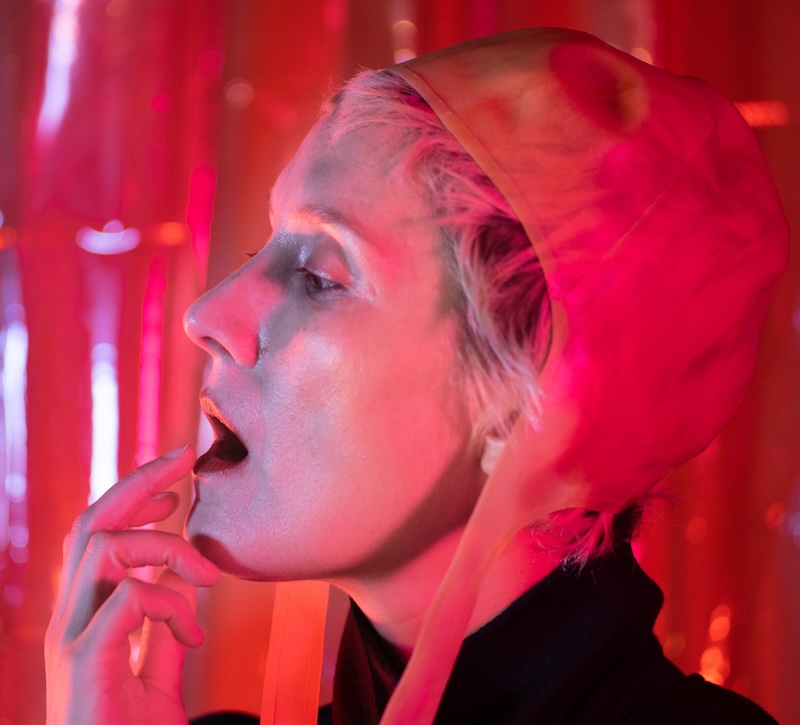
In the inset of the album cover, she’s photographed wet inside a mirrored box, possibly drowning, possibly forced to look out at something that she doesn’t want to see, or something that she’s desperate to reach – the desert, the sea, or simply a bed. At each edge, ruched pink satin forms a Colette-inspired backdrop, symbolic of a tension between burden and rest. Hard as ever to pin down, Le Bon describes each song as “a shard of the same broken mirror,” each one revealing or concealing pieces of the bigger picture, depending on the angle and the light.
“It takes time,” Colette once said of her own multi-disciplinary work. “People don’t get it at first. They may be fascinated but they don’t understand. And that’s okay, because who really wants to be understood? What artist really does?” Somewhere In the fabric of Michelangelo Dying lies Cate Le Bon's true answer.
Sign up to Best Fit's Substack for regular dispatches from the world of pop culture