Reeperbahn Festival puts its faith in the next generation
Under the banner “Forever Legit?”, there is more to this year's edition of Reeperbahn Festival's approach to music discovery than meets the eye, writes Douglas Jardim.
Reeperbahn Festival sees a total takeover of the rowdy red-light zone of Hamburg's St. Pauli district, along with annual festivities transforming local nightclubs, churches, and even the quaintest of theatres, into the stages for fresh and upcoming talent across 44 countries.
“We are proud to say that from the get-go, no edition has been the same, really,” Frehn Hawel, spokesman for the festival, tells me. Of course, there are recurring formats, like its 70-minute Opening Show at Schmidts Tivoli, or it’s ninth presentation of the International Music Journalism Award (IMJA). Expected conference programming invites global gatherings of the music business kind to inspire new ideas and drive progress. “But as we tend to have an overall theme, since a couple of years, there’s always a new focus in each edition looking into a specific matter in society, or the music industry,” explains Hawel.
Last year’s “Imagine Togetherness” centred around a call for a more cooperative industry that protects smaller artists, venues and companies. This year’s “Forever Legit?” is very much about the younger generation, the next in cutting-edge tastemaking. “Not solely as consumers, but more as shapers of the future of our industry with their values and decisions. What they consider legit, and that must not necessary align with the current status quo.”

In a time of profound social and technological transformation, look no further than AI’s impact in creative mechanics, Reeperbahn’s bread and butter is the question of cultural legitimacy, relevance, and future viability of the music industry. In an attempt to reshape business models altogether, the festival establishes a “Future Minds” consultancy board, consisting of creative industry workers under the age of 29.
Younger audiences are offered discounted tickets, and the purchase of special €49 SpotlightOn passes allow access to the full four-days' worth of performances, panels, and networking opportunities. For any fledgling melophile, it’s the ultimate party bag. Specially programmed treats include a “Heavy Reeperbahn Spotlight”, one for “Hip-Hop Culture”, and “Track ID – the Spotlight On” for all kinds of electronic dance.
In the company of an array of competitions, focusing on the overall package of outstanding and unique artists and bands, Reeperbahn’s Anchor international prize award is particularly indicative of the festival’s broad exchange capabilities. This year’s nominees provide an excellent snapshot into varied territories; be it Just For Fun from the UK, who meld French house, electro-pop and old-school acid techno in equal measure; or the queer electroclash of BIG WETT, representing for Sounds Australia’s “THE AUSSIE BBQ” showcase selects.
Hailing from Reeperbahn’s first Guest Country of Honour, Anchor finds an ultimate winner in Ukraine’s GANNA, who continues to work under extraordinary circumstances. Demonstrating a brilliant neoclassical blend in harmonious arrangements, cross-referencing nu-jazz with the cultural folk music of her homeland, she performs for an esteemed jury: Sega Bodega, Oklou, Domiziana, and Jerry Heil.

Not unlike The Beatles in their infancy, darting around the multitude of spaces on Reeperbahn’s smutty strip, the most memorable in first discoveries are, much like the festival itself, unpredictable and indefinite. On night one, Wednesday 16th September, the Mojo Club’s curved underground bunker of swanky hostings first presents Anchor nominees Dov’è Liana. Bouncing between Italo disco, Balearic house and electro-funk, the frank French trio captivate with sunglasses, colourful headscarves, and a carefree, joyous set. “For your information, we are French, but we sing in Italian,” they jest.
Elsewhere, at trendy venue UWE, Jashim offers a captivating hybrid of dubstep, trap, Colombian cumbia, and 100 Gecs-esque hyperpop. Based in Montréal, the budding young non-binary multidisciplinary sports dramatic American football shoulder pads as part of a vibrant lineup courtesy of the Canadian Independent Music Association (CIMA). 25 Club sees Amor Vincit Omnia fly the flag of Iceland newcomers with a similar display of breakbeats and hyperpop bangers; nothing short of vocoder and ambient pad play, utterly of the now.
Calid sits on the opposite scale, a Hamburg-based DIY artist whose heritage is his pride; beautifully minimalist reinterpretations of 1960s and ‘70s Afghan folk music are drawn from inspired, prewar memories of the Central Asian country. The crime thriller Imperial Theater in St. Pauli that serves as the velvet setting of his storytelling also offers a sequestered respite from outside debauchery.

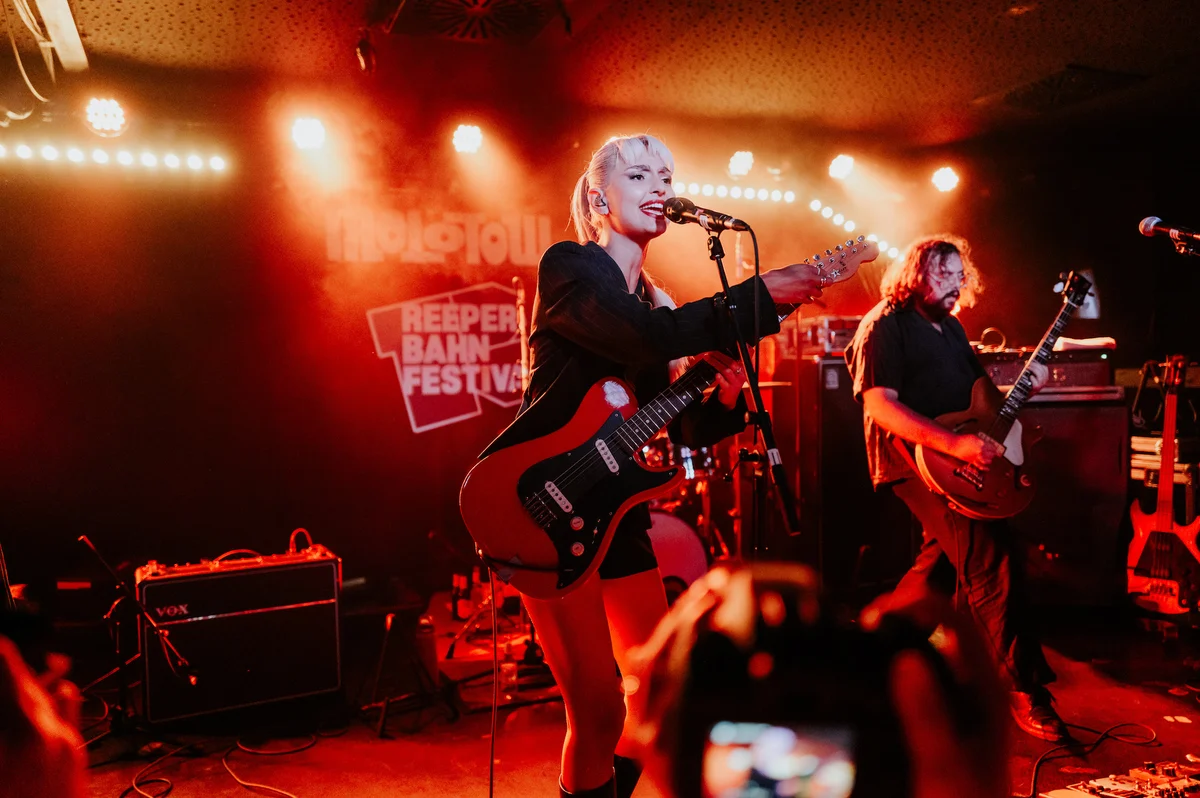
A couple of feet ahead of what looks like the district’s largest sex shop lies Molotow, one of the most popular live music venues in Germany, as illustrated with every designated slot reaching full capacity way ahead of schedule. There’s alternative trio She Her Her Hers, characteristic of the Japanese shoegaze revival, plus fuzzy, fast-rising indie rockers Hiqpy from Amsterdam.
Plausibly oblivious to the raw, rough minutiae of Dublin’s Bleech 9:3, a crowd of Hamburger kid moshers cannot contain their excitement when a deadpan Barry Quinlan belts alt-grunge opener “Jacky”. The frontman’s face does little to hide frustration over earlier tuning troubles. Even so, it is stadium-ready material the quartet is embodying.

Arriving just shy of their brand new LP release in Put A Smile On For Me, London’s Keo puts on a confident night two medley, also of grunge and alt-rock tunes. Lead singer and rhythm guitarist Finn Keogh gains some extra style points with his retro Kangol cap. In quick succession, Molotow’s programming churns out some of Britain's best breakout bands: Windmill’s 1000 Rabbits; Little Grandad highlight brotherly love and exceptional trumpet skills.
Just as impressive despite the jet lag, between a 1,200 and 1,500 cap, Fat Dog and 2024 Mercury Prize winners English Teacher follow notable past performers in Black Sabbath, David Bowie, and Liam Gallagher by respectively filling the largest music club in Hamburg, Docks.

Reeperbahn’s mass of smaller stages does not deter its spirited entertainers. Prinzenbar’s chandelier-fitted bar interior suits the mellow meditations of LA-based untitled (halo). As does the open-air, Fritz-Kola-backed hub of Heiligengeistfeld, hosting Berlin’s REMOTE BONDAGE: a “no-fucks-given” punk outfit of the riot grrrl tradition. Mimicking the claustrophobic U-Bahn aesthetic, Banhof Pauli welcomes Maiah Manser and her wind machine. She’s an empowered cross between Caroline Polachek and Chappell Roan.
Across the weekend, the festival further accommodates spotlighted shapers in Lauren Auder, Madra Salach, Sassy 009, Tommy Barlow, Pollyfromthedirt, Sex Mask, REDD., and Boutique Feelings.
Celebrating a decade of cultural architecture, Saturday’s sophisticated Elbphilharmonie programming comprises individual takeovers of The Grand Hall by Sweden’s Anna von Hausswolff and Berlin’s Moses Yoofee Trio. The latter’s nu-jazz and hip-hop fusion is a hallmark equilibrium of precise and restless; their drummer understudy for the night effortlessly fills in for a sick Noah Fürbringer.

In addition to its typical, well curated international music lineup, this year’s Reeperbahn Arts & Word programme honours the 20th anniversary of poster convention Flatstock. At Festival Village grounds, visitors peruse memorable concert prints. “The arts has been a part of every Reeperbahn Festival since day one,” Hawel says. “It’s such an important part of the creative industries.”
A project focused on better access to clean drinking water in Africa, YUNOMI makes its premiere in the Village as a container holding a water treatment plant, painted by renowned artists. Conceived by social architect Onejiru Arfmann, it’s also a stage for a surprise free show on Thursday night from German rapper Jan Delay.
Simply put, Reeperbahn stands for, as stated by Hawel: “Showcasing the most promising new international talent, addressing the most pressing matters in the creative industry with an approach for equal, fair and sustainable solutions.” In a sector so preoccupied with algorithms as acceleration, the answer to “Forever Legit?” is found in the unpredictability of navigating Hamburg’s sweaty, communal clubs; currywurst in hand.
Find out more at reeperbahnfestival.com
Sign up to Best Fit's Substack for regular dispatches from the world of pop culture