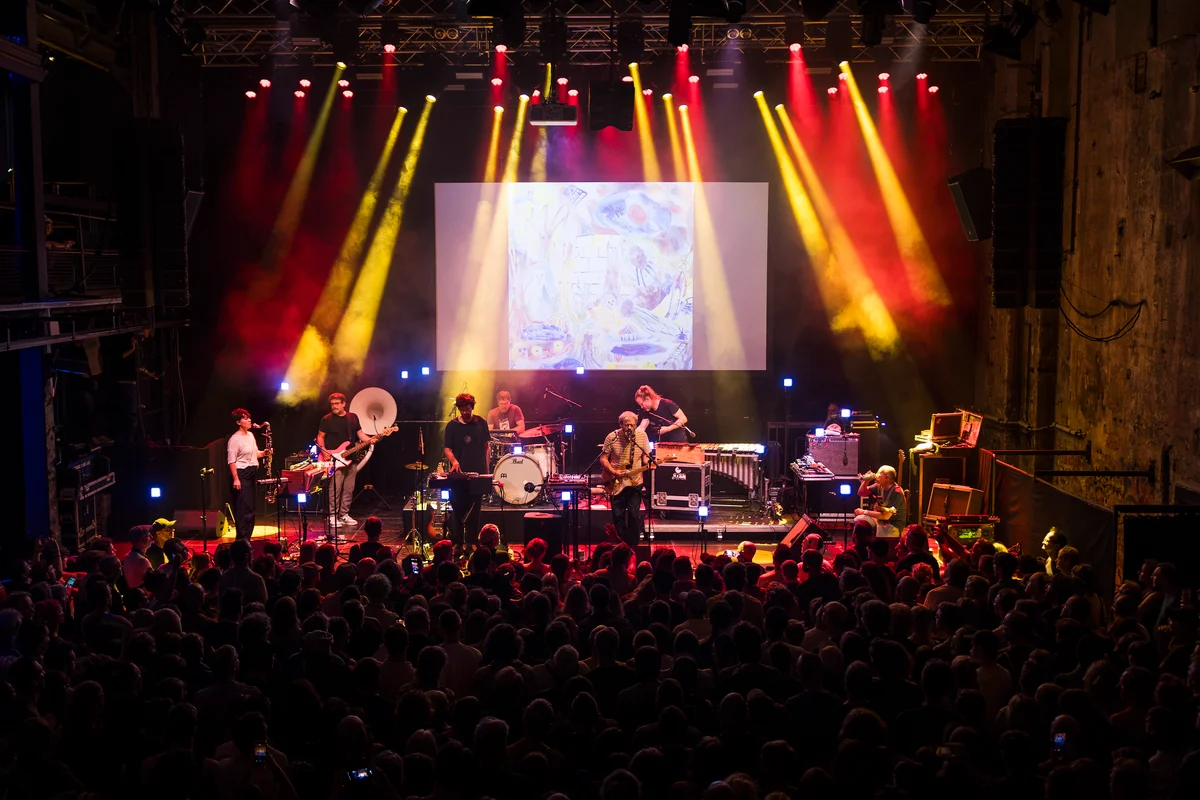
Pop-Kultur is a homecoming for the indeterminable German sound
Berlin’s Pop-Kultur festival brings home international appreciators of German music and sets them alongside unmissable locals – the ideal way to take stock of today’s pop culture and what that term even means, writes Hayden Merrick.
What is the sound of New York? Or London? What about Berlin?
You know it when you hear it, right? Confronted with such a pain-in-the-ass question, you might offer a feeling, an energy, a moodboard of bands, colours, adjectives, and onomatopoeias. In any case, there are many right answers. In Berlin’s case, I think of words like retrofuturism, paranoia, prickly, monochromatic, surveillance, graffiti. I think of drum machines that thump and crackle like they’re about to break; softly murmured vocals; collage-like self sampling; pops and spurts of a cartoon factory; and obviously the greatest drum beat ever invented: the motorik, popularised by Can’s Jaki Liebezeit and Neu’s Klaus Dinger. Cue the arguments.
It seems that, more than any other European country, Germany has embedded itself into the British and American sonic consciousness. The Postal Service are so ubiquitous that the name has become shorthand for a style of bleep-bloop sample-pop, but they were partly inspired by the phenomenal roster of Morr Music. The same goes for Stereolab pilfering Neu’s chuggling-along one-chord vamp. It’s difficult to find a post-punk or indie rock band nowadays that haven’t used the motorik beat on a song, or looked – at least in part – to the aloof robotics of Kraftwerk, or the ambient space-rock trailblazing of Cluster. From Squid to Japanese Breakfast to Water From Your Eyes. “You wouldn’t be familiar with our immediate influences; they’re mostly German,” Jack Black’s character snips in the High Fidelity movie. There’s a reason Lou Reed, David Bowie, Stephen Malkmus, Bob Mould, and you-name-it all came here to make records.
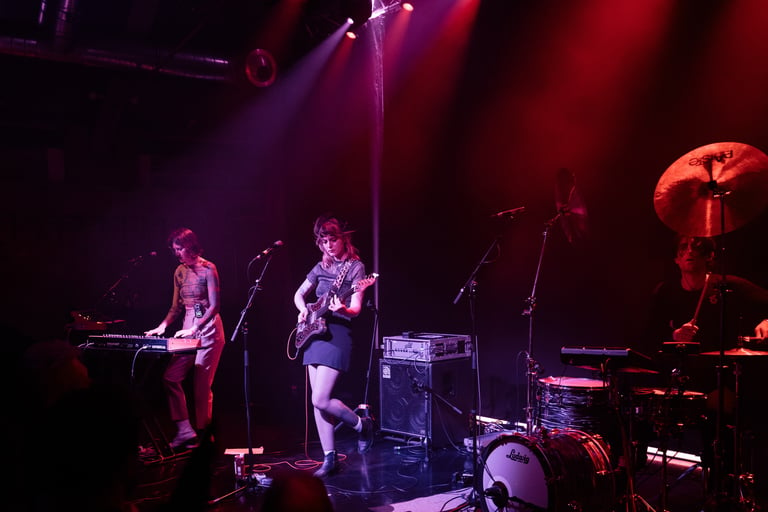
Yes, German music has beamed around the world, but each year Pop-Kultur brings it home to the capital. Or, more accurately, the festival curates some of the most compelling artists working with a toolbox we might think of as German: from Leal Neale’s retro-futurist lullabies and tick-tocking drum machines to Automatic’s tight, monotone, motorik synth-punk. Pop-Kultur platforms such acts from overseas alongside local must-sees. It’s the ideal way to take stock of where pop culture is at, however you choose to interpret that term, even though the festival is not German-focused or in any way nationalist.
Indeed – Elektrokohle are “from” Berlin, but their three members hail from Sardinia, Sicily, and, okay, the suburbs of Berlin. They describe their sound as cold punk – a chilling, gothic onslaught of barbed-wire guitars lost in synth cobwebs, hurled forward by an almost-malfunctioning drum machine and incanted cultish shout-singing, delivered in four different languages. It’s their first time at Pop-Kultur, but they are regulars of the underground scene, typically playing (and attending) the city's charmingly grungy venues, they tell me.
“I don’t think I know any band where all the members are from Berlin,” the vocalist/synth player says. He goes by Mr Cigarette Butt and co-founded Elektrokohle (Electro Coal) during the pandemic, when, in Germany, you were allowed to see one other person. He and Mona Manie became a duo out of necessity, setting their thick synths and “surf garage black metal” guitars to analogue drum tracks. I suggest that lots of the British and American acts I like – including those on the bill this weekend – sound German-influenced, however dumb and shrug-worthy that observation is.
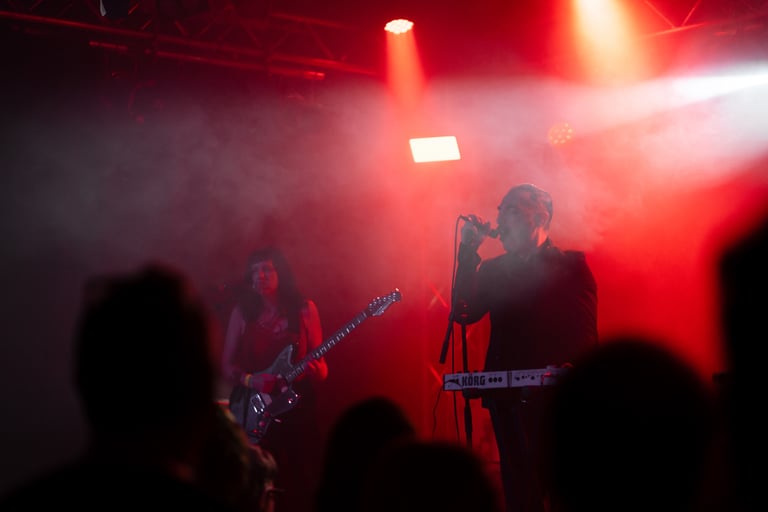
“We live in Berlin so we don’t realise that a lot of people are taking a lot from Berlin. I’ve met bands from America and they say the same – inspired not only by Berlin but Kraftwerk to D.A.F. or Neu or modern German bands.”
“The good thing about this festival in general is that it’s pop culture, which means everything,” counters the bassist, who goes by Fab. He joined more recently, after producing their exceptional debut album, Kalt Wie Du Bist, the three of them bonding over a monotone/minimalist/melancholic approach to songwriting. “There’s a lot of different music genres and it’s very inclusive. There’s everything for everyone.”
Mr Cigarette Butt largely agrees, but still believes there’s something in the water here. “I think about New York bands – it can be hip hop, can be punk, can be folk – there is something special in the sound of New York bands. And it’s the same in Berlin.”
The “everything for everyone” USP is great and all, but every festival is increasingly “everything for everyone” nowadays, and if that goes too far, it becomes “nothing for no one.” I’ve written extensively about how festivals – not just the culture they uplift but the format itself – can be an unbeatable antidote to nationalism, authoritarianism, divide-and-conquer tactics. But it’s okay sometimes to just celebrate how great German music is, or music descended from German pioneers. Pop-Kultur doesn’t take it upon itself to be a renegade leader; its mission seems to be more about taking stock and reflecting where we are, hence the name. It’s not radical. But it is exhaustive: if a Martian wooshed down to earth, waggled its fat green finger in your face, and demanded a crash course in the current music trends, subgroups, and politics worth the time of day, you should take it straight to Pop-Kultur.
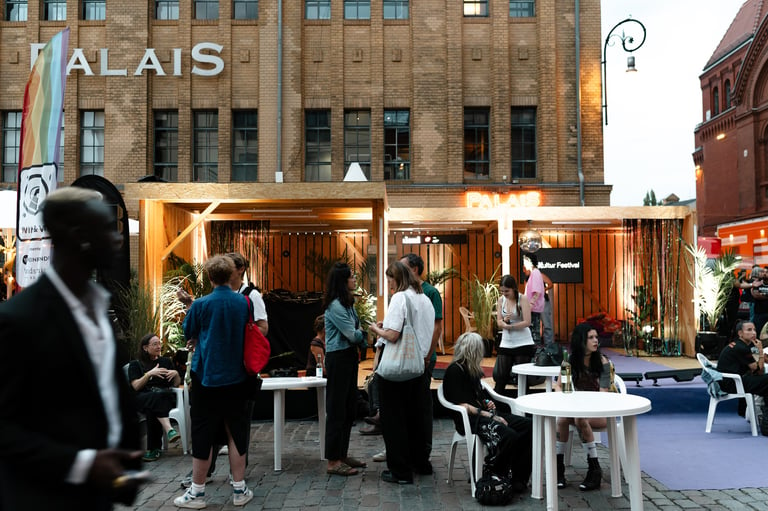
But there’s a step before we get here. The real legwork, as always, happens in those dingy, DIY spaces across cities like Berlin, or London, or New York. And that brings us to gentrification – the elephant in the room.
We’re in Prenzlauer Berg, after all – the poster boy for gentrification in Berlin. Largely undamaged by allied bombing in WW2, the district became home to successive waves of East Berlin counterculture under Soviet rule: Liberal Christians, bohemians, artists, punks, the gay community, and was instrumental in toppling the Berlin wall. After reunification, the turn-of-the-century housing stock was overtaken by squat culture in the ‘90s, much of East Berlin having been left abandoned.
You can still find a few remnants of this era today. K77, a reference to its street address, is a squat-turned-studio space in Prenzlauer Berg, which one of its residents called “the last hardcore project in Berlin.” It’s no longer a squat, technically, as the government designated it as a “housing project” in exchange for its contributions to arts and culture, but 30ish people live there, working as artists. For the most part, these setups have been bashed out of existence, Prenzlauer Berg having been besieged by gentrification and its attendant yuppie families, expensive bakeries, and glossy condos.
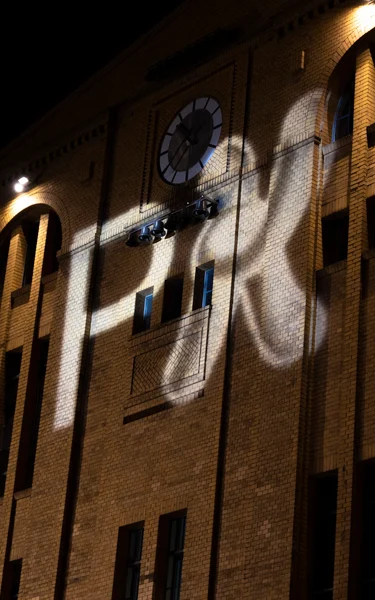
A five-minute walk around the corner from K77 you will find Kulturbrauerei, the setting for Pop-Kultur. Despite all the casualties of gentrification, the repurposing of sprawling industrial spaces for arts and culture is a huge win, from the ex-chemical factory Nová Cvernovka in Bratislava to the Lukiškių kalėjimas 2.0 prison in Vilnius.
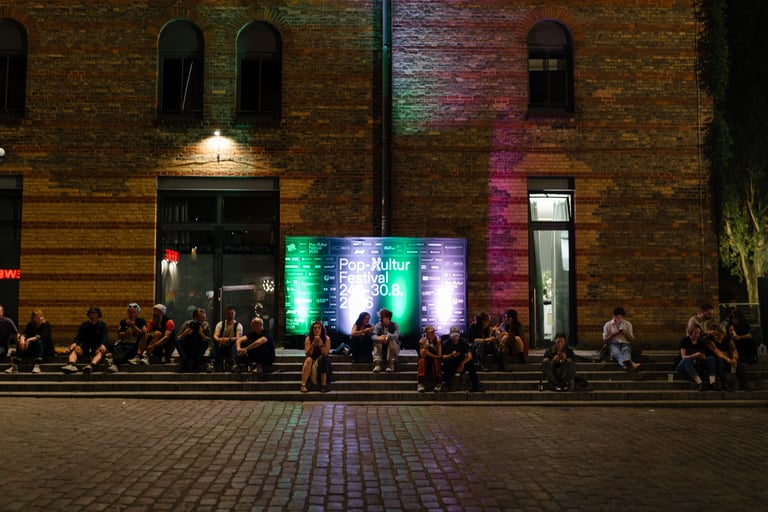
Kulturbrauerei – culture brewery – was once the largest brewery in Berlin (circa 1891); after merging with another brewery in 1921, it became the largest lager brewery in the world. Today, it’s a complex of art schools, cinemas, event spaces, clubs, publishing houses, and even the Berlin branch of NYU.
Pop-Kultur commandeers several of these indoor venues, but there’s also a lot of action in the cobbled courtyard that leads between them: free wine and ice cream, yes please, but also a pop-up basketball court where Göksu Kunak reads a spoken-word piece over theta wave drones. The Turkey-born non-binary artist compares ballet and basketball – the pain for entertainment’s sake, the damaged feet, the unrealistic standards, the system of control. It’s part recontextualised history, part societal critique – as with many things when it comes to Berlin.
It goes without saying at this point that every independent festival, pretty much, is operating in opposition to damaging social structures, but it’s also worth noting the total absence of hierarchies at Pop-Kultur. No headliners. No “main” stage. Few queues. And for the most part everyone gets the same set length. The Notwist feel like a headliner, if only because of their end-of-night set time on the final day, and their legendary status. Sometimes nothing beats a true pro, Markus Acher, slumping through messed-up, gold-sounding weird pop that makes you feel like you’re driving your first crush home from a summer job in your parents’ car. File next to too-oft mansplained bands like Wilco and Yo La Tengo, who are as comfy with vibraphone-tronica experiments as driving power anthems.
There are several legends in the house, actually: Chris Imler, Berlin weirdo-genius, has been around the block over his 40-year career, but still receives plaudits like experimental album of the month from the Guardian, only last year. He’s all about the beat, pogoing at the front of stage, attacking cymbals and trigger pads the whole time other than when he’s warping a trumpet loop. He’s giving Mark E Smith schooled by John Zorn’s record collection and the dark web (not the really evil stuff).
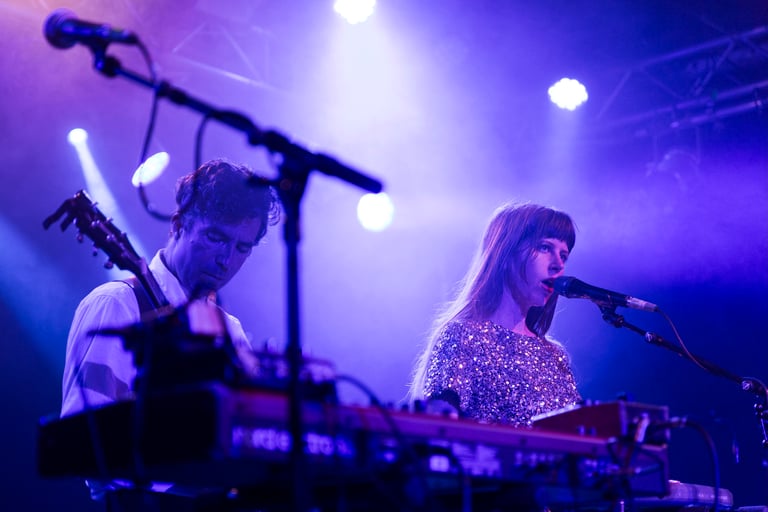
The venue that hosts Chris Imler – Frannz Club, once a GDR youth club – is just as packed for newer acts like Elektrokohle, and for international guests. Lael Neale’s thing is brittle, lofi, tape-hissy production, turning her could-be-any-era pop capsules into heavenly dreamspace memories. Miraculously, her live set doesn’t suffer despite the absence of that very specific format. Seeing her play the Omnichord – the central component of all her work – is, I’ve decided, a bucket list thing I can now tick off. It’s a fascinating creation – a mix between a kids’ toy and a venerable old organ hidden under a sheet in a haunted attic.
On upbeat tracks like “I Am The River”, driven by an urgent, thumping drum machine loop, she dances like she’s trying to wriggle out of a hug as her guitarist Guy Blakeslee wrangles Velvet Undergroundy spurts from an upside down guitar. They are two very clever, outside-the-box people. Still, I’m surprised to find “Blue Vein” is the most spellbinding song, just Neale singing solo with her guitar. “I’m gonna fly,” she lilts and her voice does the same, backed sparsely by a perfect pop song chord progression that tells you where it’s going but is still totally satisfying in the way few live performances really nail.
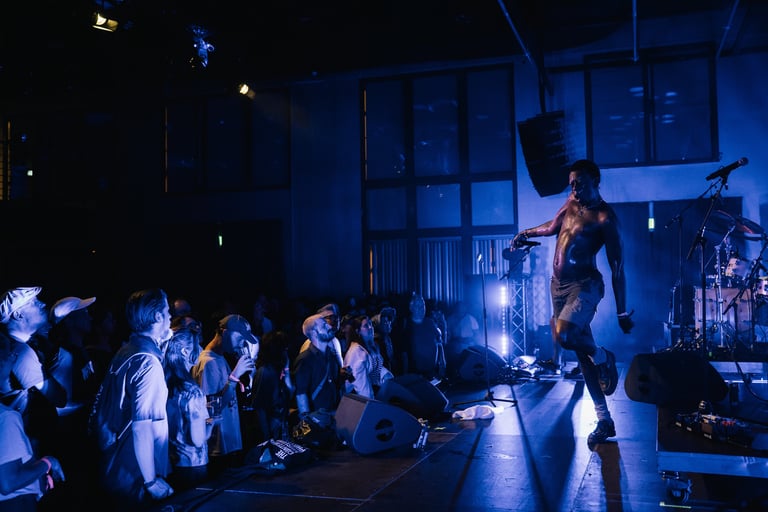
It’s the opposite energy to Boko Yout, out of Stockholm. Theirs is one of those sets where the front man is everywhere but the stage: draping over the staircase while bemused runners carry equipment back and forth, or getting into the pit to bark instructions like Phoebe Lunny of Lambrini Girls. Paul Adamah is a blur, a force, a lightly Disneyfied Zack de la Rocha who’s comfortable getting “hey oh” and “nine to five” (not a Dolly reference) football chant-like back-and-forths going with us. Adamah leads an unhinged party-punk trio, who dress in matching Scouts uniforms – often the only thing that does match – and offer sweet “ooh ooh” backing melodies to counterweight his yells. It’s very loud-quiet, frantic, Dismemberment-Plan-does-Blur, and few vocalists put this much (everything) into a performance.
Queercore locals Deutsche Laichen continue the chaotic punk vibes, their set completely fucking ramshackle in the most endearing way. They aren’t exactly playing their instruments deftly, but that’s why it’s perfect – like a car barrelling down the motorway as bits fall off of it. I have no idea what she’s singing about – indeed they are one of the few German acts to sing in German – but the way she’s singing it makes me want to drop everything and get involved.
You can understand every word uttered by Beaks, though – the Vienna project of Anna Francesca that we profiled last month. Not just because of her cogent murmur delivery, but because she’s singing about universal life shit: dreams and friends and sex and feeling paranoid. Beaks are one of the most talented and coolest bands around at the moment – a rock band for times in which you’re so ironic that you end up back at earnest. The music, unnerving, inviting, and always on the move, has a lovely lethargy quality as much as the nighttime-in-the-city, skinny-jeans-and-shades kool thing. I don’t know why some of our Geese fever can’t be reassigned here. They deserve as many ears as possible.


Balm are gloomy too, but in a different, grubbier way. They don't sound wide-eyed or playful like Beaks. Their entrancing boy-girl slowcore seems built for an exhausting, rainy walk home from your late shift in the city, everything built on repetition, filigree baritone guitar, waterlogged organ, and the sorrowful voice of Lina Boehnke. “It doesn’t matter how much money I make,” she sighs over and over on “no worries”. I read it as a mantra for a city that’s maybe not hostile to art as much as rapidly de-prioritising it. I guess the logic is, the more times you repeat it, the more you believe it.
But that doesn’t work forever: pop culture – and Pop-Kultur – doesn’t exist without the legwork and underground innovation of DIY artists. Like Balm, like Deutsche Laichen, like Elektrokohle, and like the generation below them. Doing all we can to lift up culture before it becomes pop culture will help ensure that the sound of Germany – indeterminable though it is – isn’t lost to history like so much else.
Find out more at pop-kultur.berlin
Sign up to Best Fit's Substack for regular dispatches from the world of pop culture