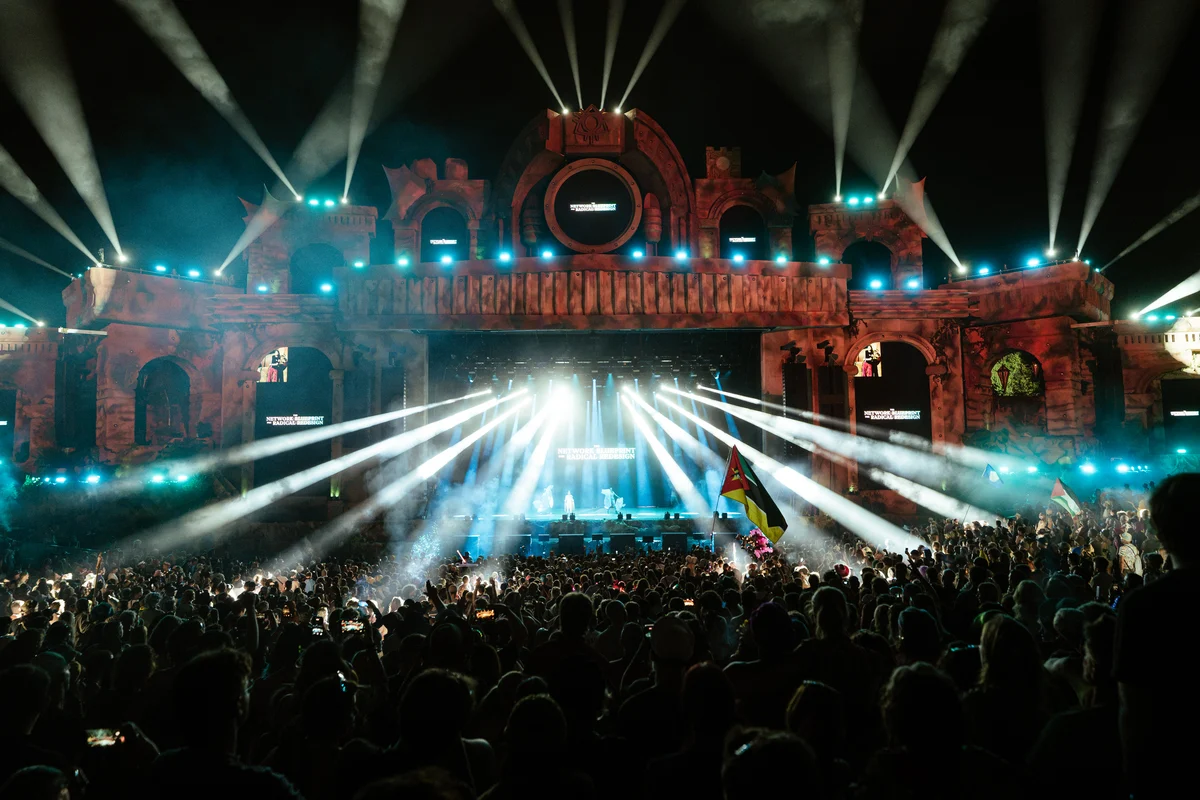

Boomtown proves that ambition, escapism and conscience can share the same dancefloor
A festival once built on spectacle, Boomtown has come to trust the quieter, in-between moments to hold its crowd together as it expands with a new blueprint for 2026, writes Kayla Sandiford.
Over the past fifteen years, the Matterly Estate in South Downs has undergone an annual transformation. Every summer, for one week only, the family-owned farm and natural amphitheatre become a home for the residents of Boomtown — a fictional cityscape first established in 2009.
When Chris Rutherford and Luke Mitchell initially launched Boomtown, it was on a much smaller scale. With backgrounds in free party movements, underground scenes, and a general love for world-building, the pair recognised a glaring issue with mainstream festival spaces before Boomtown’s inception; there were few opportunities for alternative genres and artistic countercultures to thrive.
Taking matters into their own hands, Rutherford and Mitchell went on to create an experience that not only offers a platform for underground music, art, and theatre, but also fosters an immersive environment held by core values of creativity, connection, celebration, as well as respect for yourself, others, and the planet.
The inaugural chapter, Boomtown Begins, took place over three days at The Speech House Hotel in Gloucestershire. As the legend goes, an explorer called Nickolas Boom discovered gold in the hills. Eventually, Boom would find that he’d only scratched the surface with his discovery, and the gold came from a lion-guarded temple built into the mountainside that housed remarkable treasures. It would be revealed that a lost tribe from the stars had built the temple, and the treasure was an offering for a day in the future in which they might return. Respecting the tradition of the star tribe, Boom took a portion of their tribute and founded a small township and port — promising not to tell anyone about what he’d unearthed. What began as a small community would soon grow with circus troupes and exotic beings. And every year, they would celebrate their good fortune with music and dancing.
In its second year, Boomtown was held at Stowe Landscape Gardens in Buckinghamshire. External forces began to descend on the lawless community with attempts to enforce state control. By 2011, the festival had grown too large for the garden space, and the decision was made to relocate to Matterly Estate — which already carried a rich history of open-air events due to its natural infrastructure — and expand the fair into a four-day event. By this point in the story, Boom was captured by external forces that threatened the land, and the treasure that he vowed to protect was stolen.
In the years that followed, as Boomtown grew into a multi-district society, the storyline only become more complex with democratic shifts, time travelling, revolutionaries, and invasive technology. At the same time, the line-ups expanded to include more artists and bigger names to accommodate the growing population and changing demographics.

When the pandemic hit, Boomtown, like most other large-scale events, was forced to come to a halt. The festival emerged from “the dark ages” with a new volume in 2022, introduced by The Gathering. Pre-Covid, Boomtown operated on a map of twelve distinct districts split across the upper hills (known as “Hilltop”) and the lower valley (known as “Downtown”). But immediately after the pandemic, Boomtown dialled things back considerably, cutting the districts down by nearly half, removing longstanding main stages, and keeping things contained within the “Downtown” area of the estate.
“We had to reduce the festival down into a much smaller footprint because the infrastructure didn’t exist,” Mitchell tells me, in a conversation following the end of Boomtown 2026. “It was just impossible to build the festival in the same way. But it was never the version that was truest to Boomtown, the kind that we like to host or want to host. So we always knew that we wanted to build it back out again into multiple valleys, using the full footprint of this amazing place.”
Four years later, Boomtown has made a grand return in its most expansive form with Chapter Five: Radical Redesign. The redesign is advertised as a thematic opus which “…asks us to question how we live, what we value, and what needs to be reimagined from the ground up to build a better world beyond Boomtown”. In line with this ethos, this year’s instalment was developed around opportunities for citizens to slow down and rethink, revisit inherited wisdom lost to convenience, reconnect with nature and others, and rebalance power and peace within a society built on shared meaning. Stepping back, articulating these concepts into a cohesive festival experience sounds immense. And while Mitchell has taken on the task of doing so alongside a longstanding team for several years now, this doesn’t make it any less daunting.
“I have been in so much anxiety for months, and it wasn’t until everyone left on Monday afternoon that I felt my nervous system could even vaguely regulate itself,” Mitchell admits.

His anxiety is certainly not unfounded. This year’s line-up boasts over 500 artists spread across eight districts, twelve main stages, and several hidden venues. Upon entering the fair, the terrain is vast — almost intimidatingly so. Finally ending its seven-year hiatus, The Lion’s Den was reinstated in its own concave within the grounds. Travel down the scenic Hippie Highway route, and you find yourself entangled in the rustic whimsy of Oldtown, and the 1920s-era hedonism of Copperwood Heights that overlooks a downhill path into the bustling central valley of the fair, culminating in the zero-emission HYDRO XL stage, which received a 150% capacity increase to accommodate 20,000 Boomtown citizens.
Mitchell acknowledges that when Boomtown first returned in its downsized form, the constraints meant that the crowds were more intense with less room for circulation. But looking at a sold-out crowd of 77,000 — the largest attendance in Boomtown history — expansion comes with its own considerations. “Whenever we do a big shift, there are always so many things to anticipate and tweak," he explains, "and with such a major change to the site you have to think about how crowds are going to populate and flow between the stages. It felt like there was a real vibe at all of the stages this year. I haven’t heard of one artist that didn’t have an amazing show with a good crowd.”
While Boomtown's first two days – Wednesday and Thursday – offer a more condensed programme of artists across smaller, tucked-away stages, the festival goes into full swing on Friday with an opening ceremony at Lion’s Den led by Eve Lazarus and Solo Banton, accompanied by dancers and performers, introducing Boomtown with nothing short of spectacle. They promptly followed by Madness — marking their return to the festival a decade after their debut Boomtown performance — who push through a blazing heatwave to christen the stage. By the time the audience disperse to explore what the other sites had to offer, as Mitchell comments, you can find a good crowd no matter what stage you wander off to. Around this point, while observing what seemed like endless pathways to take on the grounds, I find that beyond maintaining a sense of open-mindedness, there's considerable power in simply stating: “I’m feeling a bit lost; where should I go next?”

Because fundamentally, getting lost — or better yet, escaping — is part of Boomtown’s charm. It’s how I’d find myself guided to the Hidden Woods to catch a set from British-Ghanaian producer and DJ Juls, who, for two hours, coursed through Afrobeats, reggae, dancehall, and Baile funk with a centre of Black club music. Kicking up sand with strangers who become friends for snapshots of time, movement becomes language, and ultimately something that forms a thread of connection within Boomtown. Regardless of where you are on the estate, the dancefloor is the nexus.
"For me, understanding the dancefloors was important,” Mitchell notes when I ask about his key takeaways from this year’s instalment. “Understanding how they feel, and making sure that they’re inviting and feel held. But actually, in equal measure, the gaps between the dancefloors are just as important, and that’s taken us a long time to really figure out. For years we thought that we just needed to put on the most incredible stage shows and build these productions, but actually, it's the elements between it all.”
What's particularly fascinating about Boomtown is the distortion of time. I don’t say this in a pseudo-metaphysical way, but when a set ends, it doesn’t feel like a hard, disorienting stop. During its active hours, Boomtown is constantly on. While lulls can be quite apparent at other festivals, signalling that it might be time to stop at a food truck or swing by the toilets, there is so much happening at once throughout the fair that you never feel disconnected from the experience when one performance ends and another begins.
Mitchell notes that these are also notable periods for citizens to connect, and this year, they've engineered a system that tracks the network of socialisation extended throughout the week. Citizens could collect and pass along cards with different roles based on their interactions. For example, someone seen stepping up as a leader might receive a ‘Pioneer' card, or someone creating might be given a ‘Visionary’ card, and these can be scanned into the Boomtown app in order for their reach to be tracked. The construct itself encourages a social consciousness and a natural desire to acknowledge the good that others contribute to the world around them.

In those “limbo” moments, I spend time chatting to some of the veterans of Boomtown whose highlight the community and sense of home that the festival offers as part of their decision to keep coming back. “This is my third year now, and it’s changed a lot since I’ve started,” festival regular Rachel June tells me. “But the festival itself has this core that’s remained, where it’s all about the people, art, creativity, and music. The togetherness and community have stayed the same.”
As one of Boomtown's core values, consideration and respect of others and the environment is a throughline that connects everyone on the land, even the acts. On Thursday evening, when poet Kae Tempest takes to the Grand Central stage, it's with a message that calls everyone to pause and look around. “The water level’s rising,” they assert, performing their 2016 track “Europe is Lost”. “The animals, the elephants, the polar bears are dyin’ / Stop cryin’, stop buyin’, but what about the oil spill? / Shh, no one likes a party pooping spoil sport”. Speaking to an audience who watch intently, interlocked arms with loved ones, and move graciously in response to Tempest’s words, their performance feels deeply resonant.
Although Boomtown has been misinterpreted as a festival that merely prioritises the party, this feels reductive. When interacting with the storyline, one of the early side plots that I encounter is a feud between The Liquidians, who are dedicated to protecting Boomtown's water supply, and the Von Vanderhausens, who, in their words, just want to “party and play” — both of whom occupy Copperwood Heights. Given the clouds of dust that fill the air, the blazing heat and the yellow-tinged grass due to the ongoing drought, the narrative around ecological conservation feels more pertinent than ever, and the story doesn't shy away from the bleak conditions that we face if we don’t actively choose eco-consciousness.

In conversation with Mitchell, I ask how they tend to go about striking a balance between promoting social and ecological awareness while also maintaining the desired escapist nature of Boomtown. "There's a really delicate dance between the two," he tells me. "We are forever stepping forward into the arena and trying different ways of telling stories, and considering how we can encourage different perspectives on how the world could work more fairly, but without preaching about it. Festivals exist for people to be exactly who they are, embrace freedom of speech and openness, and I love how many artists step onto the stage and stand for what they believe in.”
And for the most part, some of the heavier content is dispelled through the story. When following the Liquidians plotline, one of the challenges involves having a conversation about capitalism and throwing a cup of water at your opponent when prompted. In the steampunk Area 404 district, I find myself bribing outlaws for information about a billionaire-led plot to abandon Earth, which they’ve regarded as a “single-use planet”. In the peaceful utopia of Botanica, a mute woman encased in a terrarium plays a message about connection through a conch shell and offers a plant, requesting that I protect it (which, admittedly, isn’t the easiest thing to do at a festival). Elsewhere, clowns host a sound bath that seems peaceful at first glance, but quickly becomes jarring as they enter a guided meditation about a day from hell in the corporate world. So, while Boomtown can be a party, it coexists rather openly with existential concerns.
That existential undertow continued into some of the biggest sets of the weekend rather than sitting apart from it. On Friday night, House Gospel Choir sing joyful noise, casting a healing energy over the Nexus stage — before LYNKS turns the same stage into a queer club night on Saturday, translating their own joyful noise through wit, campy theatrics and choreography. This carries into Peaches’ masterful performance at Grand Central, which sees the striking pop provocateur dominate the stage with props, turn the crowd into her runway, and present the ultimate bid for self-expression — with surprise appearances from Princess Nokia and Ashnikko, who had performed just hours prior. Taking after its name, Grand Central truly feels like a major hub to host artists of all genres passing through Boomtown, having hosted the likes of rapper and songwriter Songer, writer and poet Antony Szmierek, and singer-songwriter Rose Gray earlier in the day.

This year, genre has been a slight point of contention with some Boomtown citizens. While the line-up deliberately offers a wide variety of sets, some argue that it's lost the heavy DnB presence that it boasted in previous years. But as Mitchell tells me, diversity is something that the festival intends to prioritise going forward.
“We came from an underground scene, and although it’s [Boomtown] has evolved into the mainstream, we were often criticised as being very hedonistic, chaotic and disorganised," Mitchell reflects. “We're eighteen years in now. A lot of the team have been working together for over ten years, and we made so many mistakes. Whether it was waste problems, noise problems, security problems, so many things have happened over the years. We literally just spend every year trying to figure out how we can make it better. How do we make this a better experience for absolutely everyone?”
While many early Boomtown veterans might regard the pre-Covid era as the “golden age”, Mitchell looks at it without the rose-tinted glasses, pitfalls and all. “We were a mess," he admits plainly. "The festival just wasn't achieving anything that we'd set out to achieve. We'd get so many complaints afterwards because of the infrastructure. But now, the diversity is so varied, which is critically important for us for the long-term sustainability, safety, and culture of the festival."
Mitchell recognises the age diversity as the most significant shift, but also regards that there is a much broader range of different demographics, which he attributes to the musical styles on offer. “We really make sure that we have as many different styles of music represented as we can. This year in particular, we made sure that there was no dominant style. There was a mixture, which meant that we had the most diverse audience that we've ever had."

Elsewhere, the HYDRO XL crowd finds a different register entirely with Floating Points, whose set builds patiently over the better part of an hour before it properly opens up, while Four Tet's own Saturday slot leans into the same textured, meditative unfurling. HYDRO XL is primarily a space for techno acts, hosting the likes of 999999999, Brutalismus 3000, and more, but the sheer scale of it is a sight to behold for everyone. “HYDRO XL was so good," June says, recounting their experience of the stage. “The music was techno, so it does depend on whether that's your thing or not. I'm not really a techno head, but I really enjoyed 999999999. And because the stage was so amazing, we stayed for longer even though we weren't techno heads. I can't wait to see HYDRO XL again, and I hope they have more drum and bass acts in the future, but it was probably the best stage this year.”
Talking to one of the engineers from GeoPura, the company behind HYDRO XL's zero-emission power supply, gives some sense of just how much headroom has been built into the stage's expansion. The hydrogen power units on site are runn with roughly a megawatt of capacity still sitting unused — enough, by his estimate, to run a crowd four times the size of the 20,000-capacity stage, all without a single diesel generator or the drone of noise that usually comes with one. It's easy to walk past a stage like HYDRO XL and register it only as the loudest, most triumphant point of the valley with its incredible size and grandiose production, but hearing the numbers behind it, and the sheer amount of clean power sitting in reserve, presents the "zero-emission" branding in a different light. Coming so soon after wandering through the chalky, cracked ground of Copperwood Heights, it feels like a rare instance in which a festival's sustainability messaging is actually underpromised rather than being overstated greenwashing.
By Sunday, Boomtown Chapter Five begins to come to a head, but despite being the final day of the festival, things don't necessarily feel like they're slowing down. It's a particularly stacked line-up at Lion’s Den, with Vengaboys, EVE, FCUKERS and Scissor Sisters playing in succession, before FAITHLESS close off the stage with electrifying intensity. Their set is arguably one of the trickiest clashes of the festival, as Skrillex finishes off the night across the valley at HYDRO XL. Although there are delays due to crowds, the closing performance proces to be a massive affair, particularly when Chase & Status join for an impromptu B2B set alongside Flowdan. The bass-forward energy moves the crowd as one formation in a final coda, as the last full-scale moment to occur before the storyline fully takes over – and finally, the outlaws' rumours are paid off in full.

The ruling class of billionaires I'd been hearing about all week make their move, siphoning what remained of the estate's power directly out of Lion's Den to fuel a towering rocket, intending to launch themselves off Matterly Estate — and, by the story's logic, off Earth itself — rather than stay and answer for having treated the planet as disposable. Drones litter the sky to form a rocket, and it seemes as though the operation is a success. The storied billionaires fly high in the sky, until they're disrupted by a masked-fox figure associated with the name Bill Tops. The figure had been spotted on posters throughout Area 404, but now, it's all coming together. As citizens gaze at the fox, formed by a recomposition of lights to replace the rocket, the apparent vigilante issues a message: "We have taken over mission control. We have reclaimed your hoarded wealth. We will redistribute everything, equally, to every district. This is our world. Utopia belongs to us.”
And with that final unambiguous punchline, it's time for festivalgoers to be sent back into the world, with questions around what to expect from the next instalment.
Walking back out through the gates on Monday morning, caked in dust, it's hard to consider a return to reality after being so deeply immersed in such a considered world that shifts between utopia and dystopia depending on where you look; the pantomime of the billionaires' rocket next to the silent grace of the Botanica terrariums, the enormous pop-star spectacle of Peaches next to churning discomfort of a Liquidian questioning what ownership truly means, and a stage running at a quarter of its available clean power next to a landscape visibly cracking under drought. Boomtown has always sold itself as more than a music festival, and after a week inside Radical Redesign, it feels like it truly lives up to its word despite misconceptions — despite having to jump over hurdles to get there over the years. It’s an incredible and ambitious feat, and looking ahead, Boomtown is focused on truly getting it right for Chapter Six.

“Whenever we do a shift around the site or make a big change, it takes around two years to tweak everything and really get it right," Mitchell explains. “So the big focus will be tweaking everything to get it right for next year. The tap is always on when it comes to public safety and welfare. That’s always top priority. There will also be a big push on how we become more sustainable from an environmental perspective, and we will continue to step forward in the way that we express creatively as well.”
“There is a unique style of creativity that we tap into at Boomtown that feels really underground British,” he continues. “You wouldn’t get a Boomtown anywhere else in the world. It feels so authentically us, and I love that. And it makes me so proud of our unique culture to be able to host that and see that. It's hard to put a pin in what exactly that form of art is, but it feels quite eccentric and silly. It doesn’t take itself too seriously. It’s got a punk element, but also a cosmic out-of-the-box spirit.”
June corroborates this, acknowledging that while the festival could do with some improvements around operations and welfare to ensure a safe and seamless experience for all attendees, the pull to return to Boomtown is something undeniable. “You can just be so free," they muse. “What keeps me coming back is the people, the stages, the time that goes into it, the vibe and decorations. Just being in this huge adult playground keeps me coming back. There's nothing that I've ever seen that's as big and has so much thought and creativity. Everything around you is oozing with what life could be if we all got along.”
“It’s literally like a piece of heaven. That’s why I keep coming back.”
Until next time, Boomtown.
Find out more at boomtownfair.co.uk
Sign up to Best Fit's Substack for regular dispatches from the world of pop culture